


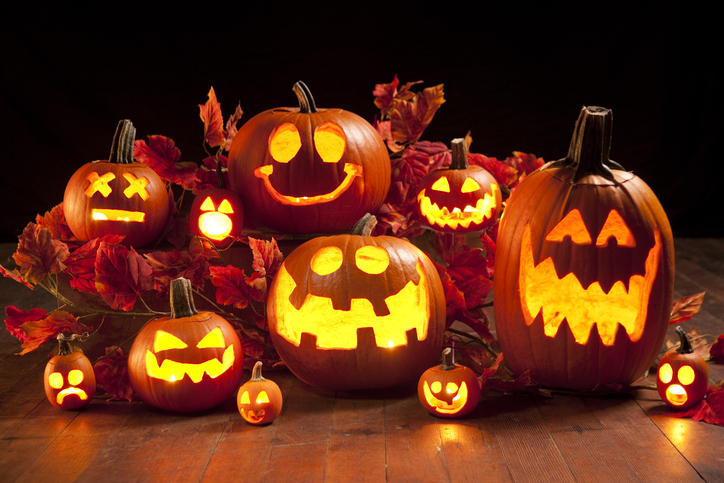
By the time you read this, Halloween is truly upon us once again. And when the children show up at your house looking for treats, they will probably be unaware of the origins of people dressing up as monsters, vampires, and zombies.
The roots of Halloween go back at least 2,000 years to the Celtic festival of Samhain, and marked the beginning of the Celtic New Year on 1 November, and was a portent of colder, more harsh weather. It was also believed that on 31 October, the line between the living and the dead became a little blurred, granting the deceased temporary re-entry to the world of the living.
Part of the reason why people dress up at Halloween also has its roots in this festival. Because of the deceased having a temporary pass to this world at Samhain, people dressed up in the most terrifying costumes they could devise. This was done in order to blend in with, or frighten, the visiting spirits so that the wearer would escape their attentions.
Many people subscribe to the view that a lot of what we call ‘monsters’, and the costumes to represent them, have their roots in medical conditions – werewolves, zombies, and vampires, for example. Some have postulated that the ‘vampire’ concept derives from people with porphyria, a group of metabolic disorders that affect haemoglobin. This, they suggest, could explain extreme skin photosensitivity, with many of the sufferers historically avoiding direct sunlight and preferring to live their lives after sunset. This haemoglobin disruption led to iron deficiency, resulting in the characterisation of these people as desperate for blood. As you can imagine, these unfortunate people suffered with chronic anaemia, leading to a pale appearance.
Others have linked leprosy to the cultural ‘zombie’ phenomenon. Leprosy caused loss of feeling in some limbs, hence the legend that zombies feel no pain. Necrotic tissue further reinforced this supposed connection, and people with leprosy often were isolated from the rest of their communities.
Nowadays of course, leprosy – or Hansen’s Disease, in modern parlance – is easily curable with antibiotics, but one can see how the presentation of the illness might have appeared to our ancient counterparts. Interestingly, Hansen’s Disease still exists in parts of Asia, South America, and Africa, and even to this day there is a stigma associated with it.
The legend of the werewolf may also have its origins in illness, some researchers suggest. Clinical lycanthropy is an extremely rare psychiatric disorder whereby the sufferer believes that they are a wolf, or are in the process of transitioning into one. Another theory links werewolf legends to porphyria, a group of rare disorders that affect the body’s production of haem, a component of haemoglobin. Certain forms of the condition can cause increased facial hair growth, skin sensitivity, and blistering, while some may cause reddish discolouration of the teeth. However, there is little evidence to suggest that porphyria played a significant role in the origins of werewolf folklore, and the theory remains speculative.
The last beautifully lyrical word goes to author and folklorist Florence Marian McNeill, who, in her book The Silver Bough Volume Three: A Calendar of Scottish National Festivals – Hallowe’en to Yule, wrote about how groups of people known as ‘mummers’ or ‘guisers’ continued the costume tradition:
“[T]here is nothing even nominally Christian about the Hallowe’en guisers. It is thought that they may have originated in a folk-memory of the actual initiators at the Druidic feast, who, as masked men, represented spirits, but until fairly recent times their object was to avoid being recognised by the spirits of their dead, who might possibly do them a mischief.
“To-day, the grotesque masks and fantastic garments of the guisers represent the uncanny creatures whom their forefathers believed to be at large on this occult night – ghoulies, ghaisties and bogies; fairies, banshees and gruagachs; witches, warlocks and wurricoes; brownies, urisks and shelly-coats; kelpies and water-bulls; spunkies, gnomes, trolls and sprites: The whole unhallowed clanjamfrey of the netherworld.”




Leave a Reply
You must be logged in to post a comment.