







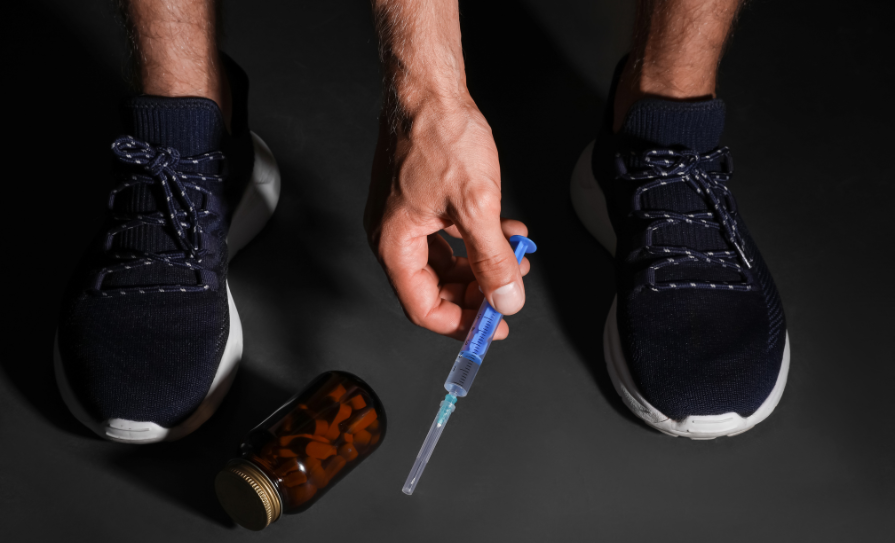
The world’s first Enhanced Games took place recently in Las Vegas (where else?). At the tournament, athletes were permitted to openly use performance-enhancing drugs (PEDs) that are banned in mainstream sports. Participants were well remunerated for taking part and were also offered bonuses if they could eclipse the relevant ‘non-enhanced’ world record.
The final event was the men’s 50-metre freestyle. Greek swimmer Kristian Gkolomeev set a new world record; however, this will not be recognised by regular athletics bodies worldwide. Not only did Gkolomeev receive $250,000 for winning the event, he also pocketed a $1 million bonus for beating the non-enhanced world record set by Australian swimmer Cameron McEvoy.
Apart from swimming, there were events in weightlifting and track, and 40 athletes took part. There were also plenty of Olympic athletes. Among these were British swimmer Ben Proud, US swimmer Hunter Armstrong, Barbadian sprinter Tristan Evelyn, Canadian weightlifter Boady Santavy, and US sprinter Fred Kerley.
However, despite expectations, there was no flood of broken records, with relatively few athletes surpassing established benchmarks.
Kerley is an interesting case in point. In the lead-up to the Games, no doubt partly to generate publicity and controversy, he said of Usain Bolt’s 100-metre world record of 9.58 seconds, “it’s going to get smashed.”
Bolt responded to this claim with a one-word response on social media: “Ok.”
Kerley is a 31-year-old former Olympic sprinter currently banned from the regular track circuit until 2027 for missing three drug tests over a 12-month period.
The Athletics Integrity Unit (AIU) found him guilty and stated that he was “negligent and, to a certain extent, reckless” in failing to observe the drug testing rules. However, in the Enhanced Games, competitors are not bound by the AIU rules.
It should also be noted that taking PEDs was not compulsory to participate in the Games, but merely optional. The vast majority of competitors were free to take combinations of human growth hormone, testosterone, peptides, anabolic and steroids, among other substances.
Kerley won the silver medal in the 100 metres at the 2020 Tokyo Olympics, and a bronze medal at Paris 2024, and he has stated that he intends to compete in the 2028 Olympic Games in Los Angeles. Interestingly, he also insists that he ran in the Enhanced Games ‘clean’ and had not taken any PEDs before the event.
“I don’t need it,” he insisted. “God gave me fast feet for a reason. I’m here to showcase my talent. You still have to work. Drugs aren’t going to give you an advantage if you’re not putting the work in.”
Whether he took any PEDs or not, Kerley missed out on the world record by four-tenths of a second. In the 50-metre butterfly event, Ben Proud managed a 22.32-second time (the world record is 22.27 seconds).
The company that runs the Games, Enhanced, says it is “a global movement that develops scientific insights, medical discoveries, and record-breaking sports events to unite humanity and inspire scientific innovation”. Its philosophy is that “performance is a science grounded in measurable truth. Transparency builds trust, access fuels progress, and together these pillars push human capability forward.” Enhanced said there were 14 personal bests set by 12 athletes at the event, all of them swimmers and weightlifters.
Make of that what you will, but the International Olympic Committee and World Anti-Doping Agency beg to differ. They stated: “Promoting performance-enhancing substances and methods sends a dangerous message, especially to current and future generations of athletes. Such substances can lead to serious long-term health consequences, even death – and encouraging athletes to use them is utterly irresponsible and immoral. No level of sporting success is worth such a cost.”
There is a major medical aspect to this development in athletics. A 2014 study by the University of Oslo established that muscles can retain the advantages given by anabolic steroids decades after the point at which they were taken. That has serious longer-term implications for anti-doping authorities as they grapple with the consequences of the new controversial tournament.
Indeed, World Aquatics has adopted a new rule that bans any athlete who participates in the Enhanced Games, whether he or she chooses to take PEDs or remain clean.












Leave a Reply
You must be logged in to post a comment.