







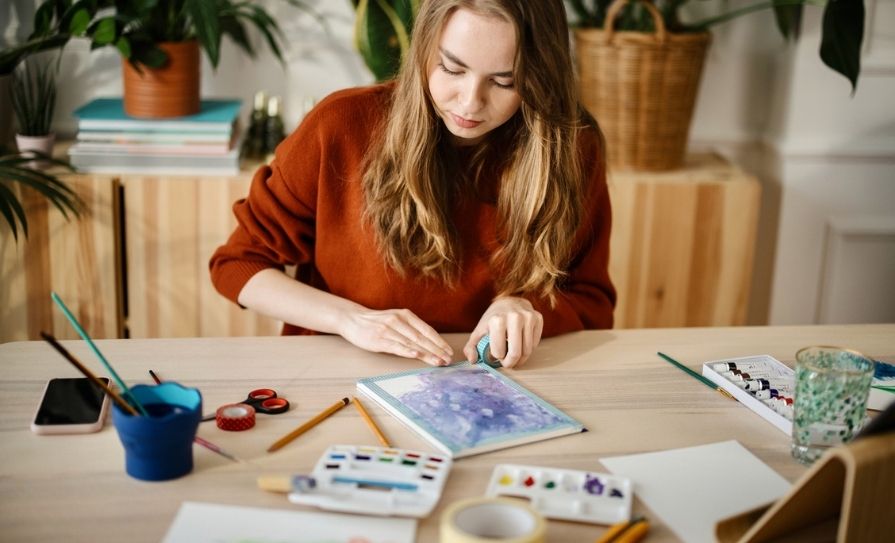
Art, in all its forms, is now rightly recognised as a therapeutic ‘Swiss Army knife’, and has practical benefits for body and mind. It is increasingly researched as a powerful tool in the healing process, backed up by a growing body of evidence, as well as a number of practical initiatives in hospitals and clinics in Ireland and internationally.
For instance, the St Luke’s Radiation Oncology Network has been established since 2001 and promotes and explores the creative arts as a therapeutic aid to healing. Pottery, sculpting, glass engraving, silk painting, fine arts with watercolours or oil colours, drawing, flower-arranging – there are myriad other artistic avenues, and since 2009, therapeutic art activities have also been offered to staff. The Arts and Activity Centre in St Luke’s was also central to the Art in Healthcare Settings exhibition, organised by the HSE in 2005.
Likewise, the Waterford Healing Arts programmes deliver visual art, creative writing, music, and storytelling activities to patients at University Hospital Waterford, as well as other healthcare settings. Dr Abdul Bulbulia is likely to be well known to some readers for his work and he was also instrumental in founding the Waterford Healing Arts Trust in 1993.
Waterford Healing Arts delivers art-making and storytelling to children in the paediatric ward, as well as creative writing, art, music and storytelling to the renal dialysis unit. Mental health service users are also invited to participate in more than 300 arts experiences in the department of psychiatry and in community settings each year.
As you might expect, St Patrick’s Mental Health Services also offers art therapy to patients as individual sessions, group therapy, or as an ‘open studio’ approach, where the therapist works with individuals in a group, rather than in the group process.
The National Centre for Arts and Health at Tallaght University Hospital also offers a “creative arts and health” programme for staff, as well as patients, to enhance care and wellbeing. The programme promotes the arts in health, and it also offers consultation services to other facilities looking to establish their own arts and health programmes.
For patients recovering from cardiac- and stroke-related conditions, the arts and health programme Mending HeArts provides creative workshops led by professional artists.
The artists come to the hospital setting to meet people during treatment and early recovery. By “linking hospital, recovery, and community life, the project seeks to reduce isolation, build confidence, and support creativity and emotional wellbeing”.
Healthcare professionals help to identify the suitable participants and support the artists. Sessions in hospital settings and local communities have been run by Mending HeArts in University Hospital Galway; Merlin Park University Hospital; Portiuncula University Hospital; Croí House, Ballinasloe Library; and Loughrea Family and Community Resource Centre, among other locations in the west of Ireland.
“Use of the arts in healing does not contradict the medical view in bringing emotional, somatic, artistic, and spiritual dimensions to learning,” wrote the authors of a 2010 study in Am J Public Health, titled ‘The connection between art, healing, and public health: A review of current literature’.
“Rather, it complements the biomedical view by focusing on not only sickness and symptoms themselves, but [also] the holistic nature of the person…. When people are invited to work with creative and artistic processes that affect more than their identity with illness, they are more able to create congruence between their affective states and their conceptual sense-making…. Through creativity and imagination, we find our identity and our reservoir of healing. The more we understand the relationship between creative expression and healing, the more we will discover the healing power of the arts.”
Using the power of art to heal is a concept that has been instinctively understood by patients and doctors for a long time. In 1889, following a period of mental illness, the artist Vincent Van Gogh spent a year in a psychiatric hospital, painting and drawing whenever he was capable of doing so.
He had a small studio in the hospital that overlooked a garden and many say that some of his most beautiful works were created there.





Leave a Reply
You must be logged in to post a comment.