







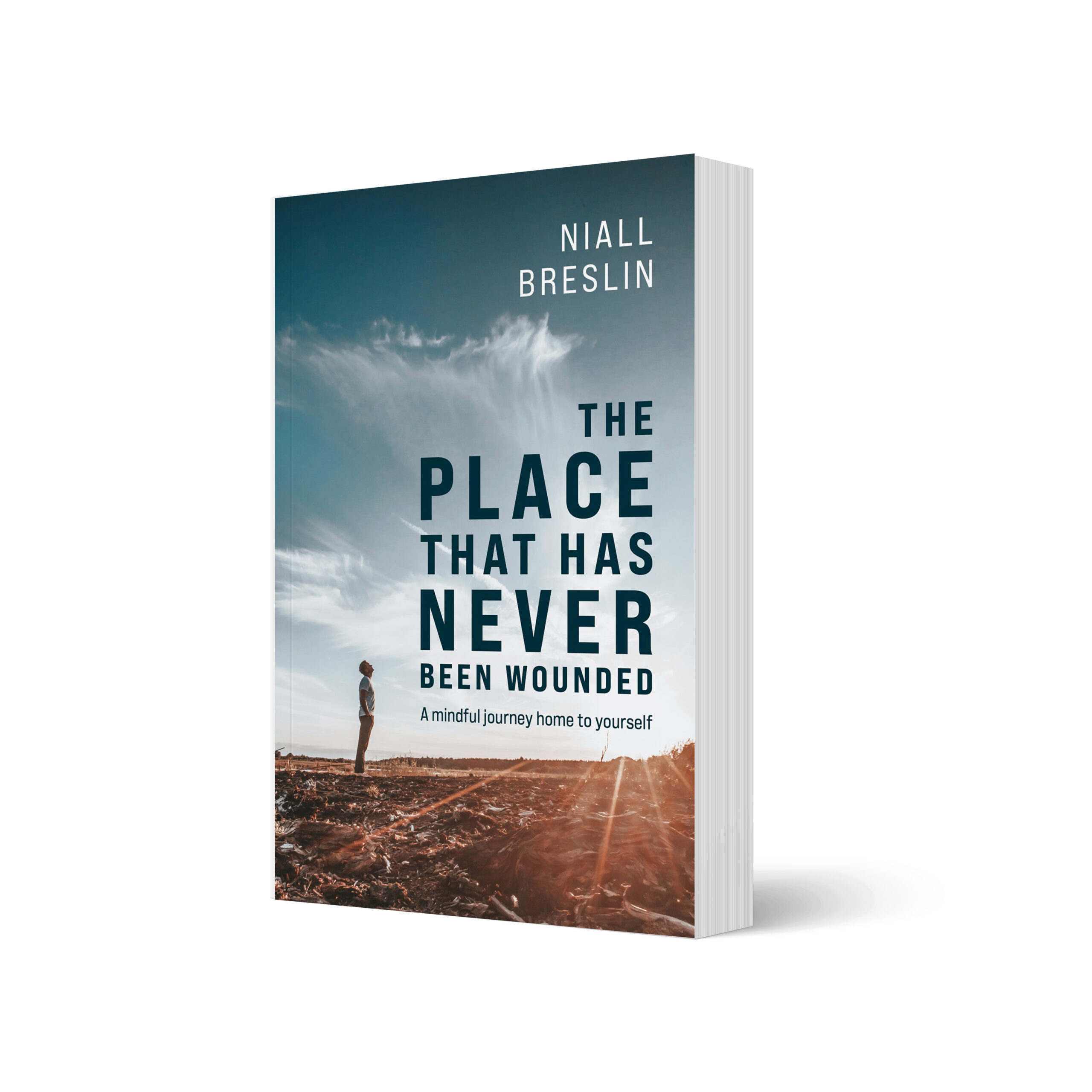
Title: The Place That Has Never Been Wounded: A Mindful Journey Home to Yourself
Author: Niall Breslin
Publisher: John Murray One
Reviewer: Prof Brendan Kelly
There is a particular challenge in writing about inner life without either sentimentalising it or reducing it to technique. In The Place That Has Never Been Wounded, musician Niall Breslin navigates this territory with intelligence, humility, and strength. The book, which is accompanied by an album of the same name, offers a reflective exploration of psychological resilience and interior steadiness, framed less as instruction and more as invitation.

Breslin, already well-known for his advocacy around mental health, writes in a voice that is measured and personal without being excessively confessional. The central premise – that beneath the inevitable injuries of experience there remains an aspect of the self that is fundamentally intact – is presented neither as dogma nor as abstract philosophy. Instead, it unfolds gradually, through reflection, narrative, and gentle guidance.
For many readers, this idea will resonate. In clinical practice, we encounter suffering in its many forms: Pain, anxiety, trauma, despair, burnout, moral strain. We also witness something else: The capacity of individuals to endure, adapt, and at times, grow in ways that are difficult to quantify. Breslin’s formulation of “the place that has never been wounded” gestures towards this enduring core. Whether one interprets it psychologically, spiritually, or metaphorically, it is a compelling image.
Compassion
The tone of the book is careful and compassionate. Breslin emphasises attention, self-compassion, and a deliberate slowing of pace. Readers are encouraged to observe rather than to fix, to become curious rather than critical. This orientation will be familiar to those acquainted with mindfulness-based approaches, yet the presentation here feels fresh and accessible rather than programmatic.
Importantly, the book does not deny suffering. It acknowledges adversity as a feature of human life. However, it resists defining individuals solely by their wounds. That shift in emphasis, from pathology to possibility, is particularly welcome at a time when both public discourse and clinical systems can become dominated by deficit-based narratives.
Multiple levels
Breslin’s style is conversational but thoughtful. He avoids technical terminology, yet the psychological underpinnings are evident. Themes of attachment, self-regulation, and trauma are woven through the text in ways that will be recognisable to healthcare professionals, even if not explicitly labelled as such. The result is a work that can be read at multiple levels: As personal reflection, as a meditation manual of sorts, or as a broader commentary on emotional culture. The accompanying music deepens many of these dimensions.
For doctors and other healthcare workers, the book may hold another, quieter relevance. Medicine often demands resilience while offering limited space to cultivate it. The pressures of contemporary practice, administrative burdens, moral complexity, and emotional fatigue can erode the sense of internal solidity that first drew many into the profession. Breslin’s reflections serve as a reminder that steadiness is not something to be manufactured, but something that already exists, albeit sometimes obscured.
Breslin’s reflections serve as a reminder that steadiness is not something to be manufactured, but something that already exists, albeit sometimes obscured
The strength of The Place That Has Never Been Wounded lies not only in its core concepts, but also in its tone and timing. It arrives at a cultural moment characterised by agitation and fragmentation. Its contribution is to suggest that beneath this turbulence, there remains continuity. At the heart of chaos, there is stillness – if we can rediscover it within ourselves.
This is not a cold, clinical text, nor does it attempt to be. Rather, it is a reflective companion that encourages gentler self-appraisal and a reconsideration of how we understand human strength.
For clinicians who spend their days attending to others, that is no small offering.
Prof Brendan Kelly is Professor of Psychiatry at Trinity College Dublin and author of Buddhism and Psychiatry: Moving Beyond Mindfulness in Mental Health Care (Open access: https://link.springer.com/book/10.1007/978-3-031-96045-1).









Leave a Reply
You must be logged in to post a comment.