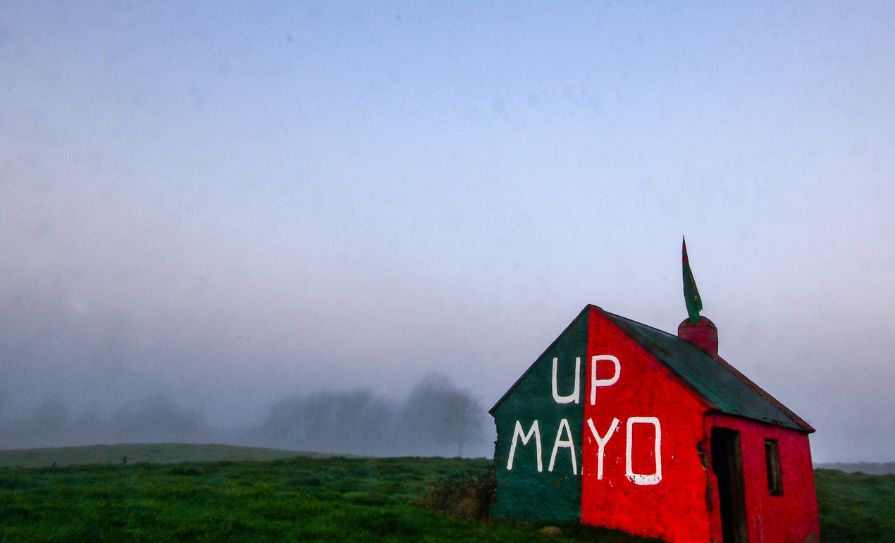
iStock.com/Simon Roughneen
No one could fail to be happy for a team and a county that had persisted
for so long, despite repeated failures
As I write, one event dominates the media – the match!
Full disclosure. I am not from Mayo, but my husband is.
I have known him for over 40 years and every year have heard the same aspiration: “This could be our year!”
His hope and enthusiasm have never waned. Optimism trumped reality every spring. But disappointment was a familiar emotion for supporters of a team that lost 11 finals, some of them very near misses, since 1989.
I only know this as we were married two days after the defeat to Cork in September 1989 and have been a close witness to every defeat since then.
This year the first shoots of hope came in February.
A call from the sitting room where he was watching Mayo play Monaghan. “You have to see this,” he said.
He knows I have very little interest in football, but even I could see that there was something special about the 18-year-old who came off the bench in the 53rd minute and scored one goal and four points with what looked like relative ease.
“This could be our year,” came the familiar mantra with added determination. Needless to say, I didn’t believe him, nor did I think he believed it himself.
But, on Sunday 26 July, Reek Sunday, when traditionally thousands of pilgrims climb Mayo’s Holy Mountain, I agreed, once again, to don the red and green and joined the two Mayo brothers and three Galway women (my sister-in-law and her two daughters, both of whom have played football for Galway) to watch the match.
The search for tickets had been in vain, even though one or both of the brothers had been at every Mayo final except the Covid one of 2020. Everyone, I knew, including my own children, staunch Tipperary supporters, was rooting for Mayo, glued to various TVs around the country.
Having lived through 40 years of vicarious disappointment and never fully understanding this obsession with the GAA, I was not prepared for the surge of pure emotion that engulfed the country when the final whistle blew.
An instantly contagious joy that could be seen spreading like a wave throughout Croke Park, even to Kerry supporters. No one could fail to be happy for a team and a county that had persisted so ardently for so long, despite repeated failures. No one could begrudge this team their moment of glory. One could only be happy for fans that should have lost hope years ago, but continued to come out in force, time after time, to support a team that nobody thought would win.
Much of the research on fandom and team success has been conducted on American football and baseball, but could also apply to county GAA competitions. There is substantial evidence that team success increases the wellbeing, identity, and even physiology of supporters. This effect can last for months. Apparently, after a team victory, supporters are more likely to say “we won” than “they won”. After a loss, fans distance themselves by referring to the team as “they”.
Another concept, the ‘identity fusion theory’, may explain why Mayo, despite repeated failures, never lost the bulk of its supporters. In Ireland, the county of origin is, for many, an important part of our identity. For those with an interest in sport, this fusing of identity with a team guarantees loyalty regardless of success or failure. These supporters are not in it for what they can get out of it. They are there for the team and this makes losses harder to bear, but success much sweeter.
But why did Mayo’s victory resonate with so many people? Despite growing up in a family that follows ALL sports and being transplanted through marriage into another one, I still find that question difficult to fathom and must defer to my more knowledgeable other half. This is what I could capture from his reply.
“There is the romance of the persistent, gallant, and resilient team that never loses hope and keeps coming back, despite years of recurring disappointment (six All-Ireland final losses since 2012; three by one point), their casting in this year’s final as being without hope, the stereotypical underdog, and everyone loves an underdog. Their style of play is high-risk and exciting, with the potential to go horribly wrong, but wonderful to watch in full flight. The young Kobe in his first and possibly last year in a Mayo jersey. Then there is the hope it gives to all those teams that have been starved of success.”
At this point, he breaks into song, which I remind him was written by two Galway men, but who cares? After 75 years, this is Mayo’s time.
“Oh the Green and red of Mayo
I can see it still
Its soft and craggy boglands
Its tall majestic hills.”
Do social media bans work?
Research is indicating that protecting young people from online harms
requires more than age limits
dr muiris houston
I’m pretty sure I’m not the only one who has asked a child for advice on some aspect of social media. Children see social media and other technologies as a normal part of life. In the UK, for example, some 79 per cent of children and adolescents aged between three and 17 now report that they use social media.
Using social media can help children fulfil some of their social and educational needs. However, ultimately, they are commercial products designed to profit their owners and shareholders.
To drive profits, platforms prioritise user engagement and aim to generate emotional dependency. This has led to the introduction of design features that promote emotionally charged content and drive habitual usage. Social media platforms that are driven by algorithms are associated with negative health outcomes for children.
Research published in the Medical Journal of Australia this year found that a higher level of social media use among Australian adolescents was associated with small, but significant increases in the risks of depression, poor wellbeing, and self-harm.
The study followed 1,195 students, who were aged around nine years at recruitment in 2012, for 10 years. Annual surveys and measurements of mental health and wellbeing were undertaken, as well as self-reported social media use.
The results showed that children who reported an average of more than two hours of social media use each day had a 29 per cent higher risk of depressive symptoms. They also found a 17 per cent higher risk of poor wellbeing than those who were on social media for under one hour a day.
Since the research was conducted, the social media landscape has become more populated with misogynistic and racist content.
When combined with greater social media use and an increased intensity of algorithm-driven feeds since 2012, experts are concerned that the results of a similar study carried out today would find even greater health concerns for young people.
Last year, Australia became the first country in the world to introduce legislation to reduce children’s exposure to social media.
It now requires that social media platforms – including TikTok, X, Facebook, Instagram, YouTube, and Snapchat – take reasonable steps to prevent adolescents under 16 years of age from holding accounts.
However, early data on Australia’s Social Media Minimum Age Act suggest that legal measures do not produce a noticeable short-term impact.
A study just published in the British Medical Journal (BMJ) and carried out three months after the law was introduced found that a substantial proportion of young people aged under 16 continued to access social media, mainly by using their own accounts.
Age verification strategies employed by platforms, primarily self-declaration of age and photo uploads, have been ineffective in reducing use.
Researchers found that 85 per cent of participants aged under 16 reported using social media platforms subject to the Act at follow-up. Some two-thirds of these reported that they had been subject to platform age verification checks, most commonly by stating their age and uploading a ‘selfie’ picture. A minority of respondents said they used fake social media accounts or accessed sites via an incognito browser.
While there was some reduction in daily social media use by 14–15-year-olds, usage increased in those over 16 and remained stable among 12–13-year-olds.
All of which must be a wake-up call for countries contemplating similar social media legislation to Australia. The UK will ban social media for under-16s next year.
Given the benefits that children perceive from social media, and the absence of consequences for non-compliance for underage children, laws alone are unlikely to shift behaviour.
In an accompanying opinion piece in the BMJ, Louise Holly, research and policy coordinator at the Digital Transformations for Health Lab at the University of Geneva, said the research findings should not be interpreted as a failure of children’s compliance.
She pointed out the law was not designed to change the habits of children, but the practices of selected social media platforms.
“If over 85 per cent of children and adolescents aged under 16 reported that they continued using the restricted platforms three months after the act came into force, the platforms have clearly failed in their duty to comply with both the letter and spirit of the law,” Holly writes.
“Age restrictions alone do not make online spaces safer or tackle platforms’ addictive features, algorithm-driven content, and commercial incentives that we increasingly understand to be at the root of harms associated with social media use.”
So what can public health policy makers learn from the Australian experience? They need to focus on what happens on social media platforms in the first place. If we are to support children to thrive in a digital world, the question is not only what should be restricted, but what kind of online environments we should be building instead.












Leave a Reply
You must be logged in to post a comment.