Credit: iStock.com/GoodLifeStudio
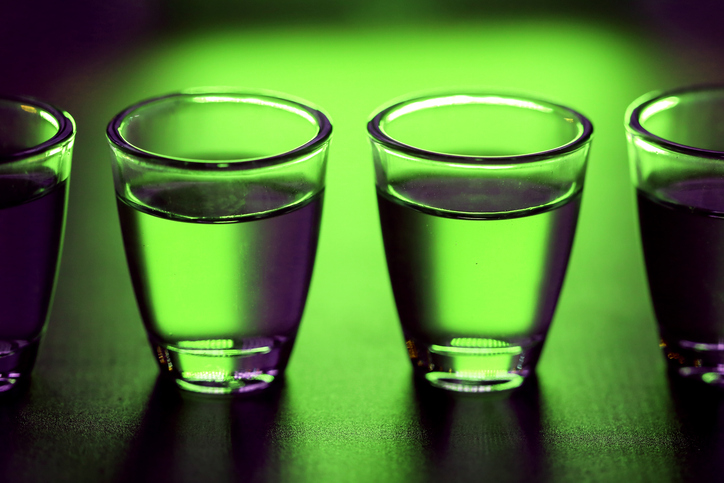
Absinthe drinking has a long history and is still surprisingly popular
Writing in the BMJ (24 April 1869), Dr WH Broadbent – perhaps with a Victorian dedication to accumulating arcane facts – addressed the claim that “[s]mall fishes are shown to be killed more quickly by the addition to the water in which they swim of a given quantity of absinthe, than by the same amount of prussic acid”. Portentous though this information was, especially for small fishes, Broadbent further disclosed that “frogs certainly, as I have ascertained by numerous experiments, and probably cold-blooded animals generally, are with difficulty killed by prussic acid”.
The Edwardian era saw the Victorians’ work on small fishes superseded by mammalian testing, with an anonymous contributor to The Lancet (29 August 1903) noting in ‘The Absinthe Evil’: “Experiments were made on dogs and other animals and the preparations to be tested were administered in various ways.” The first symptoms were agitation and restlessness and then “[c]onvulsions of transient character supervened, leading up to a definite epileptiform seizure in which the animal bit its tongue, foamed at the mouth, and passed its excretions involuntarily”.
By the 1930s, interest in the physiological effects of absinthe had extended beyond small fishes and canines to a consideration of its relationship with humans. Thus, Dr CWJ Brasher, writing in The Lancet (26 April 1930) on ‘Absinthe and absinthe drinking in England,’ observed: “‘Cocktail parties’ have become very popular among society women of all ages, and I have been told by several patients that many young men and women ask for a ‘spot’ of absinthe in a cocktail, doubtless often in ignorance of its composition.”
Dr Brasher would be pleased to know that today, ignorance of absinthe’s composition among both cocktail party attendees and the wider public has been dispelled. Thus, wormwood (Artemisia absinthium) is a felty-haired plant whose potent oil’s anti-helminthic properties were recorded in the Egyptian Ebers Papyrus, the oldest preserved medical document. As Vogt describes in the Journal of Ethnopharmacology (1981,4: 337–342), the first chemical investigation of the oil was undertaken by Leblanc in 1845; the principal fraction of the oil was determined to be an isomer of camphor; in 1873 the isomer was named “absynthol”; and in 1892 it was demonstrated that absynthol was, in fact, thujone.
Today, wormwood oil, whose principal components are the monoterpenes α- and β- thujone, is the constituent of a drink whose name is derived from the Greek word apsinthion – meaning undrinkable – which hardly gets absinthe off to a flying start. Today, there are over a hundred types of the so-called “green fairy” for sale; indeed, absinthe is probably sold in all 40 shades of green – hues often seen on the faces of those drinkers who are unfamiliar with this far-from-mild green fairy liquid.
Some with no sense of history, and possibly a few with no sense at all, drink absinthe because they’re impressed by dubious claims that it has not only aphrodisiac properties, but also induces a “cannabis-like” effect. However, while del Castillo et al, writing in Nature (1975, 253: 365–366), noted that “[t]hujone and tetrahydrocannabinol have similar molecular geometry and similar functional groups available for metabolism”, Schaan and Hughes, in the Journal of the Institute of Brewing (2025,131:126–165), explain that “after the cannabinoid receptor system was elucidated [in 1995], thujone was shown not to bind or activate receptors at physiologically relevant concentrations, discounting the hypothesis despite their structural similarities”.
There is a category of contemporary absinthe drinkers, that includes those rueing the demise of tea-clippers and steam locomotives, who view absinthe as part of Europe’s cultural heritage whose intellectual zenith was reached in the belle époque of the late 19th Century, whether in fin-de-siècle Paris or la vie bohème of Prague. My guess is that these individuals account for the resurgence of interest in absinthe. Yet there is no denying the popularity of absinthe, with Schaan and Hughes noting that “the global market for absinthe has increased from $34.25 billion in 2022 to $35.12 billion in 2023” with such expansion “anticipated to continue with a compound annual growth rate of 3.6 per cent, with a global value greater than $47 billion by 2030”.
The classic absinthe recipe was developed in Switzerland in the late 18th Century by a French physician, Dr Pierre Ordinaire, and apart from wormwood, his absinthe contained, inter alia, aniseed, hyssop, coriander, chamomile, and parsley. Following Ordinaire’s death, the recipe was acquired by Henri-Louis Pernod, who began commercial production in 1797.
Interestingly, the painting L’Absinthe (1875–76) by Degas was originally titled Dans un Café and features the engraver Marcellin Desboutin relaxing with his pipe and a tumbler of black coffee while contemplating the street outside. The woman beside him is actress Ellen Andrée. Yet Walter Crane, a leading figure in the arts and crafts movement, described it as “… a study of degradation, male and female… and the outward and visible signs of the corruption of society”.
Absinthe, in Crane’s case, did not make his heart grow fonder.












Leave a Reply
You must be logged in to post a comment.