Credit: iStock.com/geWildNatuurfotografie
My experience in a famous Japanese garden caused me to think of how Buddhism and psychology relate to each other
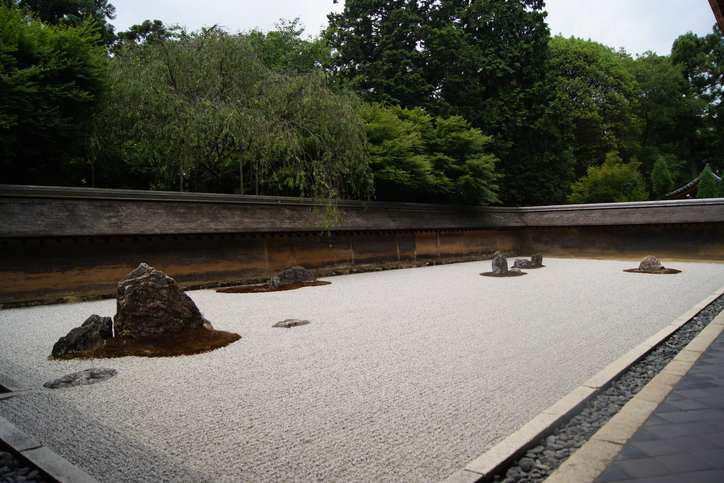
I sit in Ryōan-ji rock garden in Kyoto.
This is one of the most famous gardens in Japan, although ‘garden’ might give the wrong impression. There are no flowers here, no ornamental trees in the central space, and no water. Instead, 15 rocks of different sizes sit in carefully arranged groups amid pale gravel, which is meticulously raked into simple patterns. A low wall surrounds the garden. Visitors sit quietly on a wooden veranda and look.
And that, essentially, is it.
Kyoto has many temples. For more than a thousand years, the city was Japan’s imperial capital, and its religious landscape reflects centuries of Buddhist history, architecture, philosophy, and practice. Some temples are vast and imposing; others are intimate and surprisingly quiet. Many contain exquisite gardens, paintings, statues, and ceremonial spaces.
A substantial number are Buddhist, representing various traditions that developed in Japan over many centuries. Ryōan-ji belongs to the Rinzai school of Zen Buddhism.
Zen is notoriously difficult to define, perhaps because Zen itself is suspicious of definitions. It developed from the Chinese tradition of Chan Buddhism and places particular emphasis on direct experience rather than intellectual analysis. Meditation is central, as are simplicity, discipline, attentiveness, and an effort to see reality more clearly, without immediately covering it with our assumptions, categories, and judgments.
This does not mean that Zen is opposed to thinking. It means that thinking is only one way of knowing the world. And sometimes thinking gets in the way.
The rock garden at Ryōan-ji offers an almost perfect demonstration of this idea. It does not tell the visitor what to think. There is no explanatory narrative built into the stones. People have suggested that the rocks represent islands, mountains, animals crossing water, or something else entirely. Perhaps they represent nothing.
That uncertainty is part of their power.
We are accustomed to asking what things mean. We want explanations, conclusions, and answers. Faced with 15 rocks and a rectangle of gravel, the mind immediately starts generating interpretations. Zen invites us to notice this process rather than necessarily believing every interpretation that appears.
Just look.
This apparently simple instruction turns out to be remarkably difficult. Within seconds, the mind wanders: To yesterday, tomorrow, lunch, work, an unfinished email, a conversation that went badly three years ago. The human brain is an extraordinary machine for remembering the past and anticipating the future. These capacities are essential to survival, but they also mean that we spend surprisingly little time attending to what is actually happening now.
This is one reason why Buddhist ideas have become increasingly relevant to modern psychology.
The most obvious connection is mindfulness. Although contemporary mindfulness programmes have several influences and should not simply be equated with Buddhism, practices derived from Buddhist meditation have contributed to treatments including mindfulness-based stress reduction and mindfulness-based cognitive therapy. Mindfulness-based cognitive therapy, in particular, combines elements of cognitive therapy with meditation practices designed to help people observe thoughts and feelings without becoming completely absorbed in them.
Other modern psychological therapies contain intriguing parallels with Buddhist ideas, including acceptance and commitment therapy, dialectical behaviour therapy, and compassion-focused approaches.
There are important differences, of course. Buddhism is a spiritual and philosophical tradition extending over some 2,500 years; psychotherapy is a clinical enterprise intended to reduce psychological distress, enhance self-understanding, and improve functioning. It would be misleading to collapse one into the other.
But the overlap raises interesting questions.
Both Buddhism and psychology are interested in suffering. Both ask why the human mind can make an already difficult situation considerably worse. Both notice our tendency to cling to pleasant experiences, resist unpleasant ones, and construct elaborate stories about ourselves and the world. And both, in different ways, investigate whether changing our relationship with our thoughts can change how we experience our lives.
None of this requires 15 stones in Kyoto. But sitting here helps.
The Ryōan-ji rock garden does not provide an answer to the problem of human suffering. It does something subtler. For a few minutes, it asks us to stop demanding answers, stop rearranging the world inside our heads, and pay attention.
Fifteen rocks. White gravel. A wall.
And, inevitably, the restless human mind looking at them.
Prof Brendan Kelly is Professor of Psychiatry at Trinity College Dublin and author of Buddhism and Psychiatry: Moving Beyond Mindfulness in Mental Health Care (Open access: https://link.springer.com/book/10.1007/978-3-031-96045-1).












Leave a Reply
You must be logged in to post a comment.