







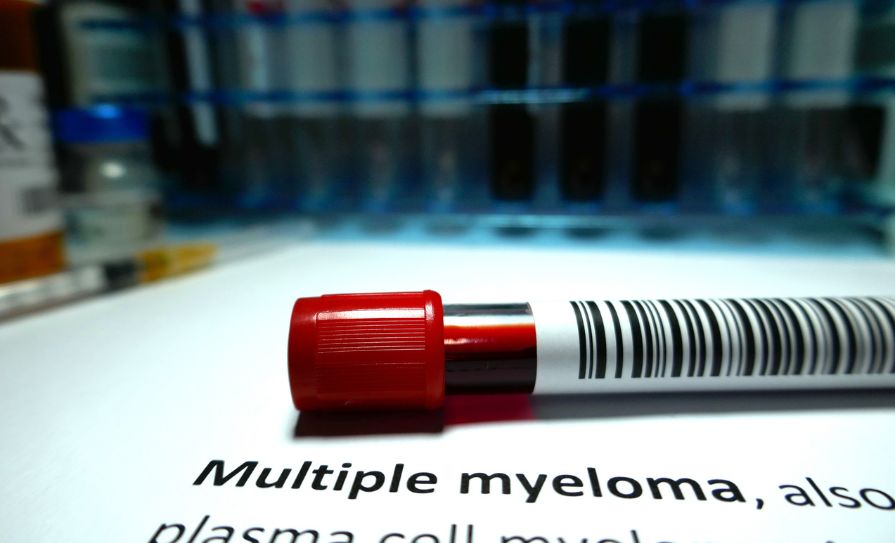
An artificial intelligence (AI)-based tool may help physicians determine which newly diagnosed multiple myeloma patients are most likely to benefit from specific therapies, including immunotherapy and stem cell transplantation.
Researchers at Sylvester Comprehensive Cancer Centre, part of the University of Miami Miller School of Medicine, US, found that immune-related signals hidden within routine bone marrow biopsy slides could predict differences in patient outcomes and support more personalised treatment strategies. The findings were presented by Sylvester research scientist Mr Arjun Raj Rajanna at the 2026 American Society of Clinical Oncology Annual Meeting.
“We are using AI to move toward a more precision-based treatment approach for patients with multiple myeloma,” Mr Rajanna said. “Instead of asking which drug combination is best overall, we are using AI to ask which treatment strategy best fits the biology of each individual patient.”
At last year’s American Society of Hematology Annual Meeting, the research team presented an AI model capable of reconstructing molecular features of the bone marrow from routine biopsy slides. Building on that work, the researchers asked whether the same images could also reveal meaningful information about a patient’s immune system – an especially important factor for immunotherapies such as daratumumab, which rely directly on immune cells to be effective.
In the current study, researchers used a foundational AI model called GigaTIME to profile immune features from bone marrow biopsy slides. They examined whether those signals could help identify which patients benefit most from daratumumab and which might safely defer a stem cell transplant.
Using GigaTIME, the team estimated levels of CD16, a biomarker associated with natural killer cells, from biopsy slides of 212 newly diagnosed multiple myeloma patients enrolled in the HealthTree Foundation registry. Researchers then analysed how these patients responded to standard therapy with bortezomib, lenalidomide and dexamethasone (VRd) or D-VRd, which adds daratumumab to the regimen.
The analysis revealed that patients with low AI-predicted CD16 levels who received VRd without transplant experienced a significantly shorter time to next treatment. In contrast, patients in the low-CD16 group had markedly better outcomes when treated with D-VRd. At 18 months, 86.8 per cent of those patients remained event-free, compared with just 28.6 per cent of patients treated with VRd alone.
The researchers also found that among patients with high AI-predicted CD16 levels outcomes at 18 months were comparable whether they received D-VRd with or without a stem cell transplant.
“This study does not suggest that transplant is no longer important in multiple myeloma,” senior author of the study Prof C Ola Landgren, Director of the Sylvester Myeloma Institute, said. “Rather, the findings support the emerging concept that transplant decisions may become increasingly personalised and biology-driven.”
This is still a research tool at this point, but the signals are strong, he said. “We still need to further validate these findings prospectively before the AI model can fully move into the clinic.”
Next, the team plans to compare AI-predicted CD16 levels with directly measured immune biomarkers. They are also expanding the model to include larger and more diverse patient datasets, as well as additional immune markers. “I hope this study highlights that AI can move beyond simply automating workflows and instead become a powerful tool for biologic discovery and clinical decision support,” Prof Landgren said. “This may represent the beginning of a new era of AI-enabled digital pathology in myeloma.”










Leave a Reply
You must be logged in to post a comment.