








The new guideline offers clinicians much-needed clarity in this area
Stereotactic body radiotherapy (SBRT) is an established treatment for previously unirradiated spinal metastases; however, the literature is limited with respect to SBRT as a re-irradiation salvage therapy.
Effective salvage treatment of previously irradiated spinal metastases represents a critical clinical challenge. Spine SBRT is an attractive option in this scenario as it allows for dose escalation.
This year, for the first time, the European Society for Radiotherapy and Oncology (ESTRO) and the International Stereotactic Radiosurgery Society (ISRS) issued joint clinical guidelines for re-irradiation of spinal metastases with SBRT.
The guideline authors Prof Filippo Alongi, ESTRO Lead, Professor of Radiation Oncology, Chair of Advanced Radiation Oncology Department, IRCCS Ospedale Sacro Cuore Don Calabria, Negrar, Italy; and Dr Arjun Sahgal, President of ISRS, Professor of Radiation Oncology, University of Toronto, Chief of the Department of Radiation Oncology, Sunnybrook Health Sciences Centre, Toronto, Canada, highlighted the importance of these new guidelines:
“This joint ESTRO-ISRS document underscores the power of collaboration in addressing complex clinical topics like the re-irradiation of spinal metastases with SBRT. Through a Delphi process informed by a systematic review and meta-analysis, we have developed practical recommendations in the spinal metastatic setting for the retreatment using SBRT.”
“These guidelines offer clinicians much-needed clarity in a demanding clinical scenario and represent an important step toward improving patient care across institutions. Moreover, these joint guidelines are an important resource for clinicians, ensuring more standardised and high-quality care across centres and countries.”
Evidence base
The recommendations are based on a systematic review and meta-analysis of papers published between January 2006 and September 2024 that reported on the clinical outcomes of at least five patients treated with spine SBRT re-irradiation (≥5 Gy per fraction) for vertebral metastases.
The intention was to provide insight into three key questions:
1) Is SBRT re-irradiation effective in pain control for painful vertebral metastases?
2) Is SBRT re-irradiation effective in local control for vertebral metastases?
3) What is the toxicity profile of spine SBRT re-irradiation?
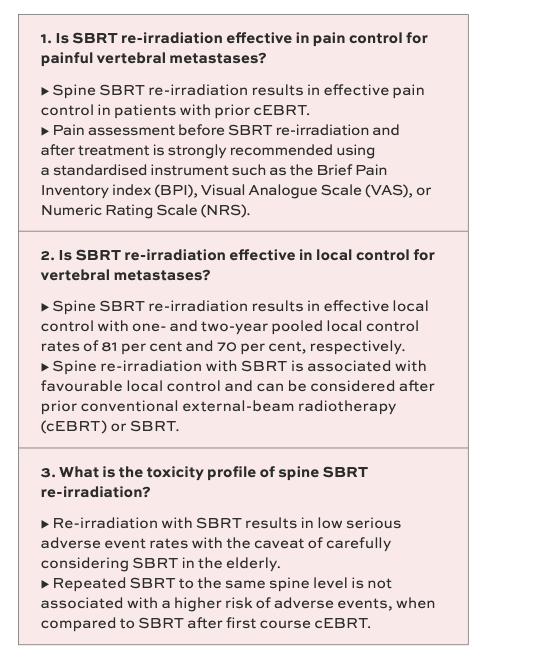
After the initial article screen, 20 studies (five prospective, 15 retrospective) met the inclusion criteria for analysis. A total of 1,538 spine metastases were treated in 1,284 patients. The median re-irradiation dose was 24Gy in two fractions (range: 16–30Gy in 1–5 fractions) after a median 30Gy in 10 fractions of prior conventional radiotherapy.
Vertebral compression fracture, nerve root damage, and myelopathy events were observed in a pooled proportion of 5 per cent, 5.6 per cent, and 1.7 per cent, respectively.
The consensus was that for painful spinal metastases, salvage SBRT shows promising results in terms of pain response, with a pooled overall response rate of 77 per cent and a complete response rate of 34 per cent. Only two studies reported on the median time to pain progression (13 and 12 months, respectively).
There was some evidence of SBRT superiority for pain outcomes; however, the guidelines committee stated that, ultimately, prospective randomised studies with precise baseline and post-treatment pain assessments are required to provide definitive evidence for re-irradiation spine SBRT with respect to superiority in pain outcomes.
With a median follow up of 12 months, the pooled one- and two-year local control rates were 81 per cent and 70 per cent, respectively.
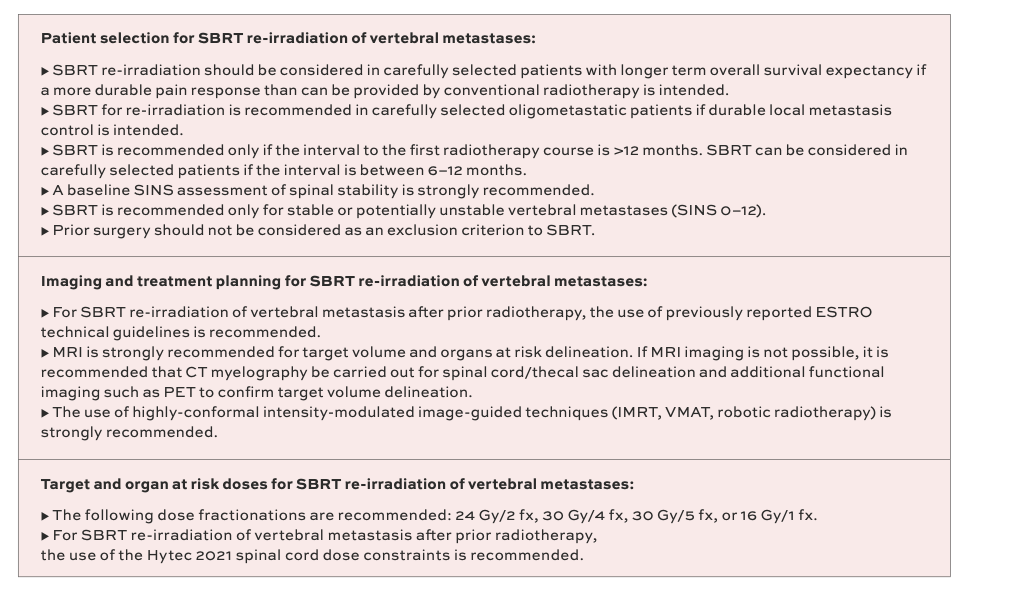
The panel expressed a strong consensus regarding the necessity of a SINS evaluation before considering vertebral re-irradiation with SBRT, limiting eligibility to patients with a score of 0–12 (stable or potentially unstable).
Despite the low level of evidence, a consensus was reached after the first round of voting for 11 practice recommendations. There was a strong consensus to recommend the use of SBRT for spinal metastases re-irradiation for carefully selected patients with a longer life expectancy, where durable results – in terms of both pain response and disease local control – are required.
A strong consensus was also reached on the recommendation regarding a minimum time interval of 12 months from the previous radiation treatment to propose vertebral re-irradiation with SBRT. However, the possibility of evaluating SBRT re-irradiation in carefully selected patients remains if the time interval is six to 12 months.
Concurrent or prior vertebral surgery was also not considered to be an exclusion criterion for SBRT re-irradiation.
There was also strong consensus around the technical aspects of vertebral SBRT re-irradiation, particularly with the mandatory use of MRI for target volume and organs at risk delineation. The guidance states that MRI can be substituted by myelography only in cases where MRI is not possible, adding that this approach requires integration with additional functional imaging such as PET for tumour delineation.
Reference
Alongi F, Cuccia F, Kotecha R, et al. ESTRO-ISRS clinical practice recommendations for re-irradiation of spinal metastases with stereotactic body radiotherapy: Delphi consensus supported by a systematic review and meta-analysis. Radiother Oncol. 2026 Jan;214:111304








Leave a Reply
You must be logged in to post a comment.