


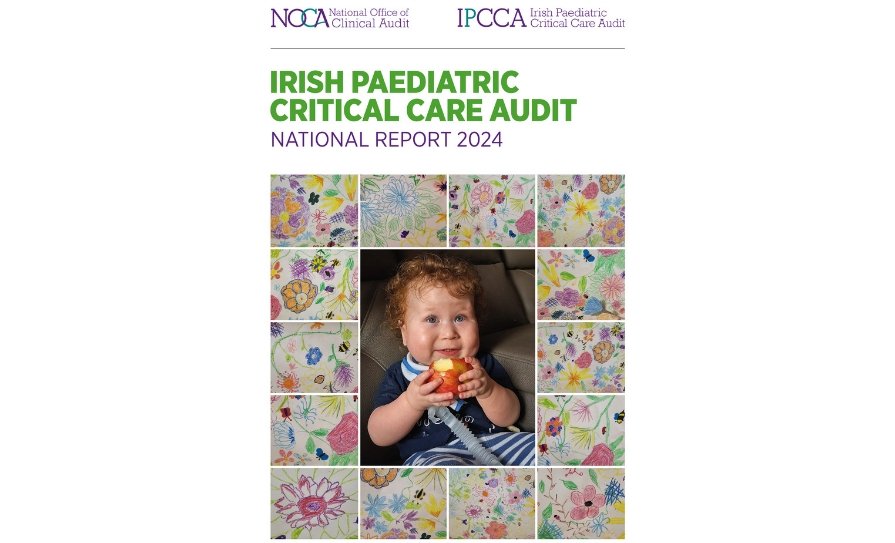
Catherine Reilly examines the latest national report from the Irish Paediatric Critical Care Audit
Some 128 children were admitted to adult intensive care units (ICUs) in 2024, states the Irish Paediatric Critical Care Audit (IPCCA) National Report 2024. This compared with 148 admissions in 2023.
This data highlights “ongoing” capacity constraints and “reinforces” the need for regional paediatric high dependency units (PHDU), a matter raised in previous IPCCA reports.
The IPCCA national reports are published by the National Office of Clinical Audit (NOCA). They provide a comprehensive evaluation of paediatric critical care services provided by Children’s Health Ireland (CHI) at Crumlin and CHI at Temple Street, both in Dublin. Data on specialist transport mobilisation is also included.
The 2024 report examines activity, reports on complex subspecialties, quality indicators, patient outcomes, and overall system performance, with benchmarking against comparable UK units. The report found that Irish paediatric critical care services “continue to deliver high-quality care with excellent survival outcomes”, while highlighting ongoing challenges related to capacity, workforce, and regional service provision.
Adult ICUs
Eleven adult ICUs received paediatric patients (aged under 16) in 2024, with most admissions being in HSE West and North West.
The most common reasons for admission included pneumonia, asthma, bronchiolitis, status epilepticus, and diabetic ketoacidosis (DKA). Almost 60 per cent of the children were aged 6–15 years, 27 per cent were aged one to five years, and 14 per cent were under one year. Median length of stay (LoS) was 11.6 hours, and about one-third required invasive ventilation. Almost half of the patients were transferred to specialist paediatric/neonatal critical care services, and overall survival was high (97 per cent).
The data on this group of children, provided by the Irish National ICU Audit, “show a short LoS and mainly Level 2 care, highlighting the need for regional paediatric high dependency units” in designated areas, as outlined in the Model of Care for Paediatric Critical Care (2019).
“Admitting children to adult ICUs is not ideal and should be avoided where possible,” stated the IPCCA report.
The report noted that work is ongoing in HSE South West to progress the establishment of a PHDU. An update from HSE West and North West stated: “It is acknowledged that it will take a number of years to deliver on this plan.”
A HSE West and North West (WNW) spokesperson told the Medical Independent: “As per published national standards for critical care for children in Ireland and recent national audit recommendations, the feasibility of the development of a paediatric HDU facility for the WNW region will be considered accordingly.”
A HSE Mid West spokesperson said a two-bedded PHDU is operational within the paediatric unit of University Hospital Limerick and staffed to support these beds.
A HSE Dublin and North East spokesperson said Our Lady of Lourdes Hospital, Drogheda, has a PHDU within the paediatric ward.
PCCUs
There are two paediatric critical care units (PCCUs): A 23-bed unit at CHI at Crumlin, and a nine-bed unit at CHI at Temple Street. These units accept patients from all counties in Ireland.
In 2024, there were 1,715 admissions to the PCCUs (1,098 to Crumlin and 617 to Temple Street), which amounted to 10,274 bed days. Almost 70 per cent of admissions were emergencies/unplanned. Median LoS was 2.9 days in Crumlin and 1.7 days in Temple Street.
Patients ranged in age from 25 weeks’ gestation to 16 years, with 45 per cent aged under one year (half of whom were neonates). Respiratory illness was the leading overall diagnostic category, accounting for 31 per cent of PCCU admissions. Infants aged under one year accounted for 41 per cent of respiratory admissions.
Notably, when compared with 2023, there was a 45 per cent reduction in PCCU respiratory admissions of neonatal infants, particularly among infants positive for respiratory syncytial virus (RSV).
This reduction is “likely attributable to the impact of the RSV Immunisation Pathfinder Programme” which was established in September 2024. An expanded RSV infant immunisation programme also ran in 2025/26, while the 2026/27 programme commenced in September.
The initiation of an RSV immunisation programme was a recommendation in the 2021/22 IPCCA report. The continuation of the programme is a key recommendation of the 2024 report.
Speaking at a recent NOCA webinar, IPCCA Clinical Lead, Associate Prof Martina Healy, added: “We will be able to produce follow-up data for 2025 in our next report, and I think this impact [of the RSV infant immunisation programme] will be even more visible.”
Admission groups
In Crumlin, cardiovascular conditions continued to represent the largest admission group, accounting for 40 per cent of admissions. Of these, 67 per cent were planned. Cardiothoracic surgical cases accounted for 64 per cent, cardiology medical cases for 24 per cent, and cardiac catheterisation procedures for 12 per cent.
In Temple Street, neurological conditions were the largest specialist admission group, accounting for 23 per cent of admissions. Most (93 per cent) were unplanned, with neurosurgical cases accounting for 54 per cent of neurological admissions. Some admissions were associated with e-scooter-related trauma.
Capacity remains a “challenge” at the PCCUs, especially during autumn and winter. Both units exceeded the recommended occupancy limit of 85 per cent for most of the year. In November 2024, Crumlin reached a peak of 106 per cent bed occupancy, and Temple Street experienced a high of 113 per cent in January 2024. There were 5.45 whole-time equivalent (WTE) nurses per critical care bed – below the recommended level of 5.8 WTE.
Despite these pressures, the services continue to provide “high-quality care with excellent survival outcomes”. Advanced therapies, including extracorporeal life support (ECLS), “continued to achieve positive outcomes, with an 82 per cent survival rate among patients receiving ECLS.” Overall survival to PCCU discharge remained high at 97 per cent, with low and stable mortality rates, stated the report. Deaths of children in the PCCUs were commonly associated with planned withdrawal of care or treatment limitation (79 per cent).
Organ or tissue donation may be considered in children who die in PCCUs if certain criteria are met and if their families wish to donate. Four children donated solid organs or tissues in 2024, representing 7 per cent of all PCCU deaths.
NCH
The IPCCA 2024 report included updates on previous recommendations. One was for CHI to continue planning for the required increase in the workforce for the “safe opening and operation” of the National Children’s Hospital (NCH) critical care unit with 32–42 beds.
According to the report, funding has been approved for the requested uplift in consultant and NCHD staffing. However, funding had not been provided for additional nurses to open any extra beds beyond the current bed base.
In addition, no funding had been provided for 15 ‘Access’ nurses, which are required to “mitigate the risks” of all 32 critical care beds in the NCH being cubicles.
The report noted there was no update available on progressing a national paediatric respiratory ECLS/extracorporeal membrane oxygenation (ECMO) programme at CHI. This is a life-saving treatment for infants and children with severe lung failure. Of the nine children requiring respiratory ECMO/ECLS support in 2022–2024, seven were transferred abroad due to the absence of a formally funded and resourced national service.
Another longstanding IPCCA recommendation is resourcing the Irish Paediatric Acute Transport Service to operate 24/7. This has not yet been achieved, with workforce planning ongoing.
In a positive development, CHI had been prioritised for support from HSE Organ Donation and Transplant Ireland to facilitate the appointment of specialist organ donation personnel.
Raising awareness of the early recognition of signs of type 1 diabetes and DKA was a key recommendation in the IPCCA 2023 report. This was based on data that showed a notable rise in the proportion of DKA PCCU admissions (from less than 1 per cent in 2014 to 2.9 per cent in 2022). The IPCCA has shared information on DKA with stakeholders and will “continue to monitor” admission trends.
In addition, the Irish Audit of Paediatric Diabetes under development at NOCA will include the monitoring of DKA admissions.
Further plans include ongoing surveillance and continued engagement with stakeholders to inform prevention, early recognition, and quality improvement initiatives.
The 2024 report made two new recommendations. One was continuation of the RSV infant immunisation programme. The second was to strengthen data systems and audit infrastructure to enable comprehensive paediatric critical care reporting, service planning, and quality improvement. This should be supported by dedicated local data management resources.











Leave a Reply
You must be logged in to post a comment.