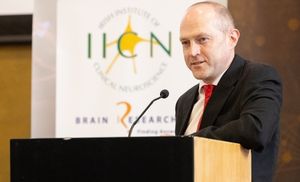
Prof Brendan Kelly
The Annual Neurology Update Meeting 2025 heard a talk by Prof Brendan Kelly, Professor of Psychiatry, Trinity College Dublin, on the intersection of psychiatry and neurology.
The title of Prof Kelly’s lecture was ‘Psychiatry and neurology: Contested aspects of a complex relationship’.
Early in his talk, Prof Kelly discussed recent positive data in the field of psychiatry.
Prof Kelly highlighted the FIN20 study – a 20-year Finnish follow-up of 62,250 patients with schizophrenia – which examined physical morbidity and mortality in relation to long-term antipsychotic use. While antipsychotics are known to prevent relapse, their extended use was often thought to harm physical health. The study, however, found no evidence to support this assumption, using nationwide registry data to assess hospitalisation rates, mortality, and causes of death among patients treated between 1972 and 2014.
The data suggested that long-term antipsychotic use does not increase severe physical morbidity leading to hospitalisation and is associated with substantially decreased mortality, especially among patients treated with clozapine.
Throughout his talk, Prof Kelly discussed the shifting ground between psychiatry and neurology.
One aspect of this relationship is ‘neuroimaging’, or brain scanning.
Quoting directly from his book, In Search of Madness, Prof Kelly said: “Neuroimaging… despite vast numbers of eye-wateringly costly studies remain essentially a research tool contributing virtually nothing to day-to-day clinical psychiatry (except, perhaps, in the field of dementia).”
Continuing, he stated that many forms of neuroscience command a “seductive appeal that they do not merit”.
However, Prof Kelly highlighted how conditions once viewed as psychiatric are now recognised as neurological. Before the 18th and 19th Centuries, epilepsy, for example, was regarded primarily as a mental illness, explained through both natural and supernatural means. However, once its biological basis was identified, it came to be understood chiefly as a neurological disorder.
He noted that there are more recent parallels, citing a 2019 Lancet Neurology update on anti-NMDA receptor (NMDAR) encephalitis, intended for both neurologists and psychiatrists. The identification of anti-NMDAR encephalitis made it possible to recognise that some patients with rapidly progressive psychiatric symptoms or cognitive impairment, seizures, abnormal movements, or coma of unknown cause, had an autoimmune disease. In this disease, autoantibodies serve as a diagnostic marker and alter NMDAR-related synaptic transmission.
Prof Kelly pointed out how, at symptom onset, distinguishing the disease from a primary psychiatric disorder is challenging. Previously, many people with the condition would have been diagnosed with and treated for schizoaffective disorder, depression, mania, or other mental illnesses. Now, they are diagnosed with anti-NMDAR encephalitis and effectively treated with immunotherapy, among other treatments. Primarily, they are treated by specialists other than psychiatrists.
Prof Kelly postulated that other disorders currently seen within psychiatry may in the future be discovered to be the result of “some kind of biologically-defined condition that we cannot yet imagine”.
Referring to the paper he wrote on the subject, published in 2021, Prof Kelly said, while psychiatry is essential at present, the specialty might eventually become obsolete.
However, he added, based on current evidence, this is unlikely to occur anytime soon.
Uncertainty about the future of the specialty is nothing new, Prof Kelly told the meeting. He noted that in April 1979, Time magazine published a cover story titled ‘Psychiatry’s Depression’, arguing that psychiatry was experiencing an identity crisis and needed to find new directions in order to survive.
In an editorial 20 years later, in 1999, renowned Irish psychiatrist Dr Anthony Clare touched on some of the same themes. While Dr Clare was optimistic about the future of neuroscience, Prof Kelly noted that the treatment of conditions such as schizophrenia remains, in many ways, unchanged since 1999.
Moreover, he observed that the closure of psychiatric hospitals in the decades since has left many people with schizophrenia facing circumstances increasingly reminiscent of the early 1800s – before the construction of asylums – with rising rates of homelessness, imprisonment, and premature death.
At present, Prof Kelly noted, the most meaningful progress for psychiatric patients and their families is most likely to come from improvements in mental health services, legislation, and social policy.
The final lecture of the meeting – ‘Sound waves and brain waves: The neuroscience behind music as therapy in epilepsy and beyond’ – was delivered by Dr Yerko Ivanovic-Barbeito, Consultant Neurologist with a subspecialty interest in epilepsy, Tallaght University Hospital.
He played a number of piano pieces, including works from Mozart and Bach. Dr Ivanovic-Barbeito also played the east-meets-west flavoured Alla Turca Jazz, which is based on Mozart’s Turkish March.
For more information on the meeting, see www.iicn.ie












Leave a Reply
You must be logged in to post a comment.