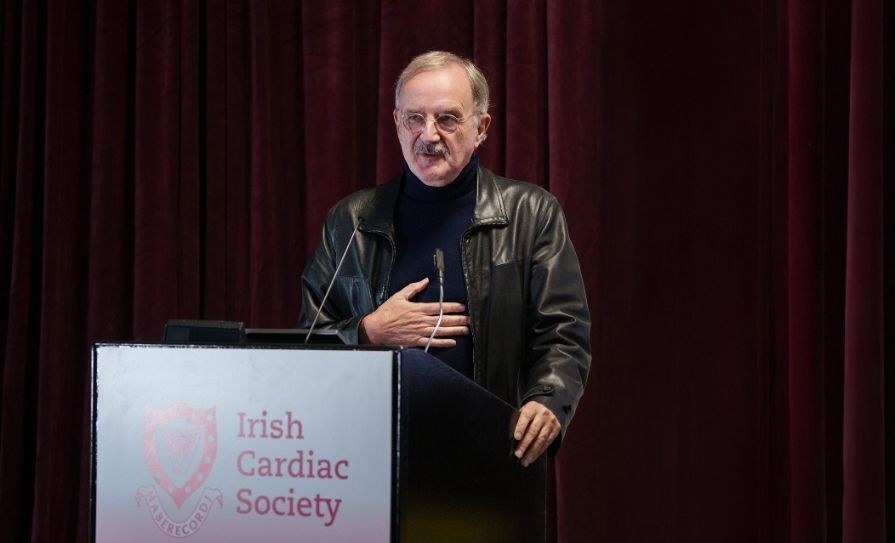
Dr Garret Fitzgerald
The Irish Cardiac Society (ICS) annual Stokes Lecture – titled ‘Time’s arrow: The ageing chronobiome’ – was delivered by Dr Garret Fitzgerald, McNeil Professor in Translational Medicine and Therapeutics, University of Pennsylvania, US.
Originally from Greystones, Co Wicklow, Dr Fitzgerald has produced more than 650 original papers and has won several awards.
In his introduction to the Lecture, ICS President Prof Brendan McAdam said that Dr Fitzgerald’s research has been characterised by an “integrative approach to elucidating the mechanisms of drug action, drawing on work in cells, model organisms, and humans”.
“His work contributed fundamentally to the development of low-dose aspirin for cardioprotection. His group was the first to predict and then mechanistically explain the cardiovascular hazard from NSAIDs,” Prof McAdam told delegates.
“His laboratory was the first to discover a molecular clock in the cardiovascular system and has studied the importance of peripheral clocks in ageing and in the regulation of cardiovascular and metabolic function.”
Dr Fitzgerald said ‘time’s arrow’ is a concept that suggests the movement from the past to the future. He stated it has been used to explain the second law of thermodynamics, which states “that in isolated systems as we move across time we accumulate entropy or disorder and I’m going to talk today about how that can apply to us in our bodies”.
He spoke about the molecular clock and how there is a master clock in the suprachiasmatic nucleus (SCN), which drives coordinated activity across a 24-hour cycle or daily circadian cycle.
“We have come to learn that we have molecular clocks in all of our tissues and the SCN is the master clock and it communicates with clocks in other tissues in a variety of different ways, through hormones, through physical factors, through proteins and lipids of various sorts. It orchestrates through them the circadian oscillation of a variety of hormones and proteins of functional relevance in terms of all our biological systems.”
Dr Fitzgerald said a way to think about the system was like “an orchestra keeping time”.
“The SCN is like [someone] with the baton on a dais and the SCN instructs the periphery how to behave. But like performance in an orchestra, the peripheral clocks have the capacity for autonomous behaviour. And just like in an orchestra, while signals from the centre instruct the periphery, the reaction of the periphery through hormonal signals and so on can feed back to instruct the behaviour of the centre. It’s a simple concept for a very complex biological system.”












Leave a Reply
You must be logged in to post a comment.