







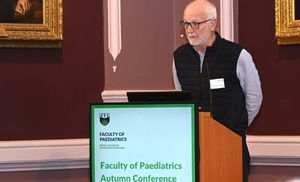
At a recent RCPI meeting, Consultant Paediatric Oncologist Prof David Walker highlighted decades of work dedicated to raising awareness and speeding up the early diagnosis of cancer in children and teenagers
At the RCPI’s headquarters in No 6, Kildare Street, the College’s Faculty of Paediatrics held its Autumn Conference on 3 October. The conference is a key meeting in the College calendar and showcases the latest clinical updates and research in the specialty.
Among the speakers was Prof David Walker, Consultant Paediatric Oncologist, Nottingham Children Hospital, UK. In 1997, Prof Walker co-founded one of the UK’s first research centres dedicated to brain tumours in children and young people.
“When I arrived in Nottingham, I was seeing images no one else in the world was seeing of children’s brains,” said Prof Walker, ahead of the meeting.
It was the mid-1970s, and the city’s university was home to English physicist Peter Mansfield and his discoveries in magnetic resonance imaging (MRI). Nottingham was the first city in the world to have an MRI scanner for clinical use.
Prof Walker was a university student undertaking a Bachelor of Medicine degree and was interested in paediatrics. “It used to be that every book of paediatrics started their chapter on cancer saying cancer is rare in childhood,” he said.
This is a myth Prof Walker would spend the next 50 years dispelling.
Early career
Upon qualifying as a doctor, he worked in medical oncology diagnosing and treating leukaemia in adults, before proceeding to work on children’s cancer wards. He was successful in securing a research Fellowship at the Royal Children’s Hospital Melbourne, Australia, specialising in neuro-oncology. When he returned to Nottingham in 1990 and was asked what research he would do, he decided to work further in the area of brain tumours in children and young people.
The result was the Children’s Brain Tumour Research Centre at the city’s university, which he co-founded with neurosurgeon Mr Jonathan Punt. The first of its kind in the UK, it remains dedicated to improving the understanding and outcomes for children and young people with brain tumours.
“In the late 1990s, there wasn’t much money being spent on the research. Committees giving out grants weren’t really familiar with the problems of brain tumours in childhood. They thought they were very rare.
“They didn’t think brain tumours in childhood were very important and they hadn’t heard much from the public or the parents. We formed the Children’s Brain Tumour Research Centre to engage with the families and encourage them to tell their story,” he said.
Unlike some other cancers, survival rates for brain tumours remained frustratingly unimproved. Prof Walker partially put this down to late diagnosis. Until the early 2010s, the median diagnostic interval before diagnosis was about 13 weeks.
Findings from the Children’s Brain Tumour Research Centre showed that brain tumours accounted for around a fifth of childhood cancers in the UK. More than a third of children with brain tumours died despite modern treatment. Of those cured, two-thirds are left with a disability caused by their tumour.
Guidance
After much campaigning, including the presentation of children’s stories to the UK’s Houses of Parliament, the guideline ‘Diagnosis of brain tumours in children’ – which Prof Walker co-wrote as lead Paediatric Oncologist – received NHS accreditation in 2011. It advised healthcare professionals on how to identify symptoms that could be caused by a brain tumour. After years of advocacy, the accreditation marked a significant victory in the effort to improve early diagnosis. Soon after, significant grants and funding followed.
With that support, Prof Walker and the Children’s Brain Tumour Research Centre were able to partner with public relations specialists later that same year and launch a major national awareness campaign.
The campaign, HeadSmart, carried the new guideline’s message beyond hospitals and into public awareness. The results, according to Prof Walker, were extraordinary.
At the end of the campaign, the median diagnostic interval was found to have dropped from 13 weeks to six weeks.
Awareness
During his presentation, Prof Walker stated that growing familiarity with symptoms is still helping to speed up diagnosis.
A network of child cancer services in Ireland and the UK – the Children and Young People’s Cancer Association – is working to continue reducing delays in diagnosis. Information is now available on certain tumour types to help raise awareness and support earlier detection.
Prof Walker pointed out that delayed diagnosis of brain tumours can still lead to serious consequences, including persistent hydrocephalus, cognitive impairment, blindness, and temporal lobe damage. He also highlighted the growing awareness of neuroendocrine disability.
“We’re becoming increasingly aware of the consequences for survivors,” he said.
Currently, Prof Walker is senior clinical advisor on a second nationwide initiative dedicated to speeding up diagnosis of cancer in children and teenagers: The Child Cancer Smart campaign.
This campaign is a collaboration with the Children’s Cancer and Leukaemia Group charity.
“Adults get cancer because they’re getting old and their systems are deteriorating. Children’s cancers are a product of the child growing and different parts of the body growing faster at different times,” he explained.
“The commonest cancer in childhood is lymphocytic leukaemia and that’s when the bone marrow is growing most of all during the first five years of life, because your immune system is building your immune library that will last for the rest of your life. That’s an example of how the body’s growth is a driver for the cancer.
“The other common one is teenagers with bone tumours. The bone is growing fastest during your adolescent growth spurt. That’s when you go from 4ft 11 to 6ft 2. If the symptoms occur in a growing child’s bones, if they’ve a neckache or backache, or waking up in the middle of the night with a sore back, if they’ve got a swollen knee that was injured and is not getting better, those are the things you need to be thinking maybe it’s an injury, but it could also be something else.
“Lots of people just have an x-ray. X-rays don’t diagnose bone tumours. You need an MRI or a CT scan. Outcomes for children with bone tumours haven’t improved in three decades despite enormous effort and the thing that could make the biggest difference would be diagnosing them earlier,” he said.
Prof Walker’s work now stands as a kind of informed rebuttal to those older paediatric textbooks that once treated childhood cancers as too rare to merit detailed diagnostic guidance.
“[Paediatric] cancer is a predictable complication of growth and development and is not rare,” he said.
“It affects up to one in 200 people by the age of 25. It is a very common disease in young, early life. The problem lies in spotting it amongst the other symptoms of childhood and growth. Cancer is really not uncommon and it should always be on your differential diagnosis when you see a child with symptoms that are not short-lived, that don’t just go away.
[Paediatric] cancer is a predictable complication of growth and development and is not rare
“If you see a child three times and you haven’t got a diagnosis, you need to think cancer. Even if only to exclude it,” he said.
For more information on the RCPI Faculty of Paediatrics visit www.rcpi.ie/Faculties-Institutes/Faculty-of-Paediatrics
This article was produced by the RCPI.






Leave a Reply
You must be logged in to post a comment.