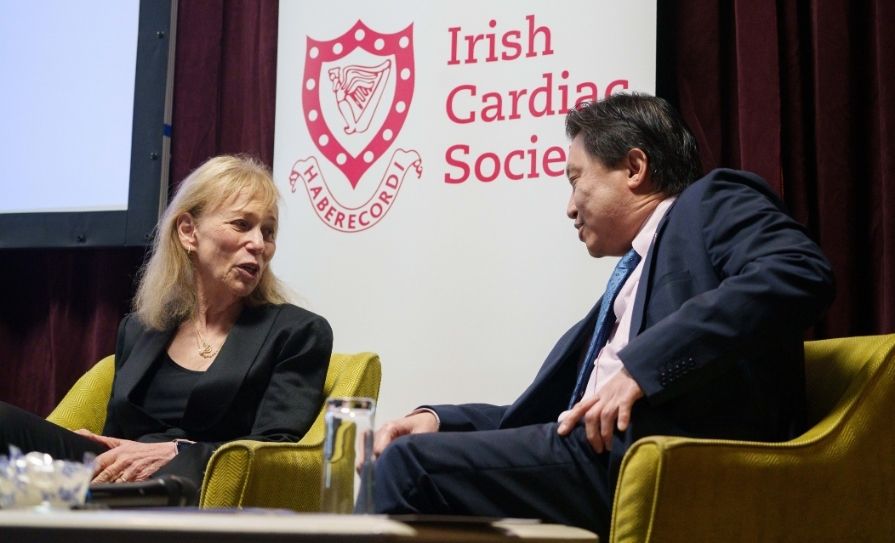
Prof Sandra Lewis and Prof André Ng
Recent research reveals persistent inequities in cardiovascular health services for female patients. Niamh Cahill reports
Cardiovascular disease (CVD) is “under-recognised and under-researched in female populations”, Prof Brendan McAdam told delegates at the Irish Cardiac Society (ICS) 76th Annual Scientific Meeting in Killarney in October.
Prof McAdam, who is ICS President and Consultant Cardiologist, Beaumont Hospital, Dublin, made the remarks during his introduction of the international session titled ‘Women and cardiovascular disease’ at the meeting.
Heart disease is the leading cause of death for women worldwide and there is a general lack of evidence on risk factors, such as pregnancy-related complications, perimenopause, and auto-immune conditions that can further complicate cardiovascular health in women, Prof McAdam added.
Research
Prof Cecilia Linde, Professor of Cardiology, Karolinska University Hospital and the Karolinska Institute, Stockholm, Sweden, and President-Elect of the European Society of Cardiology (ESC), was the first speaker in the session.
Her talk focused on women and arrhythmias and on women’s representation in research and clinical trials.
Prof Linde highlighted results from the Ontario Study on women and atrial fibrillation (AF) in Canada, which covered the period 2007 to 2019. The study determined that older age and inequalities in cardiovascular care led to a higher risk of stroke in women with AF. “The sad fact was women had worse therapy and worse treatment,” according to Prof Linde.
“So, they were older at time of diagnosis than men and they were more often diagnosed in the emergency department… they had fewer cardiologist visits. This really showed that there are inequities, at least in this study, that we should do something about.”
Guidelines
Prof Linde also drew attention to changes in the 2024 ESC and European Heart Rhythm Association guidelines. Prof Linde explained the guidelines have removed female sex as a risk factor in the CHA2DS2-VA score.
Under this updated approach, anyone with a CHA2DS2-VA score of two or more is now indicated for anticoagulation, Prof Linde said.
“This is very important and says that you need to re-evaluate thromboembolic risk in both men and women continuously, since lots of comorbidities may come up over the disease course of each individual patient,” she said.
Furthermore, she noted that research shows women derive greater benefit from cardiac resynchronisation therapy than men, independent of body size. “There are several research gaps in arrhythmias with respect to sex,” Prof Linde argued, due partly to the under-representation of women in clinical trials.
She outlined that women have a greater incidence of supraventricular arrhythmias, while men are more likely to experience ventricular arrhythmias. “Sex and gender should be considered in research design, analysis, and reporting of results,” Prof Linde stated.
Prof Linde maintained that guidelines are essential in this area, in addition to implementation plans.
She also noted the ESC’s gender policy, which aims to increase the participation of women in clinical trials and research.
Women are under-represented in cardiovascular clinical trials, she said, and evidence shows that women appear to be “worse-off” when it comes to out-of-hospital cardiac resuscitation. “EU initiatives, such as the cardiovascular health plan, which demands equality, may help,” Prof Linde said.
Menopause
The next speaker in the session was Prof Sandra Lewis, Consultant Cardiologist, Legacy Health, Portland, Oregon, US. Her talk was titled ‘Menopause – a time of opportunity for women in Ireland’.
She began by outlining several myths relating to heart disease and women. Prof Lewis argued that it was a “myth that heart disease is a man’s disease” and that women do not get heart disease until they are old.
Prof Lewis stated that CVD is the leading cause of death in Irish women and that women develop CVD seven to 10 years later than men, typically post-menopause.
Ireland, she said, ranks in the bottom 20 per cent for age-standardised CVD mortality globally.
Menopause is the “ideal time for life-cycle risk assessment”, she noted, adding that reproductive healthcare for women is “really your cardiology healthcare”.
Adverse pregnancy outcomes are linked to cardiovascular risk factors later in life, she remarked.
Prof Lewis said the menopause was an important time in a woman’s life to examine cardiac risk factors.
In particular, she noted the loss of the hormone oestrogen at this time, which she described as “the lost cardioprotective shield”.
Oestrogen has numerous cardiovascular benefits, such as improved insulin sensitivity, reduced arterial stiffness, and positive anti-inflammatory effects.
During menopause, oestrogen levels in women drop dramatically, heightening a woman’s risk of accelerated atherosclerosis, and resulting in a loss of “cardioprotection”, Prof Lewis said.
She referred to the many adverse changes during menopause, describing it as “the metabolic storm”, a period when a woman’s visceral adiposity, even without weight gain, increases.
In addition, insulin resistance rises, blood pressure increases and inflammatory markers go up, Prof Lewis said.
She drew attention to particular considerations for Irish women, including rising obesity rates, which are threatening progress in tackling CVD in this country.
She also noted high female smoking rates in Ireland compared to global standards and a growing post-menopausal population due to our ageing population.
But she also outlined opportunities, including a strong research infrastructure, the potential for population-level screening programmes and integrated CVD prevention policies in Ireland.
Menopause hormone therapy, she advised, should be guided by patient atherosclerosis risk and shared decision-making.
She called on the cardiology community to advocate for “menopause transition [MT] inclusion in CVD research and trials” and to push for the development of “MT-specific risk assessment tools”.
Prof Lewis concluded that: “Hormone therapy is not for primary CVD prevention, but may be appropriate for symptom management with careful selection.”
Closing gaps
“We must close the knowledge and care gaps that leave menopausal women vulnerable,” according to Prof André Ng, President, British Cardiovascular Society (BCS), the last speaker in the session.
Prof Ng informed delegates about the work of the Society in developing a consensus statement on women with cardiovascular disease amid efforts to improve cardiovascular outcomes for women in the UK. “Recognising sex and gender difference in cardiovascular care is vital to coronary heart disease (CHD) prevention, diagnosis and treatment,” he stated.
“CHD causes twice the fatalities in the UK in women as breast cancer. The persistent misconceptions of low risk in women leads to delays in seeking care and receiving treatment.”
Sex and gender differences in CHD are due to multiple factors, he said, including the fact that primary care often focuses on traditional risk factors in men, commencing preventative regimes earlier in this cohort.
Biological differences between men and women affect disease presentation, pathophysiology, and prognosis, Prof Ng advised.
Women, he stated, are more susceptible to conditions such as heart failure with preserved ejection fraction, autoimmune conditions, coronary microvascular disease, and coronary artery spasm. “Women present later with cardiovascular disease due to the protective effects of oestrogen, which decline with menopause along with progesterone and androgen levels,” Prof Ng noted.
CHD outcomes are worse in women than in men, he maintained, which is why exploring the role of hormone replacement therapy in mitigating these risks and improving cardiovascular health is important, he added.
But the evidence for managing menopause symptoms in women with CVD remains limited, he said.
Sex disparities within the cardiovascular workforce and within research exist. Prof Ng noted an inadequate representation of women as clinicians, leaders, and researchers in the field. “Randomised controlled trials historically under-recruited women leading to under-diagnosis and under-treatment,” Prof Ng maintained.
Trial criteria often exclude women of reproductive age and pregnant patients, he said, while cardiovascular medication and interventions are under-tested in women.
The recently published BCS Joint Societies consensus statements, he said, outline actionable points to help address sex disparities in the everyday care of cardiovascular patients and to promote the recruitment of female participants to help inform the evidence base from clinical trials.












Leave a Reply
You must be logged in to post a comment.