







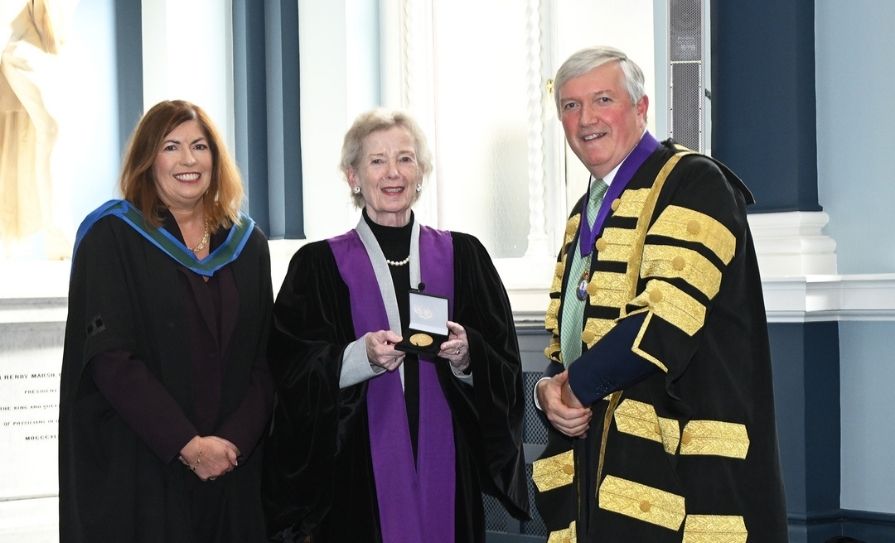
Former President of Ireland Ms Mary Robinson was recently awarded the RCPI Stearne Medal for her contribution to global health and humanitarianism
“This is, in my lifetime, the worst of times, which means we need to dig deeper and fight back.” Ms Mary Robinson, September 2025
Ms Mary Robinson, former President of Ireland, member of the Elders, and a globally renowned advocate for human rights and climate justice, was awarded the prestigious RCPI Stearne Medal 2025 at an intimate ceremony on Friday 5 September at No 6, Kildare Street.
Dr Diarmuid O’Shea, RCPI President, took the opportunity to speak with Ms Robinson in a pre-recorded interview that was aired during the RCPI Annual Conference earlier this month. They discussed global challenges, leadership for change, and the importance of vaccines.
Speaking at the event, Dr O’Shea paid tribute to Ms Robinson’s enduring legacy: “Mary Robinson’s career has been defined by courage, compassion, and an unwavering commitment to justice. Her leadership has shaped international policy, reframed climate change as a human rights issue, and brought dignity and hope to millions. She exemplifies the values of the Stearne Medal and continues to inspire generations of healthcare professionals and humanitarian leaders.”
The Stearne Medal, named after RCPI’s founding president, John Stearne, recognises Ms Robinson’s unparalleled contribution to global health, wellbeing, and humanitarianism.
From her early career as a distinguished constitutional lawyer, she stood out as a champion for human rights. Ireland’s first female President from 1990 to 1997, her term was marked by a deep commitment to social reform, equality, and international engagement.
As United Nations High Commissioner for Human Rights, she tackled global injustices and expanded the reach of human rights protections to marginalised communities worldwide. She later founded Realising Rights: The Ethical Globalisation Initiative, promoting fair labour, health equity, and women’s empowerment, and established the Mary Robinson Foundation – Climate Justice to advocate for the health and wellbeing of communities most affected by environmental degradation.
Ms Robinson continues to give a voice to those who have none, and to use her voice, with her fellow Elders – a group of global leaders founded by Nelson Mandela, to work for human rights and peace. Her efforts have included diplomatic missions to conflict zones, support for food security initiatives, and advocacy for multilateral cooperation in addressing global health crises.
Existential threats
During her interview with Dr O’Shea, she said: “We have three existential threats that we (the Elders) work on – the climate and nature crisis, the pandemic crisis, and the nuclear weapons crisis.… I’ll be using my voice with my fellow Elders, as much as possible, on all three issues.”
“This is, in my lifetime, the worst of times, which means we need to dig deeper and fight back.”
Gaza
Ms Robinson has openly condemned the war in Gaza as “unconscionable” and recently travelled to the Rafah Border with fellow Elder, Ms Helen Clark, former Prime Minister of New Zealand and former Co-Chair of the World Health Organisation Independent Panel for Pandemic Preparedness and Response.
Ms Robinson, who was speaking before the recently announced ceasefire, said: “We were there to show the truth, that this was a man-made famine, deliberately done, deliberately blocking food and medicine getting in, full lorries being refused for no reason at all… a very deliberate famine that has now been officially declared and also an unfolding genocide.”
Recollecting the 150-year anniversary of Ireland’s Gorta Mór – the Great Famine – Ms Robinson shared the story of the Choctaw people.
“I love the story of the Choctaw [Native American] tribe, who in 1847 raised $173 and gave it to Irish famine victims. They didn’t know anything about us except that we were starving because of a crop that had failed for the third time and they understood that. That was a pure act of humanitarian relief and help.
“We need to remember these parts of our history in order that we continue to be a welcoming nation for those who need, who have to leave war zones, or who desperately need to leave their country.”
Emigration
A symbol of the renowned ‘Irish welcome’ is the light that shines brightly from the window of Áras an Uachtaráin, dating from Ms Robinson’s time as President.
In her Presidential acceptance speech in 1990, the then President-Elect said: “I am not just a President of those here today, but of those who cannot be here; and there will always be a light on in Áras an Uachtaráin for our exiles and our emigrants.”
“I never realised,” she told Dr O’Shea, “that light would take on a life of its own… now I realise that that light has helped to shape an Irish diaspora and the policies followed very quickly.”
As Ms Robinson took up residence at Áras an Uachtaráin in December 1990, Dr O’Shea was completing his Fellowship in the US and received a letter from his mother. In the envelope, he found a news clipping with a picture of the light in the window of the Áras, along with a simple note – “You better come back at some stage.”
Of course, he did return to live and work in Ireland, as many doctors do after gaining valuable experience and further education in different international settings.
Similarly, Ms Robinson spoke of her time in Harvard in the late 1960s as a defining period, a time that ignited this ambassador for change and set her on the path to what would be a transformative presidency and career.
“Without that year in Harvard, I would never have dared to challenge the following year the fact that it was elderly male senators who represented Trinity in the Senate, and indeed National University, and then went forward and got elected at the age of 25. It was Harvard that gave me that sense of young people being prepared to give leadership.”
A leader for climate action, Ms Robinson spoke of how becoming a grandmother provided a new lens to view the world.
“We have to think of future generations and there is now more of a focus on long-term leadership which the Elders promote, which is the idea that you should think, especially on big problems. They require thought, they require scientific knowledge and evidence, especially at the global level, and they require thinking how will this affect future generations, not just now – no … populist, short-term decision-making, but longer term, thoughtful decision-making.”
On climate and healthcare, she said: “The health of the planet is about the health of people – we are nature … the nexus is very strong.”
The health of the planet is about the health of people – we are nature … the nexus is very strong
They discussed the importance of individual action, contributing to the community, and clinical leadership.
Referring to Seamus Heaney’s The Cure at Troy, Dr O’Shea said the poet “had a lovely quote about believ[ing] a further shore is reachable from here”.
He then asked the former President: “With all of your experience, all that you’ve been through, and when you look at the world and all the challenges there are, are you hopeful?”
Using words first shared by Archbishop Desmond Tutu, Ms Robinson said: “You have to be a prisoner of hope.”
“Why? Because, if you are, you start to see possibility – the glass may not be half full, but there may be something there at the bottom of it. You work with that, and you work with others, and you collaborate.
“The hope is through action.”
Ms Robinson is the ninth recipient of the Stearne Medal, reserved for persons of distinction who have made a significant contribution to health.
Previous recipients of the Stearne Medal include: Lady Valerie Goulding (1979); Princess Margriet of the Netherlands (1992); Dr Catherine Molloy (2005); Mr Albert Reynolds (2006); Dr Stanley Roberts (2007); Prof T J McKenna (2014); Prof Petr Skrabanek (2018); and Dr Anthony Fauci (2024).






Leave a Reply
You must be logged in to post a comment.