







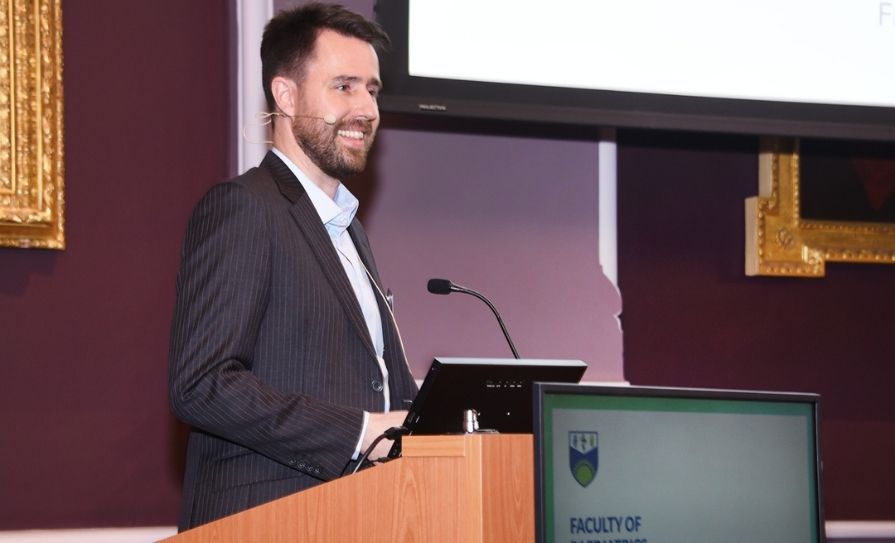
The need for better joined-up care for young people with functional disorders was discussed at the
RCPI Faculty of Paediatrics Spring Conference
The RCPI Faculty of Paediatrics held its Spring Conference on 4 May at No 6, Kildare Street, Dublin. The event is a key meeting in the College calendar and showcases the latest clinical updates and research in paediatrics.
Among the speakers was Dr Jacob Ellis, Child and Adolescent Psychiatrist. Dr Ellis secured a Fellowship to train at British Columbia Children’s Hospital, Vancouver, Canada, before returning in 2019 to take up his current position with University College London Hospitals NHS Foundation Trust, which comprises several hospitals in the city.
Part of Dr Ellis’s role is to assist paediatricians in treating children and adolescents with functional disorders. This psychological distress is related to the presence of physical symptoms, but where no disease is found to be affecting the structure of the body.
“It’s focusing on conditions that might present in a child or in a young person that don’t really have a clear, purely medical explanation,” Dr Ellis said. “There will be an emotional component to symptoms and you’re helping to develop multidisciplinary management plans. These conditions are often very challenging for paediatricians to manage.”
Dr Ellis began his psychiatry training with the Royal College of Psychiatrists, UK. During that period, he found hospital “liaison-based” specialties the most rewarding – wherein a doctor bridges the gap between mental health and physical healthcare in hospital settings.
It was posts based in child and adolescent units that stayed with him and influenced his later career.
“For me, the compassion in the sub-specialty of child/adolescent psychiatry was really important from a working practice perspective. It’s incredibly patient-focused.”
He added that the specialty recognises the issues affecting young people are part of a broader culture and system.
Functional disorders
“Functional disorders don’t have a clear identifiable pathology,” Dr Ellis explained. “It’s often very hard for a clinician to be able to communicate that diagnosis in a way that makes that young person and family feel heard and understood, as opposed to feeling dismissed, or that the doctor is saying: ‘It’s all in your head.’
“We’re talking about physical symptoms that are real, that are unconscious, that have a significant impact on that young person’s life and functioning and that don’t adhere to a medical explanation alone, but have an emotional component as well. And that need a multidisciplinary management structure.”
Dr Ellis believes that part of the challenge lies in the language used to describe these conditions. While he uses the term ‘functional disorder’ – a label also used by neurology teams at Great Ormond Street Hospital – other specialties use different terminology for similar issues. For example, in cardiology, symptoms might be labelled as ‘non-cardiac chest pain’, while in gastroenterology, they might be described as ‘disorders of the gut-brain axis’.
“I think these descriptions can be helpful for clinicians, but they also sometimes serve as a way to avoid important conversations,” he said.
“What commonly happens to young people with these conditions is that a vast majority of cases tend to resolve themselves. For the small subset that end up becoming complex and enduring, for whatever reason, those young people tend to get bounced from specialty to specialty. They tend to present repeatedly to primary care and emergency care services, they tend to be referred on for more tests and sub-specialty investigations, and it perpetuates the problem.”
Instead, Dr Ellis and his colleagues advocate for a parallel approach to patient management, where, as part of tests and investigations, the emotional components of a potential functional diagnosis are considered, and referrals can be made to psychiatrists, psychologists, and occupational therapists.
Key to this approach is having the patient’s care coordinated in one place, with a single generalist clinician, as opposed to repeatedly being sent to sub-specialists for tests.
“I think the way our medical system is structured lends itself to that onward referral. You can always go see the next expert in whatever that might be.”
TRACCS
Two of the hospitals Dr Ellis works in – Great Ormond Street Hospital and University College Hospital London – have an adolescent medicine service called TRACCS [Treatment and Rehabilitation for Adolescents with Complex Conditions Service]. In that service, patients are first seen by a paediatrician, who subsequently brings in members of a multidisciplinary team. The patient’s treatment is carried out in-house, assisted by the hospitals’ occupational therapy, physical therapy, and medical teams.
“I think having a paediatrician at the centre of their care lends legitimacy and reassurance to that young person, that allows them to then access that multidisciplinary input, in a way that isn’t a paediatrician saying, ‘You don’t have a bodily reason for your pain. We’re discharging you. You should go see that psychiatrist.’”
I think having a paediatrician at the centre of their care lends legitimacy and reassurance to that young person
Dr Ellis hoped his presentation could serve as a practical guide for paediatricians.
Position paper
Coinciding with the conference, the RCPI Faculty of Paediatrics launched a new position paper calling for regulation and accountability for online platforms to protect the health of children and young people.
“We recognise the benefits of online platforms in enabling connection, education, and self-expression,” stated Faculty Dean Dr Judith Meehan.
“But we cannot ignore or underestimate the negative health impacts we are seeing among children and young people. These include anxiety, depression, self-harm, negative body image, disordered eating, unhealthy food consumption, poor sleep, risk of obesity, as well as reduction in self-esteem, social wellbeing, and happiness.”
Dr Ellis is similarly concerned. “Seeing young people present in mental health crisis, I see so many more patients having experienced a degree of bullying or humiliation within school or community environments that just wouldn’t have been possible without social media as it currently exists,” he said.
“If a young person got into a fight in school 20 years ago, that would be the gossip of the school for a while and then it would disappear. Now it can be a video on YouTube or TikTok that lives forever. I think that scale of humiliation and its impact on self-esteem has never existed.”
Specialty
Dr Ellis said it is a privilege to work in child and adolescent psychiatry, as he is often the first adult to speak to young people about their mental health.
“I think psychiatry as a specialty is an opportunity to be really creative and thoughtful in your practice. As a junior medical doctor, I found medicine very protocolised and structured in a way that felt restrictive. With psychiatry, it’s wonderful to be able to take a really detailed history from somebody and develop quite a bespoke management plan that still adheres to reasonable principles of safety and improving their health.
“I think working with children and adolescents, in particular, has always been a joy. Adolescents are brutally honest and a lot of fun. I think it’s a real privilege to be in that position and to be kept honest and sharp by that patient group is very rewarding and a good professional challenge,” he concluded.
Find out more about the Faculty of Paediatric here: www.rcpi.ie/Faculties-Institutes/Faculty-of-Paediatrics
This article was produced by the RCPI.








Leave a Reply
You must be logged in to post a comment.