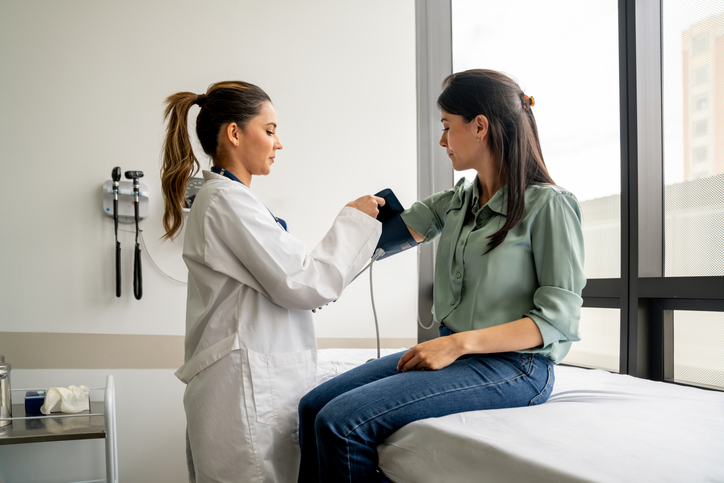
Credit: iStock.com/andresr
Despite significant progress in recent years, women in Ireland continue to experience significant inequalities in health research and care
Women’s health is increasingly recognised as a national priority in Ireland. However, gaps in research, evidence, and healthcare continue to affect outcomes and experiences of care.
To take some examples: Women may wait years for a diagnosis of endometriosis; encounter significant barriers to accessing fertility services; experience persistent or debilitating menopausal symptoms without timely access to specialist care; or present with cardiovascular disease in ways that differ from the traditional clinical picture.
At the heart of many of these inequalities is a historical tendency to treat men as the default patient and women as ‘small men’, despite fundamental biological differences between female and male bodies that can influence disease risk, symptoms, treatment response, and medication effects.
Women were largely excluded from medical and scientific research until relatively recently, and sex-specific differences, including hormonal and physiological factors, were often overlooked in research, clinical education, and treatment. Importantly, women’s health extends far beyond reproductive health. Women’s experiences of cardiovascular disease, cancer, chronic pain, osteoporosis, and mental health conditions can differ from those of men, while gaps in research and clinical evidence can affect how these conditions are recognised and managed.
Ireland has made important progress in recognising women’s health as a national priority. The Department of Health’s action plans for women’s health provide a national framework for addressing longstanding inequalities in women’s healthcare, research, and health outcomes. They were developed in response to evidence that women’s health has historically been overlooked and under-researched and with a commitment to ensuring that women’s experiences and priorities inform policy and service development.
The first Women’s Health Action Plan 2022–2023 established a national programme of work. The second plan for 2024–2025 had the subtitle Phase 2: An Evolution in Women’s Health, which expanded priorities and continued investment in services across the life course. Most recently, the third plan for 2026–2027 was launched in July of this year, outlining the next phase of Ireland’s national approach and building on progress under the previous plans.
Improving research opportunities
This policy progress is important. It signals a recognition that improving women’s health requires action across healthcare, research, education, and policy. However, the research needed to underpin this ambition has not advanced at the same pace. Women’s health research in Ireland remains underfunded, with limited opportunities to develop sustained programmes of work and build research careers. The €2 million ringfenced for women’s health research in 2026–2027 is an important step. However, the design of current funding schemes can also limit what questions can be asked and who can ask them. For example, the 2026 Applied Partnership Awards in women’s health require researchers to partner with a knowledge user and obtain a cash contribution of at least 10 per cent from that partner, with projects focused on producing relatively direct impacts within the health and social care system. While this model is valuable for translating existing evidence into practice, it is less well suited to early-stage, exploratory, longitudinal, or theoretically driven research, or to research that requires substantial relationship-building before its findings can be translated into policy or clinical practice.
Women’s health research in Ireland remains underfunded, with limited opportunities to develop sustained programmes of work and build research careers
Research network
In response to these challenges in the field of women’s health research, the RCSI women’s health research network was founded to promote and advance research dedicated to women’s health in Ireland, responding to persistent gaps in research, funding, evidence and policy. In May 2026, the network brought together women’s health researchers from across Ireland for an online workshop which explored how researchers conceptualise the current determinants of women’s health research in Ireland and the underlying positions that should shape future women’s health research, policy, and practice. The workshop brought together 42 researchers from 11 Irish organisations representing a broad range of career stages, from early-career researchers through to senior academics and clinicians.
Conclusions from the workshop
The workshop resulted in several takeaways to strengthen women’s health research in Ireland, from the point of view of its researchers.
The first was the need to move beyond a narrow understanding of women’s health as reproductive health. Reproductive and sexual health remain critically important, but women’s health encompasses the entire life course. A woman’s health is shaped by biological, social, economic, environmental, and healthcare factors, and these interact across different stages of life. Taking an integrated, life-course, and systems-based approach means asking not only which conditions affect women, but also why inequalities arise, how healthcare systems respond to women, and how these experiences differ between groups of women.
The workshop also raised the need for more reliable, longer-term funding that reflects the breadth of women’s health research. The questions that matter to women’s health cannot all be answered using the same methods. Clinical trials and biomedical research are essential, but so too are epidemiology, qualitative research, health services research, implementation science, behavioural research, and research conducted with communities and people with lived experience. Funding structures need to recognise this methodological diversity and support researchers to develop sustainable programmes of work rather than relying predominantly on short-term or narrowly defined opportunities. This is also important for building research careers. Without sustained funding, it is difficult to develop expertise, retain researchers, and establish the collaborations needed to tackle complex, long-term questions.
The third takeaway was the need for more opportunities to connect women’s health researchers across Ireland. Research can be strengthened when researchers working on different questions are able to identify common challenges, share expertise, and develop interdisciplinary collaborations. A national research community can also help researchers identify gaps that individual disciplines or institutions may overlook. This is particularly important in women’s health because relevant expertise is distributed across many areas of medicine and health research. Researchers working in obstetrics and gynaecology, cardiology, oncology, public health, psychology, primary care, nursing, health services research, and many other fields are addressing different manifestations of the same underlying questions about women’s health and healthcare.
What comes next?
The workshop represents an initial step towards building a stronger women’s health research community in Ireland. In the future, the women’s health research network aims to consult a wider range of stakeholders (including clinicians, healthcare organisations, policymakers, funders, advocacy organisations, and people with lived experience) to further understand the needs and priorities of the field. The immediate task is to build on the momentum created by Ireland’s Women’s Health Action Plans and translate policy ambition into a connected, inclusive, and sustainable research ecosystem. Strengthening this foundation will be essential if Ireland is to generate the evidence needed to improve women’s health and care across the life course.






Leave a Reply
You must be logged in to post a comment.