NOTE: By submitting this form and registering with us, you are providing us with permission to store your personal data and the record of your registration. In addition, registration with the Medical Independent includes granting consent for the delivery of that additional professional content and targeted ads, and the cookies required to deliver same. View our Privacy Policy and Cookie Notice for further details.
The longevity enterprise will not engineer another doubling of human lifespan, but it tells us much about our relationship with ageing and death
Because we now live so long, we have never feared death so much. This fear drives the contemporary fascination with the science of longevity and its attempt to extend human lifespan. Many believe that this science (biogerontology) is on the verge of a breakthrough. Until relatively recently, however, this discipline was vaguely disreputable, viewed with suspicion by other scientists; it harked back to the alchemists, who sought the philosopher’s stone, which could turn base metal into gold and grant immortality through the elixir of life.
But over the last three decades, biogerontology has gradually moved into the mainstream; with it came new industries and services. Now, the longevity movement is a broad coalition of biogerontologists and other academics, pharma and biotech firms, venture capital investors, private longevity clinics, ‘wellness’ resorts, manufacturers of nutritional supplements, anything with the label ‘blue zone’, and a secondary economy of influencers and lobbyists.
Biogerontology has matured against a backdrop of profound societal change: The so-called ‘demographic timebomb’ – the ever-increasing number of old (and very old) people, many with chronic illness and disability, who are thought to threaten the sustainability of welfare provision and health systems; the domination of our culture and economies by the new tech elite; the triumph in America of neoliberalism; and the spread of social contagions through new media and the internet.
Medicalisation
In the mid-20th Century, there was a golden age of medical science, with advances such as vaccines and antibiotics. For the first time in human history, medicine was effective; life expectancy in developed countries nearly doubled over the course of the century. Although much of this increase in lifespan was down to other factors (clean water and sanitation, better nutrition, and housing), this stupendous success led to medicine’s mission creep – the medicalisation of life. The longevity enterprise is at the forefront of medicalisation, pushing to have ageing officially declared a ‘disease’. This would open the regulatory door for the development of anti-ageing drugs; more profoundly, it would create a new, secular version of the doctrine of original sin: To be human is to be diseased.
Biogerontology achieved respectability, and some prestige, in the 1980s and 1990s, when it demonstrated that lifespan could be extended in some animals (roundworms, fruit flies, and mice) by selective breeding, by limiting food intake (‘caloric restriction’), and with drugs such as metformin and rapamycin.
Biogerontologists were confident that this ‘plasticity’ would apply to homo sapiens too, and that ageing could be delayed, and the diseases of ageing prevented, postponed, or ameliorated. Later, the new tech barons began to invest in this science; the astonishing achievements of Silicon Valley created the confidence among its leaders that they were smart enough to ‘hack’ anything – why not ageing, even death?
No intervention, however, has ever been shown to extend longevity in humans, and it is highly unlikely that the breakthroughs predicted by the longevity industry are imminent. That inconvenient fact is almost irrelevant; despite the lack of any such progress, the industry is already successful. A longevity-focused biotech startup, for example, can make money for its founders if it attracts investment from venture capital, regardless of whether it ever produces a marketable product. The principal and highly marketable product of the longevity industry is a dream – a persuasive, compelling vision of the future. Several prominent biogerontologists have privately conceded that radical extension of human life is a chimera; they are discouraged from saying this publicly because so much money depends on people believing in this dream.
The most powerful longevity drugs are money and education: In countries like the US and Britain, the uneducated poor live much shorter lives than financially secure graduates. Not only is the lifespan of deprived people much shorter, but so too is their healthspan – the period of life free of chronic disease or disability. In the US, the neoliberal concept of health as a personal responsibility has fuelled consumerism (‘me’ medicine) at the expense of public health (‘we’ medicine); politicians there have all but given up on addressing the social determinants of health, particularly income inequality. So-called longevity medicine is essentially a hyper-consumerist health maintenance programme for the wealthy.
Death
I wrote this book partly because the longevity project is the flipside of the subject that has occupied much of my time and thoughts over the last decade – death. It was death, after all, that prompted me to write my first book, The Way We Die Now (2016). Later, I worked on the Lancet Commission on ‘The value of death’. When Covid arrived in early 2020, midway through this commission’s work, we briefly wondered if a report with the title ‘The value of death’ should be abandoned, but concluded quite the opposite – it was an ideal moment for a societal reflection on death and dying. How naïve we were.
I wrote this book partly because the longevity project is the flipside of the subject that has occupied much of my time and thoughts over the last decade – death
Early in the pandemic, the historian Yuval Noah Harari wrote an essay for The Guardian, posing the question: “Will coronavirus change our attitude to death?” He concluded: “Quite the opposite.”
Harari has been proven correct: The pandemic didn’t teach us humility, or persuade us that we are part of nature, not its master. During the first lockdown, there was a transient sense of our vulnerability and the contingency of human life, but this soon gave way to martial talk of fighting the virus, of battling death. Covid propelled all death-fearing enterprises, including the longevity project. In the wake of the pandemic, a slew of popular longevity books appeared, full of breathless accounts of the scientific advances, waiting just around the corner, that would radically extend our lifespan. A new breed of expert emerged, eager to share with us the secrets – the ‘hacks’ – of diet, exercise, and lifestyle that would keep us in optimal physical shape until these advances become a reality.
Leonard Hayflick (1928–2024), one of the pioneers of biogerontology, once wrote: “The public is not interested in knowing the truth about ageing if an author is unwilling to promote a method for reversing it. Telling the truth does not sell books on ageing.”
From a commercial perspective, mine is the wrong kind of longevity book: I am not interested in the how (anyway, there is no how); I’m interested in the why. I set out to explore why the longevity project, in all its guises, has captured the public imagination; how it emerged from its cranky ghetto to become mainstream and reputable; and what this movement tells us about the way we live now.
The longevity enterprise will not engineer another doubling of human lifespan, but it is an important cultural phenomenon because it tells us much about our relationship with ageing and death.
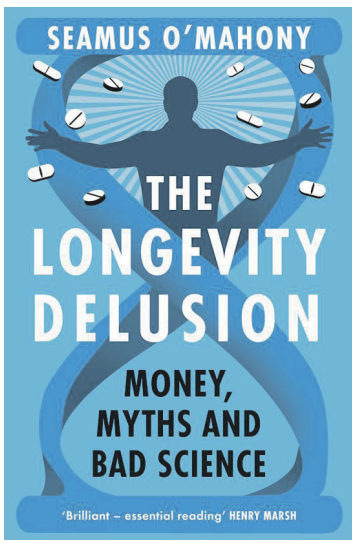
This extract is taken from The Longevity Delusion: Money, Myths, and Bad Science by Seamus O’Mahony, published by Apollo, an imprint of Bloomsbury Publishing.






Leave a Reply
You must be logged in to post a comment.