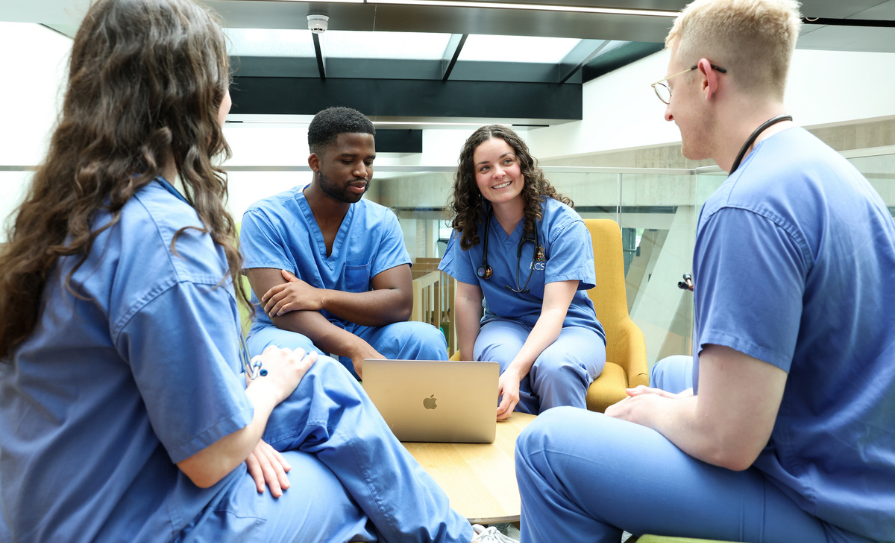
RCSI medical students at the RCSI’s Education and Research Centre, Connolly Hospital, Dublin
Photo: Maxwells
It is important to develop the personal and professional identity of doctors, alongside their clinical skills
Modern healthcare achieves extraordinary things. Every day, patients receive safe and effective care from their committed healthcare professionals. However, for some of them – and their families – the experience is less than satisfactory. Some even experience avoidable harm.
Evidence suggests that while clinical errors contribute to complaints against doctors, most complaints and litigation are influenced by failures in professionalism, communication, and moral judgement, rather than by technical error alone. Medical education must therefore shape who doctors become, not just what they know.
At the RCSI Centre for Professionalism in Medicine and Health Sciences, we work alongside colleagues in the Department of Health Psychology and School of Medicine to deliver a model of medical education that develops doctors’ personal and professional identity (PPId), alongside the clinical skills and knowledge their role demands.
PPId
PPId is not just an additional module for our medical students – rather, it forms one of the three key pillars of our medical education. The new RCSI Transforming Healthcare Education Programme medical curriculum provides equal importance to the development of knowledge (head), skills (hand), and personal and professional identity (heart). It recognises that excellent doctors need not only knowledge and skills, but also the personal and professional qualities essential to compassionate person-centred care.
PPId comprises three integrated strands which are woven into the curriculum: Professionalism, leadership, and resilience. PPId is about who a doctor is, not just what they know. At its core, it concerns improving patient safety and the quality of the patient’s experience, as well as professional behaviour and standards.
Medical education has historically been slow to move beyond knowledge and clinical skills. Throughout the 20th Century, a biomedical model dominated, and assessment both reflected and reinforced that narrow focus.
While many medical schools now acknowledge the importance of professionalism and wellbeing, these areas have frequently remained peripheral to the core curriculum. The RCSI has taken a different approach. Under its new curriculum, personal and professional identity development is deliberately embedded across all years of training and assessed longitudinally. Students are supported to integrate professional values with the realities of clinical practice from the very start of their medical education.
Lifelong process
Why does this matter? Because a well-formed personal and professional identity not only sustains doctors across long careers, but is also associated with behaviours such as empathy, integrity, effective communication, and ethical decision-making. All of these can influence patient trust and safety. Professional identity formation (PIF) is the lifelong process by which a person becomes a doctor, by integrating personal values with the ethical, professional, and social expectations of medicine.
The stakes of getting this right are high. In the Irish context, there have been numerous medical scandals in our recent history that have been widely understood as reflecting not simply system failures, but deeper failures of professionalism, ethical culture, accountability, and moral judgment. These are failures that modern concepts of PIF seek to address. At the RCSI, we understand the deep importance of our graduates having the skills to self-reflect, learn, and grow. This is why PPId is given significant weight within the curriculum.
In the context of medical education, PIF is about helping students to become a professional, to develop the empathy, self-awareness, leadership, communication, and resilience skills, which will support them to think, act and feel like a doctor. Of course, these are also universal values that could apply across many careers and disciplines; however, in medicine they carry particular weight because of the vulnerability of patients and the gravity of clinical decision-making.
Curriculum
How does this work in practice? Early in the programme, students are given a strong foundation through lectures and workshops on the fundamental principles of professionalism, leadership, and resilience. Students work through clinical scenarios in small groups, developing their understanding of communication, ethics, patient safety, and professionalism as interconnected elements of good practice. Professionalism workshops deepen this foundation by presenting real-world dilemmas centred on themes such as trust and consent, which students explore both independently and alongside faculty.
Simulation
As students progress into clinical training, learning becomes increasingly experiential. The RCSI is home to one of the most advanced medical simulation centres in Europe. Here, our students experience different simulated situations that require them to draw from their learning and demonstrate resilience and professionalism, including in tense situations of conflict. These experiences help students to rehearse professional responses in a psychologically safe setting, before they are required in real clinical context. We also deliver dedicated problem-solving workshops supporting this transition by grounding patient-centred care in four core principles: Compassion, accountability, respect, and excellence.
Open disclosure
Open disclosure is a critical area of learning for medical students. Being able to communicate honestly and compassionately with patients and families after adverse events is a core professional responsibility. In the final years of the programme, we co-deliver a workshop with a barrister-at-law. This learning activity deepens students’ understanding of their ethical obligations and of the legislative and policy frameworks governing open disclosure in Ireland, including the Patient Safety Act (2023) and the HSE’s revised open disclosure policy.
Death and dying
Another area embedded across the curriculum is education around death, dying, and bereavement. Despite advances in modern healthcare, not all conditions can be cured, yet supporting patients and families at the end of life is a fundamental part of medical practice. By addressing these topics longitudinally, the curriculum equips our students with the confidence and compassion required to engage with suffering, grief, and uncertainty.
Throughout all five years of the programme, personal and professional identity is assessed longitudinally through multiple methods and at regular time points, reflecting the developmental nature of PIF. Assessment is designed not simply to judge performance, but to support reflection, feedback, and growth.
Research
Importantly, this curriculum is underpinned by evidence-based research. We have demonstrated that professionalism, leadership and resilience are distinct yet interrelated contributors to PIF. Our systematic review on medical professionalism education has highlighted that education to enhance professional behaviours is essential to PIF and patient-centred care. We also have demonstrated the potential role of quantitative assessment to show progression in the areas of professionalism, resilience, leadership, and PIF.
Longitudinal evaluation of the curriculum has demonstrated a significant and progressive increase in PIF across the years of training, reflecting students’ transition from medical learners to doctors. Qualitative work around students’ perspectives of the curriculum and how it is evaluated is ongoing. By December 2026, we will have data for the full five years of the new curriculum, which will provide the most comprehensive longitudinal evidence yet of the impact of a structured personal and professional identity education.
The new curriculum at the RCSI gives due importance to PIF, supporting students not only to learn medicine, but to become doctors. Our aim of putting the heart back into healthcare education aligns well with the aspirations of the modern father of medical education, Sir William Osler, who said: “The practice of medicine is an art, not a trade; a calling, not a business; a calling in which your heart will be exercised equally with your head.”












Leave a Reply
You must be logged in to post a comment.