







KEY POINTS:
- RDN lowers blood pressure in blinded, sham-controlled trials, but the 24-hour effect is modest and of the order of 4-6mmHg systolic
- It works through a unique mechanism no drug targets (renal sympathetic signalling), is ‘always on’ regardless of adherence, and has a reassuring safety profile, including preserved renal function
- Response varies widely between patients and cardiovascular-outcome data are still awaited: RDN is an adjunct, not a cure or a substitute for drug therapy
- ESH (2023), ESC (2024), and AHA/ACC (2025) now broadly agree – consider RDN in carefully selected patients with resistant or uncontrolled hypertension, drug intolerance, or a preference against polypharmacy, with an eGFR ≥40, through shared decision-making
Few cardiovascular interventions have had a career as turbulent as renal denervation (RDN). Hailed in 2010 as a cure for resistant hypertension, the field was abruptly halted in 2014 when the sham-controlled SYMPLICITY HTN-3 trial missed its primary endpoint. What followed was not closure, but recalibration: A second generation of blinded, sham-controlled trials, Food and Drug Administration (FDA) approval of the Medtronic Symplicity Spyral (radiofrequency) and Recor Paradise (ultrasound) systems in November 2023, and a place – albeit a cautious one – in the 2023 European Society of Hypertension (ESH), 2024 European Society of Cardiology (ESC), and 2025 American Heart Association/American College of Cardiology (AHA/ACC) hypertension guidelines. By 2026, the ACC had described the therapy’s path as one “from controversy to comeback”.
The technology now sits at an unusual crossroads, defended and disputed in roughly equal measure by clinicians. Two broad positions have crystallised in the literature. One holds that RDN has matured into a legitimate third pillar of resistant-hypertension management, alongside lifestyle change and drugs. The other holds that its sham-verified effect is too small, too unpredictable, and too unproven on hard outcomes to justify the enthusiasm. Both deserve to be set out in their strongest forms, because the gap between them is narrower than the rhetoric suggests.
The case for RDN
The proponents’ argument begins not with the device, but with the failure it is meant to address. Hypertension remains the single largest modifiable contributor to global mortality, yet control rates are dismal. Observational data show blood pressure inadequately controlled in roughly 69 per cent of treated US patients and 74 per cent of UK patients, with therapeutic inertia meaning a year or more typically passes before treatment is intensified. Even where medication is prescribed correctly, between 17 and 44 per cent of patients with apparently resistant hypertension are partially or completely non-adherent on biochemical testing, and many simply cannot tolerate polypharmacy. Single-pill combinations, the supposed solution, achieve control in only around two-thirds of patients. Antihypertensive medications also have pharmacological limits that are easy to forget as trough to peak ratios for many agents fall short of true 24-hour cover.
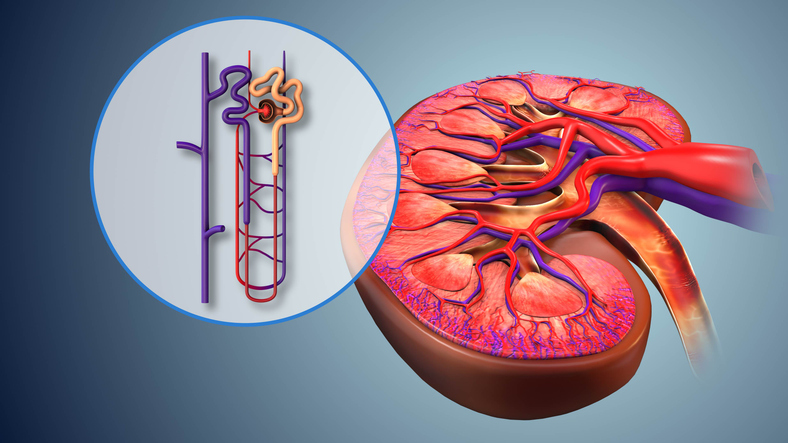
Against this backdrop, RDN offers something genuinely different: A mechanism no drug targets. By interrupting renal afferent and efferent sympathetic signalling, denervation reduces renin secretion, promotes sodium excretion, and increases renal blood flow – addressing the sympathetic-activation node of Page’s mosaic of hypertension directly. Crucially, the proponents argue, the effect is ‘always on’ – independent of adherence, present overnight, and through the early-morning surge.
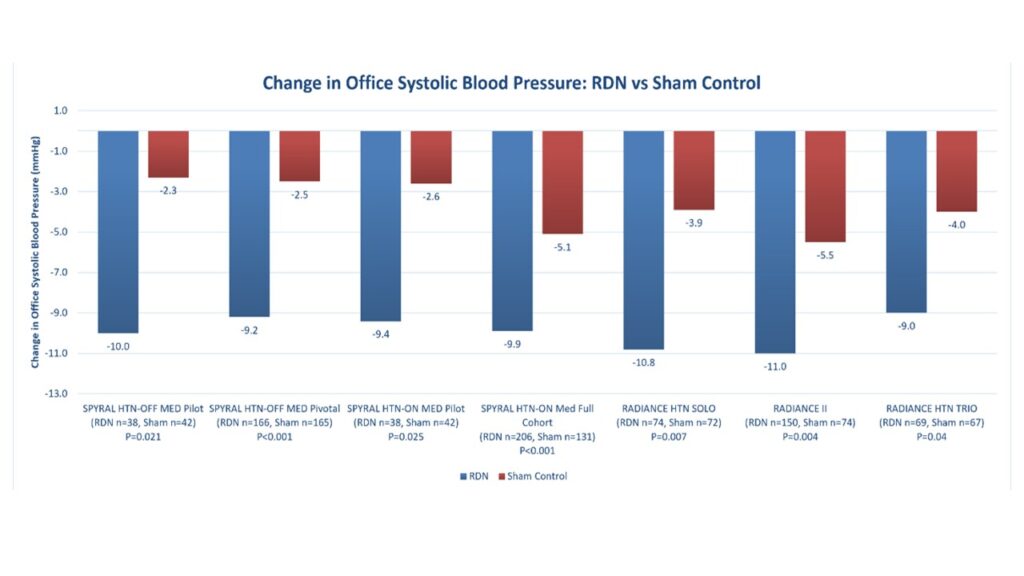
The second-generation sham-controlled trials are the backbone of the pro case. Across the SPYRAL HTN-OFF MED, SPYRAL HTN-ON MED, and RADIANCE (SOLO, II, and TRIO) programmes, office systolic reductions of roughly 9 to 11mmHg were seen in the RDN arms, all reaching statistical significance against sham (Figure 1).
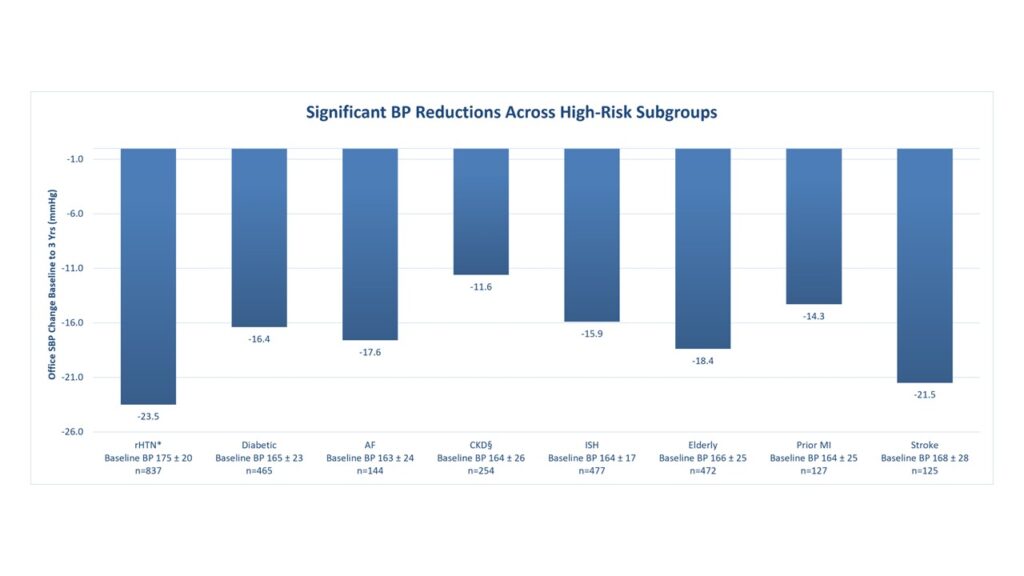
Pooled and registry data suggest the effect is durable and may even deepen with time: A 2025 meta-analysis of 18 studies (2,212 patients, mean follow-up 4.4 years) reported office systolic reductions of 23mmHg and 24-hour ambulatory reductions of around 14mmHg. The most recent SPYRAL HTN-ON MED three-year results reinforce this, with a sustained office systolic reduction of 18.5mmHg with RDN versus 11.7mmHg with sham – a treatment difference of 6.8mmHg – and roughly twice as many RDN patients reaching a 24-hour systolic below 140mmHg.
The benefit appears to extend across phenotypes – diabetes, atrial fibrillation, chronic kidney disease, isolated systolic hypertension, the elderly, and patients with prior myocardial infarction or stroke (Figure 2). The safety record is reassuring: Renal artery re-intervention runs at about 0.2 per cent per year, two meta-analyses show no meaningful change in estimated glomerular filtration rate (eGFR), and no renal artery stenosis or need for reintervention has been observed through three years in recent pooled analyses, which also reported a 43 per cent reduction in acute hypertensive events. For its advocates, the conclusion is straightforward: RDN fulfils an unmet need, patients want options beyond lifelong tablets, and the guidelines have now set the stage.
The case against – or at least, for caution
The sceptics do not dispute that RDN lowers blood pressure. Their objection is about how much, in whom, and whether it matters for outcomes – and about the distance between the trial data and the marketing.
The starting point is the number itself. Industry materials and tertiary-centre patient leaflets cite reductions of 9, 17, even up to 40mmHg, alongside testimonials of liberation from medication. These findings are largely within outlier groups, the sham effect, and improved adherence. The honest, sham-subtracted, ambulatory effect is far smaller.
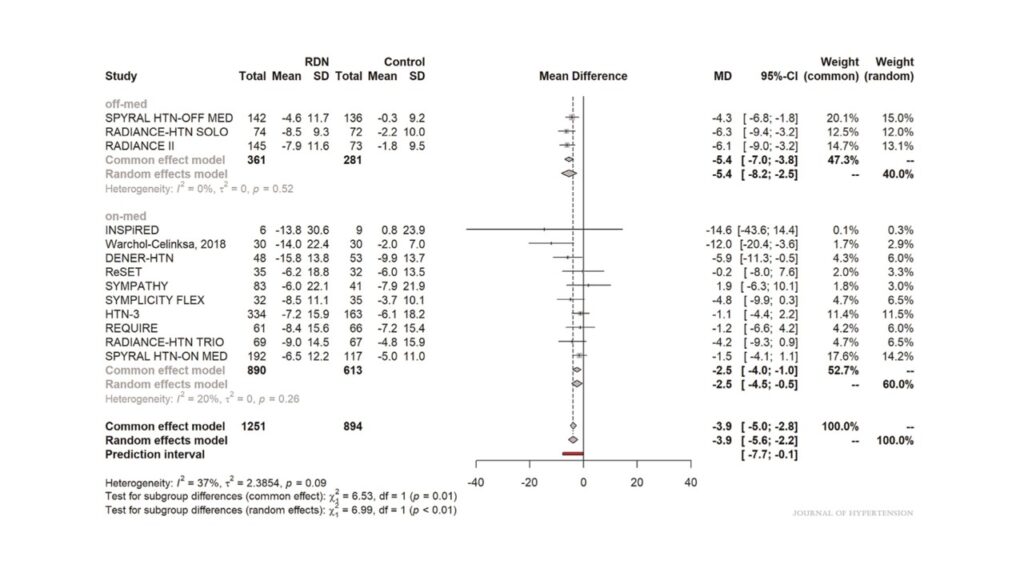
An industry-commissioned meta-analysis in 2024 estimated a mean 24-hour systolic reduction of just 3.6mmHg (95% CI -5.2 to -2.0) over control (Figure 3). A 2024 mixed-treatment comparison put the ambulatory advantage over sham at around 2.3mmHg for radiofrequency and 4.7mmHg for ultrasound denervation. The 2025 AHA/ACC guideline text captures the heterogeneity bluntly: Some trials show a small but significant 3 to 5mmHg ambulatory reduction over sham, while others failed to reach their primary endpoint.
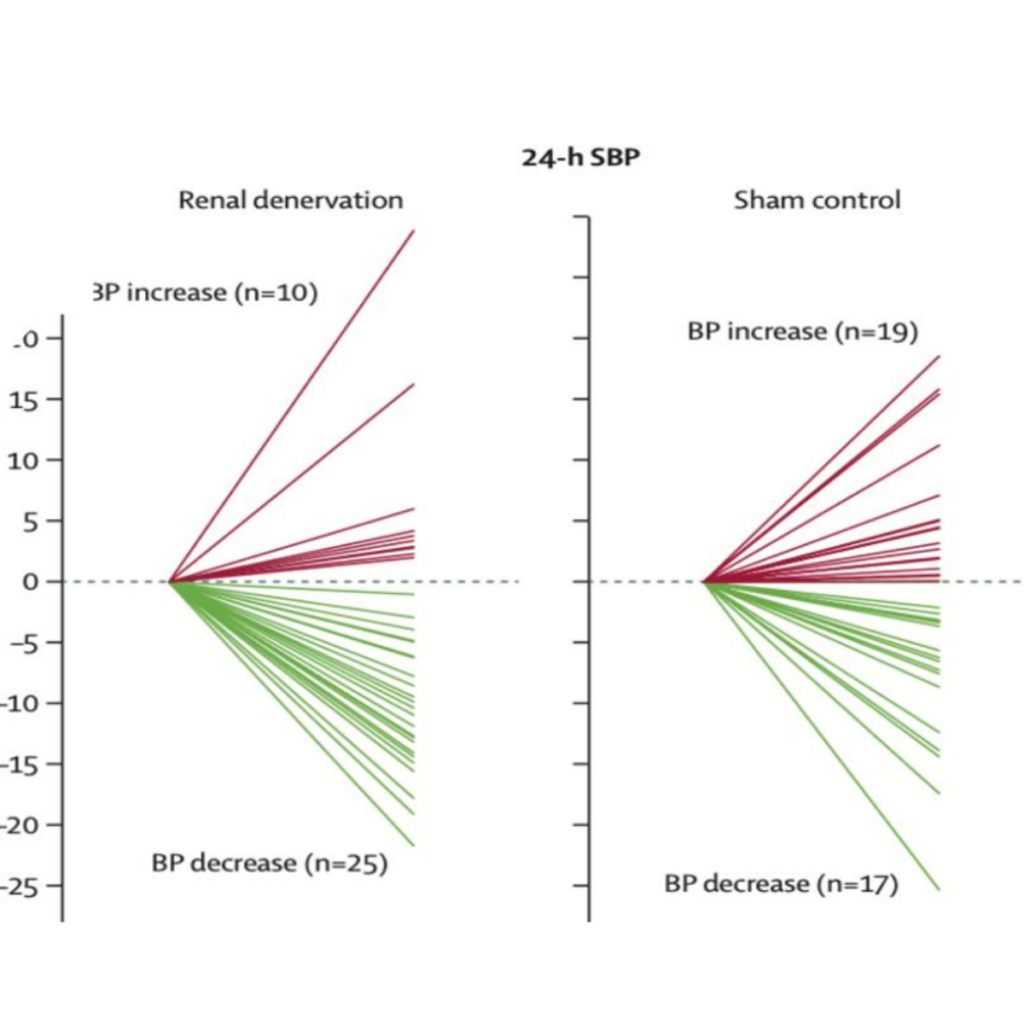
Based on the evidence, the sceptics argue the device is sold on the large number while it earns its evidence on the small one. They also flag the response heterogeneity laid bare by the SPYRAL HTN-OFF MED response plot, in which a small number of denervated patients saw blood pressure rise rather than fall, with the distributions in the RDN and sham arms overlapping considerably (Figure 4).
An AHA scientific statement in 2024 reached a similar conclusion: Efficacy is modest, individual responses vary, and further work is needed to identify who benefits most. As Sir George Pickering observed of surgical sympathectomy in 1962, the chief difficulty was that there was no reliable way to determine in advance those in whom the operation would succeed from those in whom it would fail. As this similarly is a permanent, catheter-based procedure that cannot be reversed or titrated, more is needed to determine the patients who may benefit.
Two deeper concerns complete the sceptic’s brief. First, RDN trials are powered on blood pressure, a surrogate, not on cardiovascular events; outcome-driven data remain awaited, and whether a 3 to 6mmHg ambulatory difference translates into fewer strokes and deaths is, for now, an inference rather than a demonstration. Second, the financial stakes are large, and enthusiasm for a novel, high-technology procedure can outrun the evidence – what one 2025 editorial, borrowing from Oppenheimer, called “gizmo idolatry”. The same unease was voiced at the device’s FDA panel in August 2023, when the advisory committee chair said he could not honestly tell patients that the benefit outweighed the risk for the population at large.
And yet – the part most often lost in the caricature – the sceptics do not call for abandonment. The 2025 editorial, despite its provocative title, answers its own question in the affirmative: Yes, there is a role, particularly for genuinely refractory, ‘end-of-the-rope’ hypertension driven by demonstrable sympathetic overactivity. It is the same position reached in a 2014 editorial: Time to turn the page, but not to close the book.
Reconciling the two numbers
Much of the apparent disagreement dissolves once the metrics are separated. Large within-patient office reductions and small between-group ambulatory reductions are both real; they simply measure different things. Sham-controlled, 24-hour ambulatory monitoring – the most rigorous yardstick – converges on a treatment effect of roughly 4 to 6mmHg systolic. That is modest at the individual level but, applied consistently and continuously across a population at the steep part of the risk curve, is not trivial. A recent cross-guideline analysis makes the point that the modest mean reduction of 4-6mmHg, while clinically meaningful at the population level, is accompanied by substantial inter-individual variability, reinforcing the need for realistic expectations and individualised counselling.
The durability question is similarly nuanced. Registry signals of a deepening effect over time are encouraging, but come from observational data vulnerable to selection and survivorship effects; the randomised follow-ups are more measured, but still favourable and, importantly, reassuring on renal safety.
Sham-controlled 24-hour monitoring converges on roughly 4 to 6mmHg – modest for one patient, not trivial across a population
Where consensus is heading
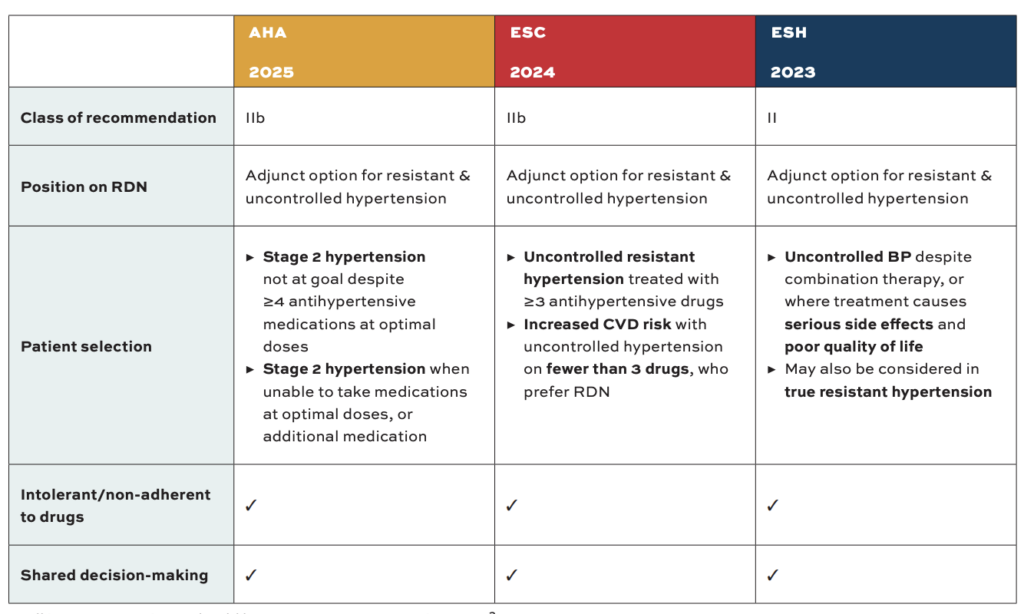
For all the heat, the guideline bodies have landed in remarkably similar territory. The 2023 ESH, 2024 ESC and 2025 AHA/ACC documents all position RDN as an adjunctive option – not a replacement for lifestyle change or medication. They suggest a role in carefully selected patients with uncontrolled or true resistant hypertension, drug intolerance, or a strong preference against lifelong polypharmacy, with a preserved eGFR (generally ≥40mL/min/1.73m²) and decisions reached through shared, multidisciplinary deliberation (Figure 5). The AHA/ACC recommendation carries a Class 2b designation, sitting alongside the European Class IIb/II positions. As the cross-guideline review concluded, although the recommendation-class nomenclature differs, the underlying clinical message is largely concordant: RDN may be considered in carefully selected patients after thorough evaluation.
The trajectory, then, is neither vindication nor rejection, but a settling into a defined and relatively narrow lane. Three questions will determine how wide that lane becomes. Can responders be identified prospectively – the very problem named seven decades ago – so the procedure is offered to those most likely to benefit rather than to all comers? Will cardiovascular outcome data, when they arrive, confirm that the surrogate translates into events prevented? And can the procedure be delivered cost-effectively enough to justify its place against simply adding another well-tolerated, long-acting drug?
Until those answers are in, the pragmatic synthesis for the practising specialist is this: RDN is a real, durable, ‘always-on’ blood-pressure-lowering tool with a modest, sham-verified effect. It is not a cure, not a substitute for optimised pharmacotherapy, and not for everyone. For the adherent patient whose pressure remains resistant on optimal combination therapy, the patient who cannot tolerate the drugs, or the one who – fully informed of the realistic expected benefit – would rather a one-time procedure than a lifetime of tablets, it has earned a seat at the table.
BOX 1 · WHO TO CONSIDER FOR RDN
An adjunct to lifestyle change and optimised drug therapy – never a replacement for them.
Consider referral when:
- True resistant or uncontrolled hypertension persists despite optimal, adherent combination therapy – ideally confirmed on ambulatory (24-hour) monitoring
- The patient is intolerant of antihypertensive drugs, or suffers disabling side effects from them
- There is a strong, informed patient preference against lifelong polypharmacy
- Renal function is preserved: eGFR ≥40mL/min/1.73m².
- AHA/ACC framing: Carefully selected patients with office SBP 140–180mmHg and DBP ≥90mmHg
Before referral:
- Confirm adherence and exclude or treat secondary causes – including primary aldosteronism
- Decide jointly, in a multidisciplinary setting, and set realistic expectations: The mean sham-adjusted fall is about 4–6mmHg, with wide individual variation
Use caution/less suitable:
- eGFR <40mL/min/1.73m², isolated systolic hypertension, untreated secondary hypertension, or expectations of a cure or of stopping all medication
References available on request








Leave a Reply
You must be logged in to post a comment.