



Reference: August 2026 | Issue 8 | Vol 12 | Page 41
In May of this year, the European Hematology Association (EHA) produced its first guideline for the management of chronic lymphocytic leukaemia (CLL). Previous editions of the European guidelines for the management of CLL were developed under the auspices of the European Society for Medical Oncology (ESMO).
In agreement with ESMO, the new 2026 edition has been developed by the EHA. The EHA will be solely responsible for subsequent editions, which will be published annually to keep pace with the fast-moving field of CLL research and clinical applications.
The new guidelines support approaching the management of CLL in a more holistic fashion, from initial diagnosis and active surveillance to treatment need and possible Richter transformation, which is now specifically mentioned in the title of the guidelines.
Updated recommendations address a range of matters, including the recently European Medicines Agency approved, time-limited combination of acalabrutinib and venetoclax ± obinutuzumab as first-line treatment, and continuous pirtobrutinib for patients exposed to a covalent Bruton’s tyrosine kinase inhibitor (BTKi) in the relapsed/refractory setting.
Diagnosis
The new guideline defines CLL by the presence of ≥5 × 10⁹/L clonal B lymphocytes that are positive for CD19, CD5, and CD23. CLL cells typically express low levels of CD20, CD79B, and surface immunoglobulin, with either κ or λ immunoglobulin light-chain restriction or (apparent) absence at flow analysis. Additional phenotyping (CD43, CD200, ROR1) may assist in differential diagnosis from other clonal B-lymphoproliferations.
Small lymphocytic lymphoma (SLL) is characterised by <5×10⁹/L clonal B cells and presents with involvement of secondary lymphoid tissues.
Monoclonal B cell lymphocytosis (MBL) is characterised by the presence of circulating monoclonal B cells with a CLL phenotype, but at a concentration lower than in CLL, and without cytopenias, secondary lymphadenopathy or B symptoms. The guideline classifies MBL into two subtypes: CLL/SLL-type MBL (previously known as high-count MBL) with counts ranging from <5×10⁹/L to ≥0.5×10⁹/L; and low-count CLL-type MBL defined as counts <0.5×10⁹/L. CLL/SLL-type MBL may evolve into CLL requiring therapy, whereas low count MBL is not associated with overt CLL. See Table 1.
The guideline recommends that both del(17p) and TP53 gene mutations should be assessed before each line of treatment. Fluorescent in-situ hybridisation (FISH) is recommended for detecting del(17p), while next-generation sequencing (NGS) is the preferred method for detectingTP53 mutations.
Due to limited reproducibility, assessment of complex karyotype (CK) is not recommended before treatment initiation outside clinical trials. High CK has emerged as an independent prognostic factor for inferior progression-free survival (PFS) in patients with wild-type TP53 treated with venetoclax-based combinations. However, the available evidence is still not robust enough to allow for recommendation.
Treatment
The need for treatment of CLL is defined by the International Workshop on CLL (IWCLL) guidelines.
According to IWCLL 2018, at least one of the following criteria should be met:
1. Anaemia (haemoglobin [Hb] <100g/L) and/or thrombocytopenia (platelets <100G/L). In some patients, platelet counts <100G/L may remain stable over a long period and do not automatically require treatment.
2. Lymph nodes >10cm in longest diameter or progressive/symptomatic lymphadenopathy.
3. Progressive or symptomatic splenomegaly (>6cm below the left costal margin).
4. An increase of >50 per cent in lymphocytosis over two months or lymphocyte doubling time (LDT) less then six months.
5. Autoimmune complications including anaemia or thrombocytopenia poorly responsive to corticosteroids.
6. Symptomatic or functional extranodal involvement.
7. Disease-related symptoms:
- a. Unintentional weight loss >10 per cent in the previous six months.
- b. Significant fatigue (ECOG ≥2).
- c. Fever >100.5°F/38.0°C for ≥two weeks without evidence of infection.
- d. Night sweats for >one month without evidence of infection.
| Disease entity/subtype | Clonal B lymphocytes in peripheral blood | Lymph nodes or splenomegaly or hepatomegaly |
|---|---|---|
| CLL | ≥5×10⁹/L | No/Yes (possible for Binet Stage A) |
| SLL | <5×10⁹/L | Yes |
| MBL: CLL/SLL-type (High-count) | <5×10⁹/L but <5×10⁹/L | No |
| MBL: Low-count | <5×10⁹/L | No |
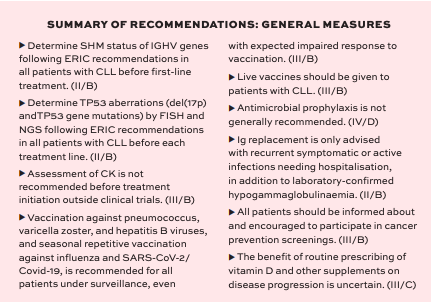
See Panel 1 for a summary of key recommendations on the general management of patients with CLL.
The 2026 EHA guidelines explicitly decouple first-line therapy choices from a patient’s age or clinical fitness status. Instead, biological traits, specifically del(17p) and TP53 mutations, serve as the absolute drivers of clinical decision-making.
Continuous administration of a second-generation covalent Bruton tyrosine kinase inhibitor (cBTKi) holds the highest level of clinical evidence for patients harbouring mutations. Acalabrutinib is recommended as a preferred continuous monotherapy due to lower rates of cardiotoxicity compared to first-generation options.
Backed by strong progression-free survival (PFS) data in high-risk subgroups, zanubrutinib is highly recommended due to superior target occupancy and a favourable safety profile. The guidelines have downgraded ibrutinib. While highly effective, its severe toxicity profile means it is no longer recommended if second-generation
BTKis are accessible.
While continuous BTK inhibition is the benchmark, the guidelines allow for shared decision-making using fixed-duration, chemo-free targeted combinations to offer patients a treatment-free interval. However, clinicians must apply distinct caveats to this population. Twelve-month fixed duration venetoclax + obinutuzumab (Ven-O) is an acceptable alternative.
However, the guidelines explicitly note that patients with TP53 abnormalities exhibit a significantly shorter durable long-term remissions on time-limited BCL-2 therapy compared to patients with wild-type TP53. Targeted triplet regimens combining acalabrutinib + venetoclax + obinutuzumab are noted for deep response profiles. The guidelines specify that if a fixed-duration BCL-2/BTKi combination is chosen for a del(17p) patient, it should include the anti-CD20 monoclonal antibody obinutuzumab to maximise clonal clearance.
Chemoimmunotherapy (CIT) regimens like fludarabine, cyclophosphamide, rituximab (FCR) or bendamustine + rituximab (BR) are strictly contraindicated for patients with TP53 dysfunction. CIT fails to clear TP53-mutated cells, selectively kills benign clones, accelerates clonal dominance of the mutation, and exposes the patient to severe cytopenias and secondary malignancies without therapeutic benefit.
Twelve-months fixed-duration Ven-O is preferred over continuous BTK inhibitors as first-line treatment for patients with mutated IGHV lacking del(17p) or TP53 mutations. Second-line options include a second-generation covalent BTK inhibitor (acalabrutinib or zanubrutinib) or retreatment with venetoclax. Third-line management centres on non-covalent BTK BTKi (ncBTK) specifically using pirtobrutinib to overcome resistance.
For patients without del(17p) or TP53 mutations but with unmutated IGHV, recommended first-line treatment is fixed duration doublet/triplet or continuous second generation BTKi, such as acalabrutinib + venetoclax (± obinutuzumab), venetoclax + obinutuzumab, continuous zanubrutinib or acalabrutinib. In the second line setting, continuous zanubrutinib or acalabrutinib is recommended for patients who received fixed-duration BCL-2i as first-line treatment. If first-line treatment was continuous BTKi, use venetoclax + rituximab.
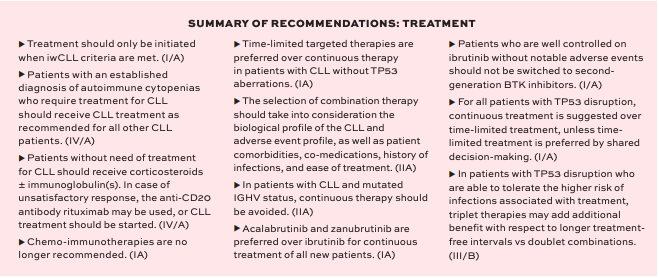
See Panel 2 for a summary of key recommendations on the treatment of CLL.
Relapse/refractory disease
Patients who relapse after CIT should not be re-treated with chemotherapy if targeted therapies are available. Venetoclax + rituximab or a second-generation cBTKi such as acalabrutinib
or zanubrutinib are preferred.
Patients with disease progression following treatment with cBTKi should not be exposed to another cBTKi but switched to a venetoclax-based regimen or to the ncBTKi pirtobrutinib. Patients stopping cBTKi due to adverse events and then relapsing after a period of observation may be re-treated with the same or another cBTKi, or with a ncBTK plus a cBTKi.
Re-treatment with a venetoclax-based regimen, especially venetoclax +rituximab, is feasible in selected patients who have had a durable prior response. Re-treatment is more effective when the prior treatment-free interval exceeds two years, whereas early relapse warrants switching drug class. Alternatively, cBTKi therapy is appropriate in the relapse setting after time-limited treatment venetoclax, if not previously used, otherwise ncBTKi becomes the preferred option.
Patients who have previously received both BTK and BCL-2 inhibitors but have discontinued either as planned or for adverse events. In this subgroup of patients, discontinuation is not due to progression, and patients can be re-exposed to either class of drugs as a combination of the two drug classes is off-label in this setting.
Double-refractory patients who have disease progression following treatment with both BTK and BCL-2 inhibitors represent a high-risk group for which the ncBTKi pirtobrutinib is the preferred treatment option. In cases where access is not possible, idelalisib + rituximab can also be used.
Patients who have received both BTK and BCL-2 inhibitors but are refractory to only one of the classes
can be re-exposed to the class they are not refractory to or may switch to ncBTKi pirtobrutinib.
Allogeneic stem cell transplantation (alloSCT) should be considered for patients who are double-refractory, using pirtobrutinib or idelalisib + rituximab as a bridge to achieve maximal disease control before transplantation.
Consideration for inclusion in clinical trials of novel agents, such has BTK degraders, bispecific antibodies, and CAR T-cell therapy, is strongly recommended in patients who are double-refractory.
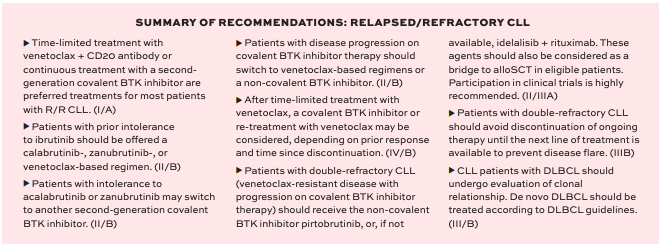
See Panel 3 for a summary of key recommendations for the management of relapsed/refractory CLL.
Richter transformation
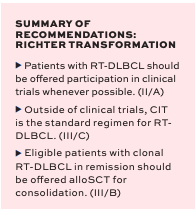
Richter transformation (RT) occurs in 2 per cent to 10 per cent of patients with CLL. The most common histologic subtype is diffuse large B cell lymphoma (RT-DLBCL), although it can also present as classical Hodgkin lymphoma (RT-cHL).
The clonal relationship between RT and the underlying CLL by IGHV-IGHD-IGHJ gene sequencing is recommended. Assessment for del(17p)/TP53 aberrations is also advised. Patients with clonally-unrelated RT-DLBCL should be treated as de novo DLBCL. No standard therapy has been defined for clonally related disease, and clinical trials should be the preferred option. RT-cHL should be treated per cHL guidelines.
When the clonal relation is not established, CIT regimens generally used for de novo DLBCL are the default options in RT-DLBCL, but these have demonstrated limited efficacy. Therefore, enrolling patients in clinical trials is the preferred option. Haematopoietic stem cell transplantation should be considered in eligible patients with clonally related RT-DLBCL and satisfactory response.
See Panel 4 for a summary of key recommendations on the management of RT.
Reference:
Eichhorst B, Ghia P, Bosch F, et al. EHA guidelines on management of chronic lymphocytic leukemia and Richter transformation. Hemasphere. 2026 Jun 10;10(6):e70403. doi: 10.1002/hem3.70403.