Reference: September 2026 | Issue 9 | Vol 12 | Page 26
Gastric cancer remains a major global health challenge, with an estimated 970,000 individuals diagnosed with the disease in 2022 and almost 660,000 deaths attributed to the disease.1 Despite this substantial burden and considerable potential for prevention, gastric cancer has been previously described as a relatively neglected cancer, receiving limited attention and investment in prevention, research, and public health initiatives.2
Its burden is expected to increase considerably over the coming decades as populations continue to age. Current projections suggest that the annual number of gastric cancer cases could reach approximately 1.8 million by 2050, while deaths may rise to around 1.3 million.3
Local epidemiology
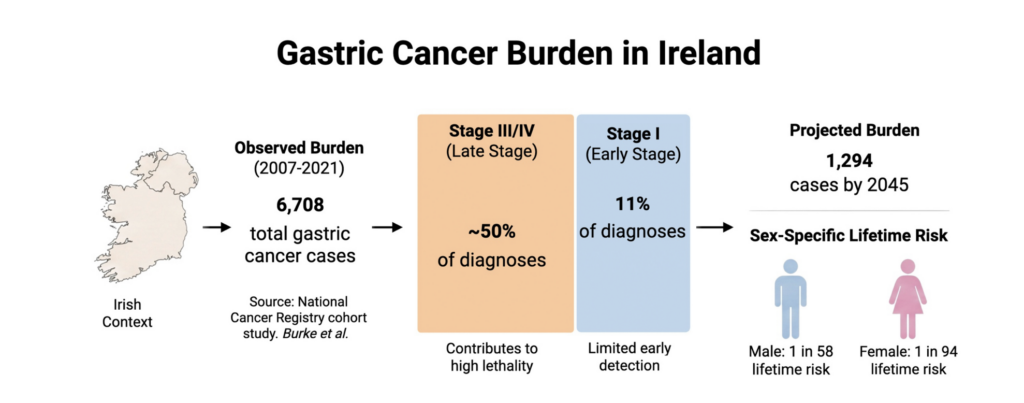
Analysis of National Cancer Registry Ireland (NCRI) data has demonstrated a persistent burden of gastric cancer nationally, with 6,708 cases recorded between 2007 and 2021, corresponding to an average of approximately 447 new diagnoses annually.4
Furthermore, the NCRI has projected a significantly increased annual case load of 1,294 gastric cancer cases by 2045.5 It is worth nothing that stomach cancer is a particularly lethal cancer, with almost 50 per cent of cases in Ireland diagnosed at stage III or stage IV and only 11 per cent diagnosed at stage I.
National gastric cancer screening programmes are well established in both Japan and South Korea for over 20 years and have proven to be highly effective in reducing mortality, likely due to earlier diagnosis.6,7

Stomach cancer has a preponderance for males, with a cumulative lifetime risk of diagnosis standing at one in 58 for males compared to one in 94 for females.8 This corresponds to a mortality rate of 5.4 and 12.1 deaths per 100,000 per year for women and men, respectively. Other risk factors for gastric cancer include low socioeconomic status, smoking, and high salt intake.9
A substantial proportion of this burden may be preventable. Infection with Helicobacter pylori (H pylori) is the most common cause of non-cardia gastric cancer, accounting for an estimated 75-90 per cent of cases, and treatment of infection can negate the risk.10,11 Emerging evidence indicates that this proportion may actually underestimate the true contribution of the infection. If lifetime exposure to H pylori could be measured with complete accuracy, the proportion of non-cardia gastric cancers attributable to the organism may approach close to 100 per cent.3
Among all carcinogenic infections, H pylori is associated with the greatest number of attributable cancer cases globally. It is estimated to contribute to approximately 850,000 cancer cases worldwide, exceeding the estimated burden attributed to human papillomavirus (approximately 730,000 cases) and to hepatitis B and C viruses combined (approximately 550,000 cases).3
It is notable that, in Ireland, screening for viral hepatitis is undertaken in specific populations, including universal hepatitis B screening during pregnancy and targeted testing for individuals at increased risk. In contrast, no comparable organised screening programme currently exists for H pylori. The continuing burden of gastric cancer is therefore particularly concerning, given that its principal infectious cause can be identified and treated.
Carcinogenesis
Long-term infection with H pylori induces chronic inflammation of the gastric mucosa, which may remain asymptomatic for prolonged periods. If infection is not detected and treated, persistent inflammation can result in progressive gastric mucosal damage, including the development of atrophic gastritis and intestinal metaplasia. These pre-neoplastic changes may subsequently progress to dysplasia and, ultimately, gastric cancer.12-15
The gastric carcinogenesis cascade, first described in 1992, illustrates the sequential progression from normal gastric mucosa to invasive carcinoma.16 Following H pylori infection, superficial gastritis develops initially and may progress to chronic inflammation over several years.
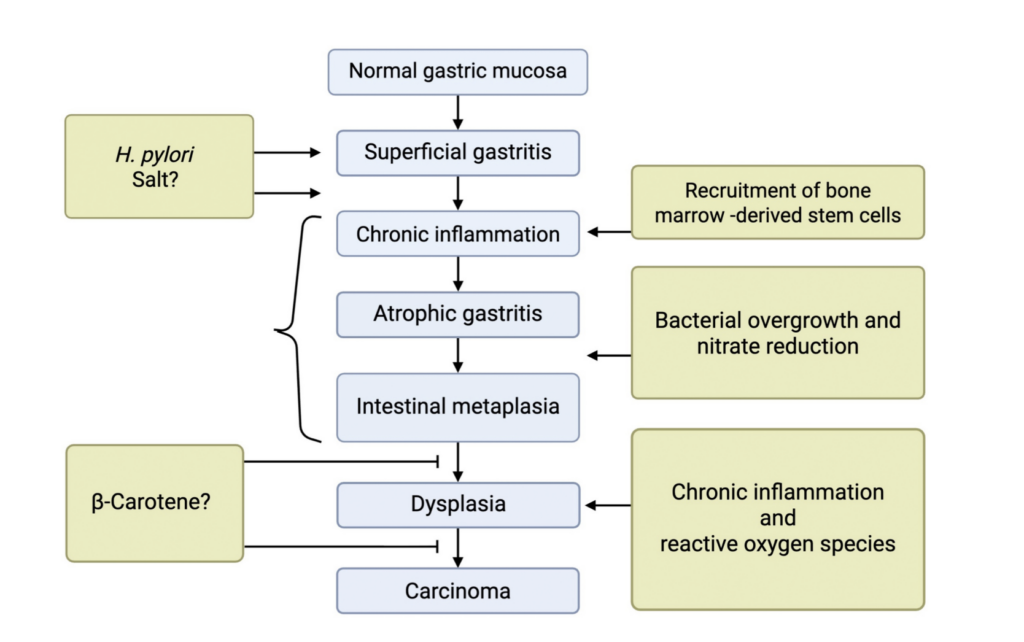
Continued inflammatory damage can lead to atrophic gastritis, characterised by the loss of gastric glandular cells and associated changes in the gastric environment, including an increase in gastric pH. These alterations can facilitate the development of intestinal metaplasia, which may subsequently progress through dysplasia to invasive gastric carcinoma.
The sequential nature of this carcinogenic process provides several potential opportunities for intervention; (i) identification and eradication of H pylori before the development of irreversible precancerous changes may prevent progression along the carcinogenesis cascade, while (ii) surveillance and treatment of individuals with established gastric precancerous lesions provides additional opportunities to reduce incidence of gastric cancer.
Endoscopic techniques for the diagnosis and treatment of gastric dysplasia and early gastric cancer have advanced considerably over recent decades. These developments further emphasise the importance of early detection of gastric pre-neoplastic lesions and early-stage malignancy, as identification of neoplasia at an early stage may allow for potentially curative endoscopic treatment and avoidance of more invasive surgical procedures, including partial or total gastrectomy.
While gastric pre-neoplastic conditions, such as atrophic gastritis and intestinal metaplasia, are primarily managed through risk stratification, H pylori eradication and endoscopic surveillance, visible dysplastic lesions and appropriately selected early gastric cancers may be amenable to endoscopic resection.
Endoscopic mucosal resection (EMR) and, increasingly, endoscopic submucosal dissection (ESD) have transformed the management of selected superficial gastric neoplastic lesions. These techniques can facilitate minimally invasive and, in appropriately selected cases, curative en bloc or complete resection, while preserving the stomach and avoiding the morbidity associated with major surgery.
ESD, in particular, enables en bloc resection of larger lesions and allows for more accurate histopathological assessment of resection margins and depth of invasion. Consequently, advances in endoscopic imaging, lesion characterisation, and therapeutic endoscopy have increased the potential benefits of detecting gastric neoplasia at an earlier and potentially curable stage. In appropriately selected patients, these procedures may be performed on an ambulatory or day-case basis, further reducing the burden associated with surgical management.17-19
Additionally, there is ongoing research into the use of non-invasive serum biomarkers for the identification of individuals at increased risk of gastric cancer, including serum pepsinogen I and II and H pylori antibodies. Pepsinogen levels, particularly a reduced pepsinogen I concentration or a low pepsinogen I/II ratio, can reflect gastric mucosal atrophy, an important pre-neoplastic stage in the Correa cascade of gastric carcinogenesis.
When combined with H pylori serology, these markers may provide a means of identifying individuals with an increased risk of gastric cancer without initially requiring invasive endoscopy. These approaches could potentially facilitate risk stratification within the population, allowing individuals at higher risk to be prioritised for diagnostic endoscopy and subsequent surveillance, while reducing unnecessary endoscopic procedures in those at lower risk.20
Gastric cancer screening
Approaches to reducing the burden of gastric cancer can broadly be considered within the framework of primary and secondary prevention.
Primary prevention aims to prevent the development of gastric cancer before pre-cancerous changes occur and is centred largely on the detection and eradication of H pylori. This approach, commonly referred to as a ‘screen and treat’ strategy, involves identifying individuals with H pylori infection using methods such as serological testing, stool antigen testing, or the urea breath test, followed by appropriate eradication therapy for those who test positive.
From a prevention perspective, identifying and treating infection earlier in life, ideally before the development of irreversible gastric mucosal changes, offers the greatest potential to interrupt the gastric carcinogenesis pathway.
Secondary prevention, in contrast, focuses on identifying individuals who have already developed precancerous lesions and on preventing these lesions from progressing to invasive cancer. This includes the detection, assessment, and surveillance of pre-neoplastic conditions such as atrophic gastritis and intestinal metaplasia.
Endoscopic assessment plays an important role in this setting, allowing abnormal gastric mucosa to be identified and biopsied where appropriate. Depending on the extent and severity of the lesions, individuals may subsequently enter surveillance programmes aimed at detecting early malignant transformation, when treatment is more likely to be successful.
Despite the potential for both primary and secondary prevention strategies to reduce gastric cancer incidence and mortality, Ireland does not currently have a national population-based screening programme for gastric cancer. H pylori testing is predominantly undertaken in the context of clinical assessment, particularly among individuals presenting with gastrointestinal symptoms or other recognised risk factors.
Consequently, individuals with asymptomatic infection may remain undiagnosed and untreated, potentially allowing the progression of gastric mucosal damage over many years. This represents an important consideration given the historically poor outcomes associated with gastric cancer. In 2015, five-year relative survival for gastric cancer in Ireland and the United Kingdom was estimated at approximately 17 per cent, the lowest reported survival among European countries at that time.21,22
The absence of a population-based approach in Ireland should also be considered within the wider European context, where the potential benefits, feasibility and cost-effectiveness of gastric cancer screening and H pylori eradication strategies are being actively investigated.
The European Commission’s Europe’s Beating Cancer Plan, launched in 2021, provides a comprehensive framework for cancer prevention and control across the European Union and has supported a number of large-scale initiatives examining strategies for gastric cancer prevention and early detection.23,24 These include studies evaluating the feasibility of H. pylori screening and eradication, as well as approaches to identifying individuals at increased risk who may benefit from endoscopic assessment and surveillance.
Evidence generated through these initiatives will be important in determining whether targeted or population-based strategies can be effectively, feasibly, and cost-effectively implemented within European healthcare systems and may help inform future approaches to gastric cancer prevention in Ireland.25
One of the major European initiatives addressing this question is the TOwards GAStric Cancer Screening Implementation (TOGAS) study, an EU-funded research programme established to investigate how gastric cancer screening could be implemented across Europe. The study incorporated three pilot projects examining different aspects of gastric cancer prevention and screening, including approaches to identifying individuals at increased risk and evaluating the feasibility of screening strategies within participating countries.
Ireland has played a significant role in the TOGAS programme, with substantial involvement in both pilot 1 and pilot 2.26 The findings from this work are expected to contribute to the development of evidence-based recommendations regarding the potential implementation of gastric cancer screening and H pylori eradication strategies across Europe.
For Ireland, these developments are particularly relevant given the potential opportunity to shift from a predominantly symptom-driven model towards a more proactive approach to prevention. Earlier identification and eradication of H pylori, combined with appropriate identification and surveillance of individuals with gastric precancerous lesions, could provide complementary opportunities to reduce the future burden of gastric cancer.
However, the optimal strategy for the Irish population will need to take account of disease prevalence, population risk, healthcare resources, diagnostic capacity, cost-effectiveness, and the potential benefits and harms associated with screening.
References
- Bray F, Laversanne M, Sung H, et al. Global cancer statistics 2022: GLOBOCAN estimates of incidence and mortality worldwide for 36 cancers in 185 countries. CA Cancer J Clin. May-Jun 2024;74(3):229-263. doi:10.3322/caac.21834.
- Organisation. WH. WHO publishes new R&D landscape analyses highlighting gaps and inequities in cancer research. Accessed August, 2026. Available at: www.who.int/news/item/22-09-2025-who-publishes-new-r-d-landscape-analyses-highlighting-gaps-and-inequities-in-cancer-research
- Morgan E, Clifford G, Park JY. The global epidemiology of gastric cancer and Helicobacter pylori: Current and future perspectives for prevention. In: Park JY, ed. Population-based Helicobacter pylori screen-and-treat strategies for gastric cancer prevention: Guidance on implementation. International Agency for Research on Cancer; 2025:33-52:chap 1.
- Burke E, Harkins P, Fenn S, Arumugasamy M. Gastric cancer recent epidemiological trends in a low-risk Western population: A National Cancer Registry cohort study. 2026.
- Ireland NCR. National Cancer Registry Ireland (2019). Cancer Incidence Projections for Ireland 2020-2045. Cork: National Cancer Registry Ireland. 2026. Available at: www.ncri.ie/en/reports-publications/reports/cancer-incidence-projections-for-ireland-2020-2045
- Lee KJ, Inoue M, Otani T, Iwasaki M, Sasazuki S, Tsugane S. Gastric cancer screening and subsequent risk of gastric cancer: A large-scale population-based cohort study, with a 13-year follow-up in Japan. Int J Cancer. May 1 2006;118(9):2315-21. doi:10.1002/ijc.21664.
- Jun JK, Choi KS, Lee HY, et al. Effectiveness of the Korean National Cancer Screening Programme in Reducing Gastric Cancer Mortality. Gastroenterology. May 2017;152(6):1319-1328.e7. doi:10.1053/j.gastro.2017.01.029.
- Ireland NCR. Cancer Factsheet. Stomach (ICD-10 C16). 2026. Available at: www.ncri.ie
- Mamun TI, Younus S, Rahman MH. Gastric cancer – Epidemiology, modifiable and non-modifiable risk factors, challenges and opportunities: An updated review. Cancer Treatment and Research Communications. 2024/01/01/ 2024;41:100845. doi:org/10.1016/j.ctarc.2024.100845.
- IARC World Cancer Reports. In: Wild CP, Weiderpass E, Stewart BW, eds. World Cancer Report: Cancer research for cancer prevention. International Agency for Research on Cancer. © International Agency for Research on Cancer, 2020. For more information contact publications@iarc.who.int.; 2020.
- Gu J, He F, Clifford GM, et al. A systematic review and meta-analysis on the relative and attributable risk of Helicobacter pylori infection and cardia and non-cardia gastric cancer. Expert Rev Mol Diagn. Jul-Dec 2023;23(12):1251-1261. doi:10.1080/14737159.2023.2277377.
- Wroblewski LE, Peek RM Jr, Wilson KT. Helicobacter pylori and gastric cancer: Factors that modulate disease risk. Clin Microbiol Rev. Oct 2010;23(4):713-39. doi:10.1128/cmr.00011-10.
- Díaz P, Valenzuela Valderrama M, Bravo J, Quest AFG. Helicobacter pylori and gastric cancer: Adaptive cellular mechanisms involved in disease progression. Front Microbiol. 2018;9:5. doi:10.3389/fmicb.2018.00005.
- Cheok YY, Lee CYQ, Cheong HC, et al. An overview of Helicobacter pylori survival tactics in the hostile human stomach environment. Microorganisms. Dec 3 2021;9(12) doi:10.3390/microorganisms9122502.
- Casey O, Dobric M, Kelly O, O’Morain CA. The importance of Helicobacter pylori eradication: a narrative review. Front Gastroenterol (Lausanne). 2026;5:1740221. doi:10.3389/fgstr.2026.1740221.
- Correa P. Human gastric carcinogenesis: A multistep and multifactorial process – First American Cancer Society Award Lecture on Cancer Epidemiology and Prevention. Cancer Res. Dec 15 1992;52(24):6735-40.
- Dinis-Ribeiro M, Libânio D, Uchima H, et al. Management of epithelial precancerous conditions and early neoplasia of the stomach (MAPS III): European Society of Gastrointestinal Endoscopy (ESGE), European Helicobacter and Microbiota Study Group (EHMSG) and European Society of Pathology (ESP) Guideline update 2025. Endoscopy. May 2025;57(5):504-554. doi:10.1055/a-2529-5025.
- Suzuki H, Oda I, Abe S, et al. High rate of 5-year survival among patients with early gastric cancer undergoing curative endoscopic submucosal dissection. Gastric Cancer. Jan 2016;19(1):198-205. doi:10.1007/s10120-015-0469-0.
- Bhandari P, Abdelrahim M, Alkandari AA, et al. Predictors of long-term outcomes of endoscopic submucosal dissection of early gastric neoplasia in the West: A multicenter study. Endoscopy. Oct 2023;55(10):898-906. doi:10.1055/a-2100-2258.
- Park CH, Kim EH, Jung DH, et al. The new modified ABCD method for gastric neoplasm screening. Gastric Cancer. Jan 2016;19(1):128-35. doi:10.1007/s10120-015-0473-4.
- Anderson LA, Tavilla A, Brenner H, et al. Survival for oesophageal, stomach, and small intestine cancers in Europe 1999-2007: Results from EUROCARE-5. Eur J Cancer. Oct 2015;51(15):2144-2157. doi:10.1016/j.ejca.2015.07.026.
- Leja M. Where are we with gastric cancer screening in Europe in 2024? Gut. Nov 11 2024;73(12):2074-2082. doi:10.1136/gutjnl-2024-332705.
- Commission. E. Europe’s Beating Cancer Plan: Communication from the commission to the European Parliament and the Council. 2021.
- European Commission: Directorate-General for Research and I, European Commission: Group of Chief Scientific A. Cancer screening in the European Union. Publications Office of the European Union; 2022.
- (HaDEA) EHaDEA. Early detection: beating cancer by improving access to screening programmes. Accessed 21 May, 2026. Available at: https://hadea.ec.europa.eu/news/early-detection-beating-cancer-improving-access-screening-programmes-2023-10-05_en
- Leja M, Ražuka-Ebela D, Tepes B, et al. Overview of Gastric Cancer Prevention Initiatives in Europe. Helicobacter. Mar-Apr 2026;31(2):e70126. doi:10.1111/hel.70126.