







Acute kidney injury (AKI) occurring during pregnancy and the postpartum period, collectively termed pregnancy-related AKI (PrAKI), remains a significant, yet largely preventable, cause of maternal and foetal morbidity and mortality worldwide. Despite substantial advances in obstetric care over recent decades, PrAKI continues to impose a considerable burden on healthcare systems, particularly in low- and middle-income countries (LMICs). As maternal age and the prevalence of chronic kidney disease (CKD) and other medical comorbidities, such as obesity and metabolic syndrome, continue to increase worldwide, nephrologists are increasingly likely to encounter women with PrAKI across both acute and outpatient settings.
PrAKI is associated with substantial short- and long-term consequences for both mother and infant. Perinatal complications include preterm birth, infants who are small for gestational age, and increased perinatal mortality. Maternal complications extend beyond the acute episode, with women experiencing higher risks of CKD, cardiovascular disease, and increased overall mortality. The fact that PrAKI occurs far more frequently in LMICs than in high-income countries (HICs) reflects marked global disparities in maternal healthcare and inequity in access to basic healthcare services. In these settings, limited access to antenatal care, timely laboratory diagnostics, specialist nephrology services, and renal replacement therapy contributes to delayed diagnosis, suboptimal management, and poorer maternal and foetal outcomes.
Recognising the ongoing challenges surrounding PrAKI, the 32nd Acute Disease Quality Initiative (ADQI) Consensus Conference published updated recommendations in 2025 focusing on earlier recognition, improved diagnosis, and standardised management pathways. A key challenge highlighted by the consensus group is the absence of a universally accepted definition of PrAKI. Furthermore, conventional markers of kidney injury – including serum creatinine and urine output – are less well validated during pregnancy. Although KDIGO (Kidney Disease Improving Global Outcomes) AKI criteria remain the current clinical standard, physiological reductions in serum creatinine during pregnancy mean that relatively small rises may represent clinically important kidney injury, despite remaining within the laboratory reference range, and can contribute to delayed diagnosis of PrAKI.
Normal physiological changes during pregnancy
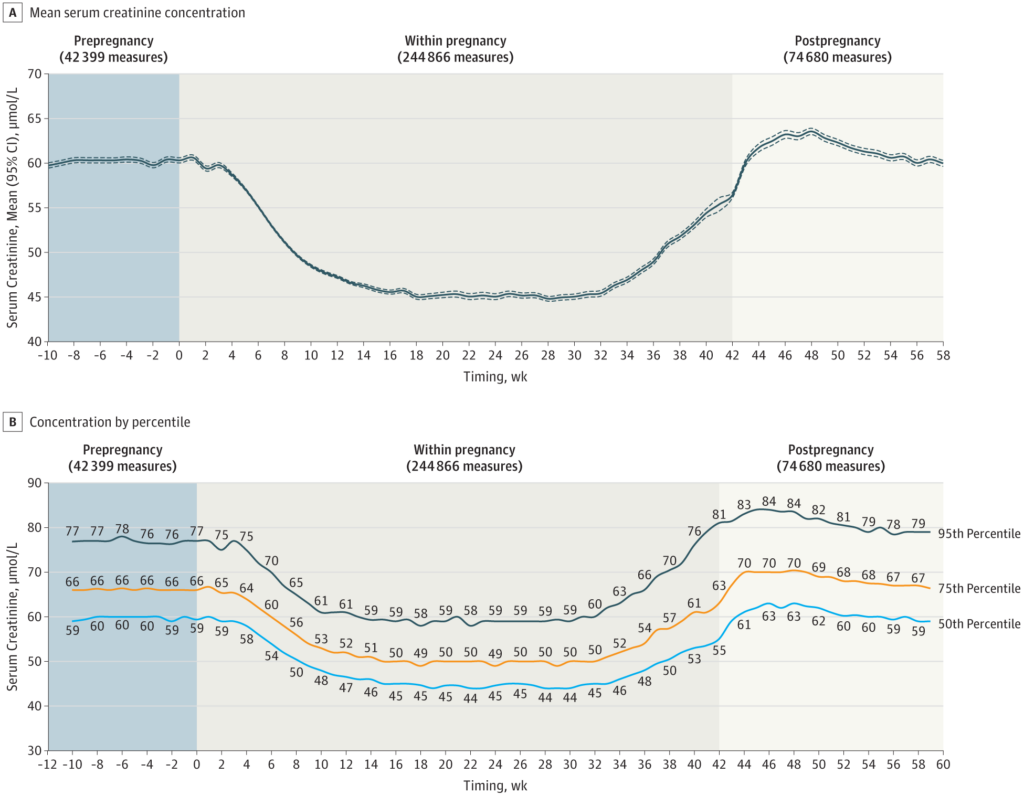
Significant hormonal, immunological, structural, and haemodynamic changes occur in pregnancy that can affect the kidneys. These normal changes complicate the assessment of kidney function and require clinicians to interpret biochemical markers differently than in the non-pregnant population. Haemodynamic changes during pregnancy include increased heart rate, reduced systemic vascular resistance, lower arterial blood pressure, and a substantial increase in cardiac output. This leads to an increase in renal blood flow and glomerular filtration rate (GFR), resulting in decreased serum creatinine concentration. Expected variations in creatinine by gestational age may lead to delays in diagnosis of PrAKI; for example, the absence of a decline in serum creatinine during pregnancy should prompt assessment for PrAKI, but may be missed if creatinine remains within normal laboratory limits. In addition to this, standard estimated GFR formulae and cystatin C are not validated for use in pregnancy.
Perinatal complications include preterm birth, infants who are small for gestational age, and increased perinatal mortality
To address this limitation, a retrospective population-based Canadian study examined serum creatinine measurements from women without pre-existing kidney disease throughout pregnancy. This data established gestational age-specific reference ranges and percentile charts, providing clinicians with more appropriate thresholds for identifying abnormal kidney function during pregnancy (Figure 1). Creatinine values above the expected range for gestational age should prompt further clinical assessment and investigation for PrAKI.
Aetiology
The most common causes of PrAKI vary between HICs and LMICs. Because the burden of PrAKI is disproportionately higher in LMICs, it is associated with worse outcomes in these regions, reflecting significant health inequity. Common causes of PrAKI in LMICs compared with HICs include infection and haemorrhage. Delayed presentation, limited access to antibiotics, prolonged labour, and inadequate obstetric services increase the risk of severe infection leading to kidney injury, making this a largely preventable cause of PrAKI. By contrast, hypertensive disorders of pregnancy including pre-eclampsia, eclampsia and HELLP (haemolysis, elevated liver enzymes and low platelets) syndrome, thrombotic microangiopathy, autoimmune disease, and advanced maternal age are the most common cause of PrAKI in HICs (Table 1).
Although hypertensive disorders are increasing as a cause in LMICs, these disorders are often associated with pre-existing co-morbidities such as obesity, hypertension, diabetes mellitus, CKD, and a continuing postponement of pregnancy. In Ireland, the average age at first pregnancy resulting in a live birth is 31.8 years. This has risen steadily from 30.7 years in 2015 and 28.7 years in 2005. During 2023, there were 4,993 babies born to women aged 40 years and over, reflecting a substantial shift over the last two decades.
| LMICS | HICS |
|---|---|
| Sepsis | Hypertensive disorders |
| Haemorrhage | Thrombotic microangiopathy |
| Unsafe abortion | Autoimmune disease |
| Delayed presentation | Advanced maternal age |
TABLE 1: Common causes of PrAKI globally
Complications of PrAKI
The consequences of PrAKI can extend well beyond the initial clinical presentation, adversely affecting both maternal and neonatal outcomes. Women who develop PrAKI experience significantly higher rates of maternal morbidity and mortality compared with pregnancies uncomplicated by kidney dysfunction. Although robust epidemiological data from LMICs remain limited, reported maternal mortality rates following PrAKI range from 6 to 34 per cent, with the highest mortality unsurprisingly observed in women requiring admission to the intensive care unit. Patients admitted to hospital with PrAKI also have a significantly higher frequency of overall cardiovascular events (0.85% vs 20.5%), with higher mortality and longer hospital admissions compared to women without PrAKI.
Renal recovery varies considerably depending on the underlying cause, severity of injury, and access to specialist nephrology care. PrAKI is associated with increased risk of CKD and end-stage kidney disease (ESKD). Women frequently receive little or no long-term healthcare follow-up, increasing the likelihood that CKD and its associated risks remain undetected. This is of particular concern in LMICs due to limited access to dialysis centres, with some countries having no access to acute dialysis, or to kidney transplant. Where it is available, dialysis treatment is often discontinued early or infrequently attended due to financial constraints.
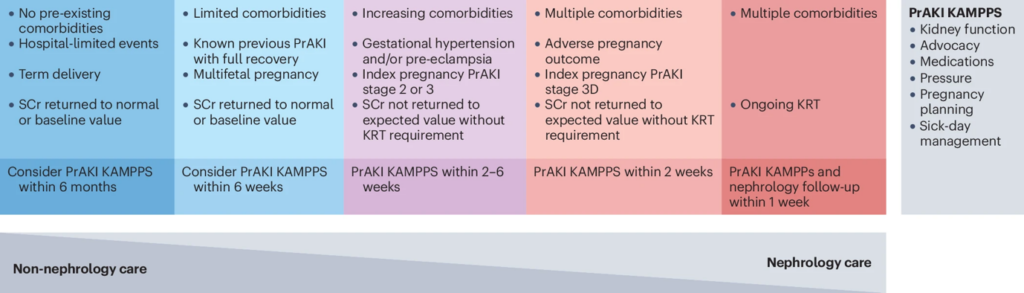
Recognising long-term risks, the 2025 Acute Disease Quality Initiative (ADQI) consensus recommendations advocate that every woman experiencing PrAKI should undergo an individualised risk assessment before hospital discharge. Follow-up should be tailored according to available healthcare resources but, at a minimum, should include repeat serum creatinine measurement and urine dipstick testing to assess for persistent kidney dysfunction or proteinuria. Where possible, women at higher risk should receive ongoing nephrology follow-up to monitor renal recovery and cardiovascular risk factors.
Perinatal outcomes are similarly poor. Reported perinatal mortality ranges from 14 to 60 per cent, with survivors at increased risk of prematurity, low birth weight, and foetal growth restriction (Figure 2).
Future steps
Despite increasing recognition of PrAKI as an important global health issue, major knowledge gaps remain. The ADQI consensus group highlighted the urgent need for large, prospective epidemiological studies to better define the incidence of PrAKI, identify modifiable risk factors, and determine long-term maternal and neonatal outcomes across different healthcare settings. In line with this, the International Society of Nephrology-supported Global PrAKI Snapshot is a prospective multisite study designed to establish the true global incidence of PrAKI across countries of varying income levels. By collecting standardised data from diverse healthcare systems, the study aims to improve understanding of disease burden and inform future international guidelines.
Improving access to early diagnosis is equally important. In many LMICs, routine serum creatinine testing is unavailable or prohibitively expensive, delaying recognition of kidney injury until advanced disease develops. Point-of-care creatinine testing offers a potential practical solution by providing rapid, bedside assessment that can be performed by non-specialist healthcare workers without the need for sophisticated laboratory infrastructure.
A prospective cohort study conducted in Sierra Leone evaluated point-of-care creatinine testing among women identified as being at high risk of PrAKI. Of those enrolled, 96 per cent successfully underwent testing, demonstrating the feasibility of implementing this approach in resource-limited settings. Importantly, over one-quarter (25.6%) of participants were found to have kidney dysfunction, highlighting the substantial burden of previously unrecognised renal impairment. Although the study was limited by the inclusion of women with underlying CKD, it nevertheless provides encouraging evidence that point-of-care testing may facilitate earlier diagnosis, more timely intervention, and ultimately, improved maternal outcomes in LMICs.
Conclusion
PrAKI remains an important, yet frequently under-recognised, cause of maternal and neonatal morbidity and mortality worldwide. While outcomes have improved substantially in HICs, significant global inequities persist, with women in LMICs continuing to experience disproportionately high rates of preventable kidney injury and death. Greater awareness of the physiological adaptations of pregnancy, adoption of pregnancy-specific diagnostic approaches, structured post-AKI follow-up, and wider access to affordable diagnostic tools such as point-of-care creatinine testing are all essential to improving outcomes. Ongoing international collaborative initiatives, including the ISN Global PrAKI Snapshot, together with implementation of the 2025 ADQI recommendations, provide an important opportunity to better define the global burden of disease, address existing disparities in care, and improve maternal and neonatal outcomes worldwide.
References
- Kontomanolis EN, Prokopakis I, Koutras A, et al. Pregnancy-related acute kidney injury: Causes and its impact on perinatal outcomes – a systematic review. J Clin Med. 2025;14(17):6031. doi:10.3390/jcm14176031.
- Meena P, Das P, Auradkar A, et al. Pregnancy-associated acute kidney injury as an important driver of chronic kidney disease in females in developing countries: A systematic review. Matern Health Neonatol Perinatol. 2025;11(1):24. doi:10.1186/s40748-025-00224-9.
- Waziri B, Umar IA, Magaji A, et al. Risk factors and outcomes associated with pregnancy-related acute kidney injury in a high-risk cohort of women in Nigeria. J Nephrol. 2024;37(3):587-596. doi:10.1007/s40620-023-01822-6.
- Misu F, Gasbarro D, Alam K. Inequality in utilisation of maternal healthcare services in low and middle-income countries: A scoping review of the literature. Matern Child Health J. 2025;29(6):741-766. doi:10.1007/s10995-025-04111-9.
- Nelson-Piercy C, Srisawat N, Kashani K, et al. Pregnancy-associated acute kidney injury – consensus report of the 32nd Acute Disease Quality Initiative workgroup. Nat Rev Nephrol. 2025;21(9):633-646. doi:10.1038/s41581-025-00979-6.
- Obrenovic R, Petrovic D, Majkic-Singh N, Trbojevic-Stankovic J, Stojimirovic B. Serum cystatin C levels in normal pregnancy. Clin Nephrol. 2011;76(3):174-179. doi:10.5414/cn106792.
- Harel Z, McArthur E, Hladunewich M, et al. Serum creatinine levels before, during, and after pregnancy. JAMA. 2019;321(2):205-207. doi:10.1001/jama.2018.17948.
- Shalaby AS, Shemies RS. Pregnancy-related acute kidney injury in the African continent: where do we stand? A systematic review. J Nephrol. 2022;35(9):2175-2189. doi:10.1007/s40620-022-01349-2.
- Central Statistics Office. Vital Statistics Yearly Summary 2024. Dublin:CSO; 2025. Available at: www.cso.ie/en/releasesandpublications/ep/p-vsys/vitalstatisticsyearlysummary2024/
- Wilson J. Births to women aged 40 and over increased by 21.5 per cent in 10 years. The Irish Times. October 31, 2024. Available at: www.irishtimes.com/ireland/2024/10/31/births-to-women-aged-40-and-over-increased-by-215-in-10-years/
- Davidson B, Bajpai D, Shah S, et al. Pregnancy-associated acute kidney injury in low-resource settings: Progress over the last decade. Semin Nephrol. 2022;42(5):151317. doi:10.1016/j.semnephrol.2023.151317.
- Shah S, Meganathan K, Christianson AL, Harrison K, Leonard AC, Thakar CV. Pregnancy-related acute kidney injury in the United States: Clinical Outcomes and Health Care Utilisation. Am J Nephrol. 2020;51(3):216-226. doi:10.1159/000505894.
- Kuhrt K, Cole R, Bayah M, et al. Assessment of point-of-care creatinine testing in pregnancy: A prospective cohort study in Sierra Leone. The Lancet Regional Health – Africa, 2026: 2026;100069: ISSN 3050-5011. doi.org/10.1016/j.lanafr.2026.100069.






Leave a Reply
You must be logged in to post a comment.