NOTE: By submitting this form and registering with us, you are providing us with permission to store your personal data and the record of your registration. In addition, registration with the Medical Independent includes granting consent for the delivery of that additional professional content and targeted ads, and the cookies required to deliver same. View our Privacy Policy and Cookie Notice for further details.
The Irish Society for Rheumatology 2026 Autumn Meeting received a practical summary of the latest updates in guideline-directed care of polymyalgia rheumatica (PMR) from Dr Sarah Mackie, Associate Professor of Vascular Rheumatology, University of Leeds; and Honorary Consultant Rheumatologist, Leeds Teaching Hospitals NHS Trust, UK. Her talk summarised the recent guideline revisions by the European Alliance of Associations for Rheumatology (EULAR) and forthcoming updates from the British Society for Rheumatology (BSR). She described EULAR as taking “perhaps a more radical approach”, while the BSR approach was more aligned with existing practice, likening the two to the “tortoise and hare”.
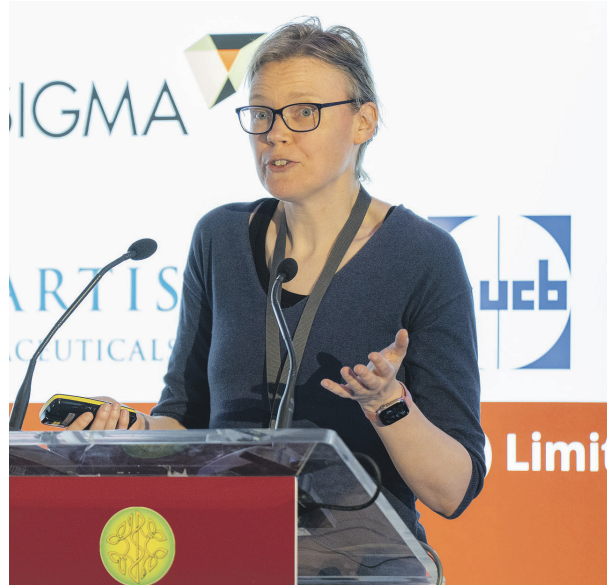
Dr Sarah Mackie
Dr Mackie opened her talk with a comparison between software and clinical guideline updates, describing how both software and clinical practice can benefit from things like “bug fixes, performance updates, and additional new features”.
“Our knowledge about PMR is constantly advancing; its relationship with other diseases, the way we manage it – it’s all advancing. So, the guidelines need to keep up with all the science, knowledge, and technology out there.”
Myths and challenges in PMR
Dr Mackie addressed the longstanding discordance between “standard messaging in PMR and what happens in real life”. She challenged the common misconceptions that corticosteroids are the only treatment option and that PMR resolves after two years. “It’s true that the average patient will be off steroids within two years, but this is often misinterpreted that PMR goes away after two years,” she explained. Dr Mackie also identified the challenge of what she termed “the PMR paradox” of corticosteroid treatment.
“The treatment is steroids, but we’ve got to get you off the steroids – this is what we tell patients. It’s all quite a contradiction and it doesn’t make sense to them.”
Delegates heard that these misunderstandings, alongside a reluctance to reduce steroids, can contribute to a “non-consultation, non-referral vacuum”. Patients may stop consulting their GP because they fear being told to taper their steroids, and at the same time, GPs may be reluctant to refer patients to rheumatology in case the patient is advised to taper their steroids – both concerned that tapering could leave symptoms inadequately controlled. Dr Mackie also noted that “most patients and GPs are unaware that DMARDs [disease-modifying anti-rheumatic drugs] may be an option”.
To refer or not to refer?
EULAR recommends that all patients with suspected PMR should be referred for specialist expertise, and that corticosteroid treatment should be delayed until the diagnosis has been confirmed. Dr Mackie noted that while these recommendations may be feasible individually, implementing them together could prove challenging in healthcare systems where access to rheumatology is limited. By comparison, the BSR guidance states that uncomplicated cases should be diagnosed and managed by GPs, with rheumatology input when required.
Dr Mackie acknowledged that the EULAR guidelines need to be applicable across all EULAR countries, with suspected PMR being routinely referred to rheumatology in many of them, unlike the UK and Ireland, where PMR is primarily managed by the GP. The guidelines do recognise that access to specialist services varies between regions. In England, she noted, expertise in PMR has increasingly developed within primary care “because they’ve been doing it for decades”. Dr Mackie also pointed to differences in the composition of the two guideline working groups. “We had GPs as well as rheumatologists (in the BSR group); I don’t think they had primary care physicians on the EULAR guideline group,” she said. “BSR guidelines had to be acceptable to primary care because we have to work with primary care.”
Diagnosing PMR
Dr Mackie warned of a growing risk of misdiagnosis in PMR, particularly in the absence of a definitive diagnostic test. EULAR states that PMR diagnosis should be based on a combination of typical signs and symptoms, alongside exclusion of potential mimicking conditions, she said. Both EULAR and BSR caution against using classification criteria as a diagnostic algorithm, the conference heard.
“We don’t want to overuse classification criteria because there is a risk that it will be used as a diagnostic algorithm, and that’s not what classification criteria were ever developed or intended for. I hope that message is heard.”
Artificial intelligence (AI) is likely to add another dimension to the diagnostic process and to patient-doctor interactions. “AI is really going to affect how we diagnose,” Dr Mackie said. While liability will remain with clinicians, she noted that the profession will need to work out how best to navigate AI and its “very rapid progression”.
Dr Mackie also questioned what constitutes sufficient expertise to manage patients with relapsing-remitting PMR. While EULAR guidance recommends that such patients should be managed in “expert hands”, it does not define what constitutes an expert, she said. The guidance also introduces the concept of an “expert centre”, but again without clearly defining what this means in practice.
“How do we know a centre is expert?” Dr Mackie said. “Hopefully we’ll hear more from EULAR on that.”
New treatments and advances
Turning to treatment advances, Dr Mackie highlighted what she described as an encouraging period for PMR research. “The good news is that there have been loads of trials in PMR for the first time in many decades,” she said about studies that are beginning to identify treatments that can reduce reliance on corticosteroids. Several pivotal trials have evaluated potential glucocorticoid-sparing therapies, including interleukin-6 (IL-6) inhibitors, IL-17 inhibitors, B-cell depletion, and Janus kinase (JAK) inhibitors. Among the trials discussed were PMR-SPARE, SEMAPHORE, REPLENISH, and SAPHYR.
“Methotrexate is already available as a treatment option,” Dr Mackie continued, noting it is first-line in BSR guidance, in contrast to IL-6 inhibition in EULAR guidance – highlighting another key difference between the two. “Methotrexate is recommended for consideration in patients who are prone to relapse,” she said. The BSR guidance encourages GPs to consider an early discussion about steroid-sparing treatment, helping to challenge the perception that corticosteroids are the only available treatment option.
Dr Mackie concluded with an overview of recent advances in the understanding of the underlying biology and presentation of PMR, including the identification of symmetrical inflammatory lesions – a potential imaging “signature” of the disease – as well as genetic associations and the diversity of potential symptom triggers, like viruses and vaccines. She finished on an optimistic note, returning to her earlier comparison between the EULAR and BSR approaches: “No matter whether we use the tortoise or hare approach, I think the prospect for patients will improve.”







Leave a Reply
You must be logged in to post a comment.