



The Chief Executive Officer (CEO) of Cork University Hospital (CUH) has called for greater clarity on the cost of implementing Sláintecare, warning that the health service may not be able to afford to deliver the reforms at the pace needed to achieve the benefits of the strategy.
Speaking at the IHCA Annual Conference in Kilkenny, Ms Jennifer Kearney said there needed to be a “clear budget and a realistic timeline” for the full implementation of the strategy.
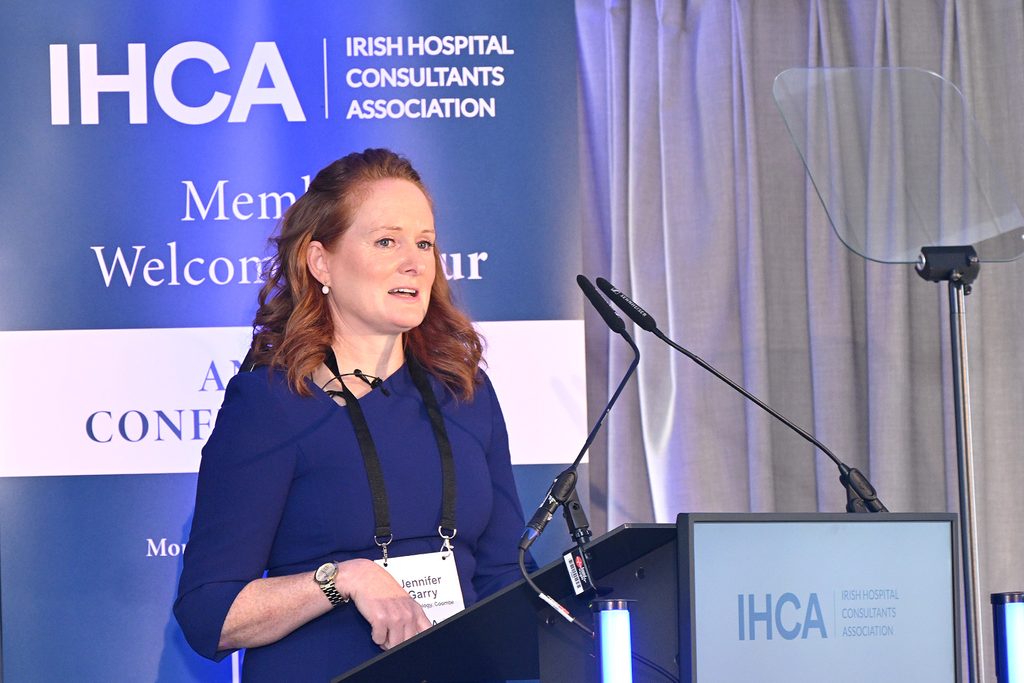
Ms Kearney said she first encountered Sláintecare while working in the UK in 2019, shortly before the Covid-19 pandemic, adding: “I was really impressed.”
She praised Sláintecare’s “all-party vision for the future of Irish healthcare”, its commitment to reform and its ambition to ensure access to care is based on need, with services delivered “closer to home”.
However, Ms Kearney said the pandemic had “disrupted” the reform process.
She said it was now necessary “to be honest about what it will take to deliver” the strategy.
According to Ms Kearney, implementing Sláintecare required greater clarity on the cost of the original vision, how much had been spent on reform rather than the wider health budget, and what it would cost to achieve the strategy’s aims today.
“My concern is not that Sláintecare was the wrong ambition… [but] it appears we can’t afford to implement it at the pace needed to reap the benefits.”
The CUH CEO told the audience that she had spent 22 years working in the NHS before joining the HSE 15 months ago.
“I knew that systems and structures would be different; I was probably a little naive about how different,” she said.
“It felt in some respects like stepping back in time, maybe 10 or 15 years. The infrastructure, the constraints, the funding arrangements, the complexity of the Pay and Numbers Strategy, the limited autonomy available for those responsible for delivering services.”
Earlier this year, Ms Kearney was involved in a high-profile disagreement with healthcare officials over staffing levels and recruitment at CUH.
In August, she wrote to HSE South West appealing for a derogation for CUH from the current employment restrictions, and the approval of a minimum of 172 priority posts to ensure a safe service entering the winter months.
During her address, Ms Kearney pointed out that the “quality of clinicians in Ireland is nothing short of extraordinary”.
However, she warned that Ireland cannot build a world-class health system “on the goodwill of people who are already giving all that they have… and we cannot go on confusing the extraordinary resilience of our workforce with the sustainability of the service itself”.
We cannot go on confusing the extraordinary resilience of our workforce with the sustainability of the service itself
Ms Kearney also called for a national programme of genomic screening for every newborn, recommending that it be “introduced in carefully evaluated phases, with informed parental choice, robust safeguards, and a clinical service to act on the results”.
“Imagine identifying a genetic condition in a newborn before symptoms develop, when early treatment can change the course of that child’s life?”
She added that newborn screening was “only the beginning”, highlighting the wider potential of genomics to transform the diagnosis and treatment of disease.
“Genomics can transform how we diagnose rare diseases, identify inherited risk, treat cancer, and select medicines more likely to work for individual patients,” Ms Kearney told the meeting.
She acknowledged the progress made through the National Genetics and Genomics Strategy, the National Genetics and Genomics Office, and the establishment of a national genomic test directory.
However, she said that while “these are important foundations… a strategy is not a service and a directory is not transformation”.










Leave a Reply
You must be logged in to post a comment.