NOTE: By submitting this form and registering with us, you are providing us with permission to store your personal data and the record of your registration. In addition, registration with the Medical Independent includes granting consent for the delivery of that additional professional content and targeted ads, and the cookies required to deliver same. View our Privacy Policy and Cookie Notice for further details.
Irish Cardiac Society, Annual Scientific Meeting and AGM, Killashee Hotel, Naas, Co Kildare, 15–17 October 2026
At this year’s Irish Cardiac Society Annual Scientific Meeting, Prof Yvonne Smyth was welcomed as incoming President.
Prof Smyth paid tribute to the work done by her colleagues in the Society and outgoing President Prof Brendan McAdam. The conference also saw the presentation of the annual Brian Maurer Young Investigator Award, which this year was won by Dr Niall Connolly and colleagues for their study titled ‘HRR10-20 in the assessment of autonomic function across controls, moderate and severe aortic stenosis’.
The presentations were chaired by Dr John Harold, Consultant Cardiologist and Professor at the Cedars-Sinai Health Sciences University, and former President of the American College of Cardiology. The distinguished judging panel included Ms Cathie Biga, Prof Paschal McKeown, and Dr Geoffrey Rose.
This year’s event also featured a presentation on ‘The patient perspective’ from Ms Shirley Ingram and Mr Michael Madigan, and a thought-provoking presentation by Prof Andrew Clark, Hull and East Yorkshire Hospitals NHS Trust, UK, and President-Elect of the British Cardiovascular Society. In a challenging presentation and lively question-and-answer session, Prof Clark invited the attendees to rethink their definitions of heart failure and evaluation of therapeutic strategies.
This year’s Stokes Lecture was delivered by Prof Rose Anne Kenny, St James’s Hospital, Dublin, and the founding Principal Investigator of Ireland’s largest adult population study on the experience of ageing – The Irish Longitudinal Study on Ageing (TILDA).
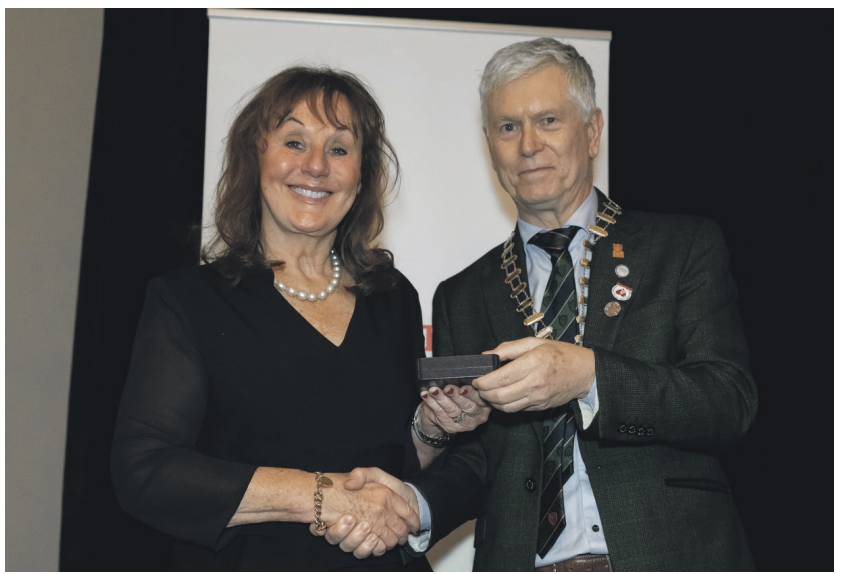
Prof Rose Anne Kenny and Prof Brendan McAdam
The topic of the lecture was ‘Syncope in adults’. Prof Kenny built her presentation around a case study that was published recently in the New England Journal of Medicine of a 75-year-old male who presented with a fracture due to an unexplained fall. Prof Kenny outlined the clinical characteristics of the patient, including current medications and comorbidities.
She summarised the current standard definitions of syncope, and noted that Dublin is fortunate to be one of the few cities that has a dedicated syncope unit. Syncope is most common in people who are very young, the middle-aged, and the highest prevalence is in the elderly, she said. “It is notable that whereas lifespan is increasing in the population, healthy lifespan is not keeping pace, and that’s the biggest challenge we all face in providing health services,” said Prof Kenny.
She provided a clinical overview of blood pressure parameters and brain blood flow in older people and discussed potential tools that might in future be used to assess older people at risk of syncope. She also presented data from the longitudinal TILDA study that pointed to an interesting outcome regarding childhood experiences. “We asked about childhood, lifelong, and adult-onset syncope, and we asked about adverse childhood events,” said Prof Kenny. “There is a dictum out there that particularly lifelong syncope is associated with adverse events, but those studies have been only in patients in very select population locations attending cardiovascular clinics.”
This dataset was applied at population level: “It was quite remarkable really,” said Prof Kenny. “Physical abuse, sexual abuse – 6 per cent of the sample experienced sexual abuse before the age of 10… substance abuse; parent died before the participant was aged 18; or a composite score of all of the ages. These are quite small numbers for the subgroups. Nonetheless, this is lifelong fainting. Significantly, each of these elements of adverse childhood experiences – particularly physical and sexual abuse – are associated with the lifelong fainter. The composite data shows a clear association.”
Prof Kenny also synopsised research that she recently completed with her colleagues and said: “This is very important – over one-third of patients with low blood pressure syncope… have another underlying attributable cause,” she told the conference. “In a series of patients who had orthostatic hypotension (OH) as the presumed attributable cause of syncope in testing, there were other abnormalities derived in the ambulatory blood pressure and tilt; ambulatory blood pressure alone; tilt alone….
“The message is, don’t assume because you come across OH – unless you’re very clear that that is the attributable cause – that there isn’t another possible hypotensive attributable cause.”
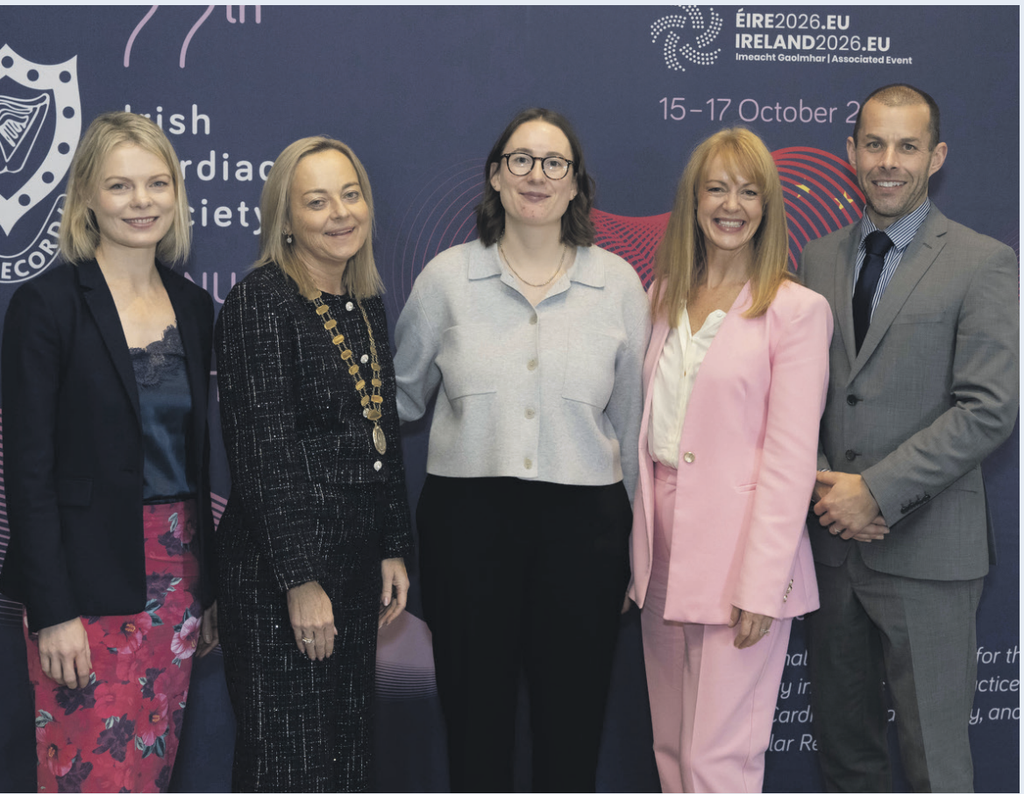
Pictured L-to-R: Prof Emer Joyce; Prof Yvonne Smyth, incoming President, Irish Cardiac Society; Dr Roisin Gardiner; Prof Patricia Campbell; and Dr Alastair Gray













Leave a Reply
You must be logged in to post a comment.