








Across Ireland, general practice nurses (GPNs) are indispensable members of the primary care team. Their work spans preventive health, chronic disease management, vaccination programmes, and the care of patients from cradle to grave, often formingthe first-line of patient contact within the community. While the importance of nursing in general practice has long been recognised, the professional pathways and nursing infrastructure supporting these nurses has sometimes been difficult to pinpoint.
As nursing continues to evolve in response to growing patient needs and complex community health challenges, the role of the professional development coordinator for GP nursing (PDCGPN) has never been more important. Embedded within the HSE primary care structures, PDCGPNs act as the vital link between policy and practice –supporting nurses in general practice in delivering safe, high-quality, and evidence-based care in line with national health strategy.
The PDC team – comprising Kathy Taaffe, Marie Courtney, Liz Carroll, Marie Cantwell, and Mairead Murphy, works across Ireland and each individual PDC (continuing professional developmet) works within a local region. These regions are currently undergoing a significant restructure and alignment of the PDC posts may change accordingly. For the most up to date locations and contact details for the PDCs you can check the HSE website at: www.hse.ie/eng/services/list/2/primarycare/generalpracticenursing/contact-a-general-practice-nursing-coordinator/
This regional model of professional coordination allows for responsiveness to local service needs while maintaining alignment with national policy objectives. It acknowledges that general practice nursing, though often situated in independent GP practices, is an integral component of Ireland’s public health infrastructure.
Role of the PDCGPN
The PDC’s role is multi-faceted and dynamic. At its heart lies a commitment to support, advocate for, and advance general practice nursing in Ireland.
The PDCGPN sits within the primary care departments of the HSE, but extends across a broad collaborative network that includes internal and external stakeholders such as nursing and midwifery services, the Office of the Nursing and Midwifery Services Director (ONMSD), HSE programme and operational teams, external and partner agencies, and GPs themselves.
Through these partnerships, we ensure that the experiences and perspectives of GPNs are embedded within the national dialogue on health service delivery.
For nurses transitioning into general practice, the move can be both exciting and daunting. Many ask: “What’s different in general practice? How do I keep my practice safe? How do I maintain my continuing professional developmet (CPD)? How do I develop my role?”
All GPNs are registered with the Nursing and Midwifery Board of Ireland (NMBI), and as such, operate within a regulated profession. As outlined by the Government of Ireland, a regulated profession is one “where access to, or practice of, a profession is restricted by national law to those who hold specific qualifications”. This brings with it autonomy of practice and accountability to the regulator (NMBI).
With their unique employment status as individual employees of small GP teams, GPNs are accountable directly to the employing GP and to their regulatory body. There is rarely a structure of nursing line management or reporting, and while the PDCGPN has no management function, they can provide the structured mentorship and professional guidance as senior nurses that will substitute for those structures typically found in other health service settings.
For new nurses entering general practice, the adjustment can be steep. The scope of practice is broad, the patient relationships are long-term, and the level of autonomy is high. Ensuring safety, maintaining standards, and building confidence require time and support. That is why the structured involvement of PDCs is so critical in providing a professional safety net, offering evidence-based guidance, and promoting best practice across all aspects of care.
PDCGPN activities include:
- Providing advice and guidance to GPNs (and GPs) at local, regional, and national levels, at all stages, from novice to advanced practice.
- Planning bespoke practice development pathways for GPNs based on service need, individual interest, and ambition.
- Facilitating education, training, and CPD opportunities.
- Promoting quality and safety in practice.
- Supporting policy and programme development that recognises and builds on the unique contribution of general practice nursing.
- Encouraging innovation and role development, ensuring that GPNs are empowered to adapt to evolving service demands.
The PDCGPN role ensures that nurses working in private GP settings are not professionally isolated, but rather supported by a system that values education, consistency, and clinical excellence. This includes assisting practices with the implementation of clinical audits, policy development, and standard operating procedures aligned with best practice and evidence. It also includes developing leadership and quality improvement skills, facilitating peer support networks, enabling GPNs to share knowledge and experiences, reducing professional isolation, and fostering a sense of community.
The PDCGPN will work with GPNs and their practice employers and colleagues to plan bespoke practice development journeys based on service need within the practice settings, married to the areas of interest and continuing education ambitions of the GPN. That demand-led planning will ensure support for the GPN to upskill and practice in an area that brings value to the practice in the form of improved or additional patient care.
Education and lifelong learning
Importantly, PDCGPNs act as advocates for lifelong learning. In a field where clinical guidelines, technology, and patient expectations are constantly evolving, maintaining professional competence is essential. By promoting reflective practice and supporting access to accredited education, the PDCGPNs help to ensure that GPNs remain at the forefront of community-based healthcare delivery. This includes guiding GPNs to fulfil CPD requirements, maintain competence in practice, and, where interested, expand practice to meet patient needs.
Continuing education is supported by signposting to relevant opportunities as well as coordinating delivery of, and access to, training programmes, CPD workshops, and specialised courses that address the diverse skill sets required in general practice. These include regional study days and national conferences run in collaboration with colleagues from across acute and community services, as well as partner agencies.
These include immunisation updates, chronic disease and integrated care study days, and skills workshops designed to update the GPNs clinical knowledge and competence in areas such as foot care for diabetic patients, clinical holding for childhood vaccination, antenatal skills for midwives, to name just a few.
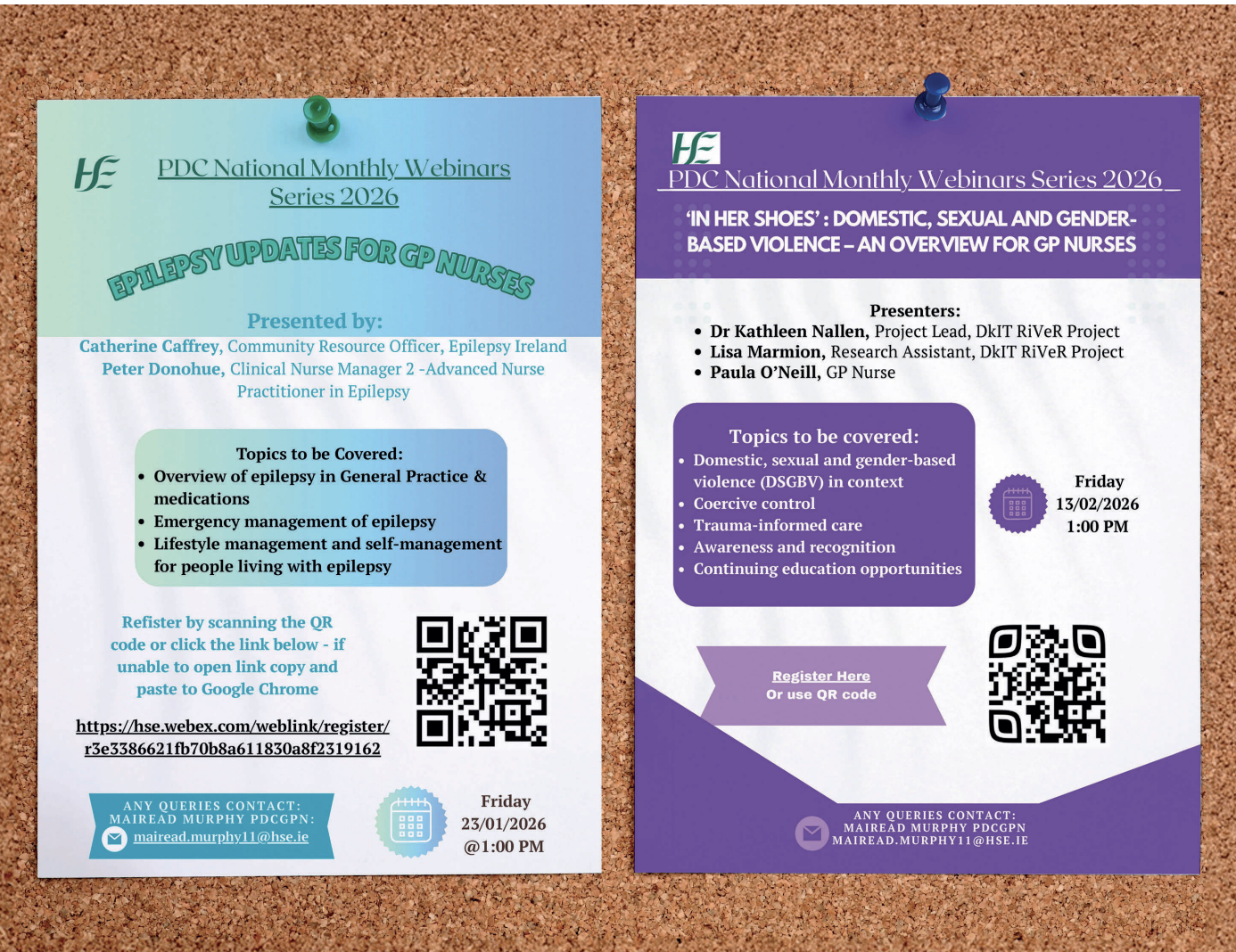
The monthly PDC lunchtime webinar series has been running for almost three years and sees hundreds of GPNs attend a bespoke, hour-long, online educational session on the second last Friday of each month. These webinars address topics of significant interest or relevance to general practice and are delivered by expert speakers who have tailored their teaching to the GPN audience in particular. Topics have included hypertension management, contraception updates, palliative care, and professional portfolio development.
Keeping abreast of education and training opportunities pertinent for GPNs and signposting appropriately is key to the success of the PDCGPN advisory role. Local, regional, and national learning opportunities, online webinars and short courses, university and college based courses (from micro credential to masters level), clinical partner educational meetings, and education via the Centres for Nurse and Midwifery Education are all collated and communicated to GPNs looking to engage with practice development.
Additionally, the PDCGPN collaboration with higher education institutions and providers ensures greater availability of education that meets the needs of the expert generalist role, as well as advanced roles where appropriate.
Challenges for GPNs
While the role of the GPN is both rewarding and essential, it also presents unique challenges. Unlike nurses in hospital settings, GPNs most often work within independent GP practices, which can vary widely in size, resources, and governance structures. This independence can lead to variability in access to support, professional development funding, and clinical supervision.
Another ongoing challenge is ensuring that general practice nursing is visible and valued within the broader healthcare system. Despite being the first point of contact for many patients, GPNs have historically been under-represented in strategic workforce planning.
The PDCGPN role seeks to redress that balance by bringing data, evidence, and advocacy to national discussions. Working closely with policymakers and professional bodies to highlight workforce trends and identify emerging needs ensures that the general practice nursing perspective informs developments where appropriate.
A ‘collective voice’ for GPNs
Collaboration is at the core of the PDCGPN approach, and includes engagement with primary care teams, nursing and midwifery colleagues, academic partners, and GP organisations to strengthen the infrastructure supporting general practice nursing.
In addition, PDCs contribute to policy development and research, sharing insights from frontline practice that inform national decision-making. Our collective voice helps ensure that new strategies are grounded in the lived experience of nurses and the realities of general practice.
Engagement with senior national nurse leaders and educators has reaped great improvements in access to education, research, and leadership training for GPNs. As a result, patients will benefit from more consistent, evidence-based care, and nurses will gain a clearer career trajectory within general practice.
The future of general practice nursing is bright – but it will require continued investment, visibility, and advocacy. The PDCGPN model demonstrates how dedicated coordination can elevate a profession, ensuring that nurses are supported, not only in their clinical roles, but also as leaders, educators, and innovators.
As Ireland’s healthcare system continues to pivot toward community-based care, GPNs will play an increasingly central role in achieving population health goals, managing chronic conditions, and delivering preventive care.
For this potential to be fully realised, sustained support through the PDCGPN network will be essential to achieve a system where every GPN has access to structured mentorship, clear pathways for education and career advancement, and the professional recognition they deserve. The foundation is already strong – the challenge now is to build upon it, ensuring that general practice nursing continues to thrive as a cornerstone of primary care.
GPNs are at the heart of community healthcare – providing compassionate, skilled, and patient-centred care every day. The PDCs stand beside them, ensuring that they are supported, empowered, and professionally connected.
By fostering collaboration, advancing education, and embedding quality and safety into everyday practice, the PDCGPNs help shape a resilient, adaptable nursing workforce ready to meet the evolving needs of Irish communities. In doing so, they not only strengthen general practice, but also reaffirm the core values of nursing – compassion, care, and commitment.





Leave a Reply
You must be logged in to post a comment.