







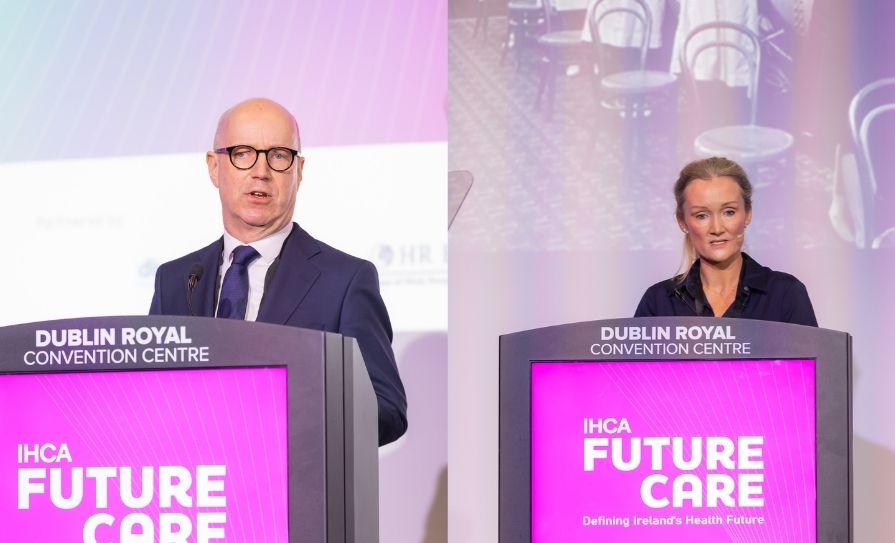
The recent FutureCare conference in Dublin explored the role of clinical leadership at hospital level and in the formation of national policy. David Lynch reports
“We’ve had a politician-led policy [with Sláintecare]…why not a clinician-led policy?”
This was a question posed by IHCA CEO Mr Jim Daly in his address at the Association’s FutureCare conference in Dublin on 12 February.
The well-attended event heard from Irish and international speakers on how leadership, governance, and funding models can be aligned to improve patient outcomes and the health service more generally.
Consultant clinical leadership in hospitals, as well as in wider health policy formation ‘post-Sláintecare’, were the main themes of the meeting. The Association also launched a new clinician-led 10-point action plan to reform the health service (see panel).
“I’m not sure it is on the radar of the political system to find a successor to Sláintecare,” Mr Daly told the Medical Independent (MI).
Mr Daly was appointed IHCA CEO in late 2024, joining from the Private Hospital Association (PHA). Before the PHA, he had an extensive career in politics with Fine Gael, including serving as Minister of State for Mental Health and Older People from 2017 to 2020.
Consultant leadership
“I’m not sure how much of Sláintecare has been achieved and that might be for another body to independently adjudicate,” Mr Daly told this newspaper.
“But from our perspective as the body that represents consultant doctors, we’re very clear and very anxious to bring forward consultants as the leaders that they are.”
“They are the people who take decisions every day on the floor, that literally change, save, and transform lives. They have to do it in an instant. I don’t know anybody better placed to become leaders in the healthcare service than those same consultants.”
Mr Daly pointed to the examples of An Garda Síochána and secondary and primary schools as organisations where the “leadership comes from within”.
He added that there should be no barrier for clinicians to take similar roles.
Sláintecare was launched in 2017. The 10-year cross-party health strategy to transform the health system into a universal, single-tier service has officially only two years to run.
The Department of Health did not outline what will come after Sláintecare when asked by this newspaper about a successor strategy.
A spokesperson confirmed that the Sláintecare Progress Report 2025 and Sláintecare Action Plan 2026 are currently in development, adding that next steps will be considered following their publication.
“I think Sláintecare had many positives, and some negatives,” said Mr Daly.
“I think primarily… [the] biggest win was it took a lot of the politics out of healthcare, which was welcome.”
He added that it was important to declare his “own interests”, noting that “he was a politician” for a period of time during Sláintecare’s implementation.
“But I think really clinicians… are showing that they are willing to stand up to the mark” and make significant input to the formation of national health policy.
Speaking at the conference, the new Master of the National Maternity Hospital (NMH), Prof Jennifer Walsh, outlined the unique history of more than a century of the Mastership system at Dublin’s major maternity hospitals, including the NMH.
She said this system of governance was one of the “first examples of modern clinical leadership” and was in some ways “ahead of its time”.
Evidence
Prof Walsh, a Consultant in Obstetrics and Gynaecology, made the case in favour of clinical leadership in contemporary healthcare.
“The evidence supporting clinical leadership is substantial,” Prof Walsh told the conference. “It provides clear benefits for quality of care, team effectiveness, and overall health system performance.”
Prof Walsh said hospitals with high clinical engagement in management score up to 50 per cent higher in key performance indicators compared to those with low clinical engagement.
“Clinical leadership in healthcare enhances patient outcomes.”
Also addressing the conference on clinical leadership, CEO of the Mater Private Healthcare Group Mr John Hurley said that physicians “are well positioned to understand the balance” between clinical care, research, and education needed in hospitals.
He noted that “in general, it is easier for a physician to understand… business principles, than for a business person to appreciate healthcare”.
Mr Daly described the FutureCare meeting to MI as “the largest gathering of consultant doctors ever, I believe, in Ireland”.
He said consultants are “coming together to show that they are willing to accept not just new authority, but new responsibility and to bring that [clinical] leadership forward”.
New approach
According to Mr Daly, any future national health policy plan should take a different approach to more closely reflect the experience of consultants and others working in the sector.
“Sláintecare was very much built around ideology,” he said.
“We are not as focused on ideologies. That is more a matter for the politicians. We as the representative body for consultant doctors are patient-focused and want to see what works for patients.”
Speaking to MI in the week prior to the conference, IHCA President Prof Gabrielle Colleran said the concept behind Sláintecare, as a cross-party political agreement, was “really positive”. However, the plan “was definitely under-funded”.
She believes a greater focus on hospital capacity and reducing patient waiting lists will need to be part of any new national health plan.
During her address to the FutureCare conference, Prof Colleran revealed results from a new IHCA survey.
According to the findings, 86 per cent of consultants are working longer than their contractual hours, with 40 per cent working 45 hours or more per week.
When asked to quantify the level of extra work or ‘discretionary effort’ they provide each week on a voluntary basis, ‘above and beyond’ their contractual hours, 41 per cent said they are working seven hours or more extra per week. A quarter (24 per cent) of respondents said they provide 10 or more hours in ‘discretionary effort’ and 11 per cent said they work an additional 13 hours or more.
The Association warns that continued reliance on such “goodwill” from consultants and crisis management from health officials is no longer tenable.
Failure to act now will carry “significant” clinical, human, and economic costs, according to the Association.
A ‘clinician-led’ roadmap for health
The IHCA launched its “major clinician-led reform plan” for healthcare at the recent FutureCare conference in Dublin.
The document, titled FutureCare: Action Plan for Health 2026, calls for additional bed capacity, a doubling in National Treatment Purchase Fund (NTPF) funding, more physician-run hospitals, and new accreditation standards.
The Association described the 10-point action plan as an alternative to the “almost decade-old, politician-driven Sláintecare policy, much of which has yet to be delivered”.
The IHCA maintains its plan provides a sustained, structured focus on real world policies “that are shaped by those who see, first-hand, how system design affects patients on wards”, in emergency departments and on waiting lists.
The Association’s 10-point plan sets out a number of priorities, including:
▶ The immediate and sustained expansion of hospital and critical care capacity, including the full delivery of all elective hospitals and surgical hubs.
▶ A doubling in the level of NTPF funding from €200 to €400 million to provide timely care to an additional 143,000 patients.
▶ Mandatory, internationally recognised accreditation and quality standards.
▶ Clinician-led governance at hospital and system level.
▶ Accelerated delivery of national electronic health records.
▶ Significant increases in consultant and other medical staff to deliver timely patient care.











Leave a Reply
You must be logged in to post a comment.