NOTE: By submitting this form and registering with us, you are providing us with permission to store your personal data and the record of your registration. In addition, registration with the Medical Independent includes granting consent for the delivery of that additional professional content and targeted ads, and the cookies required to deliver same. View our Privacy Policy and Cookie Notice for further details.
The College of Psychiatrists of Ireland Spring Conference featured a wide range of talks on the challenges and opportunities facing the specialty. Paul Mulholland reports
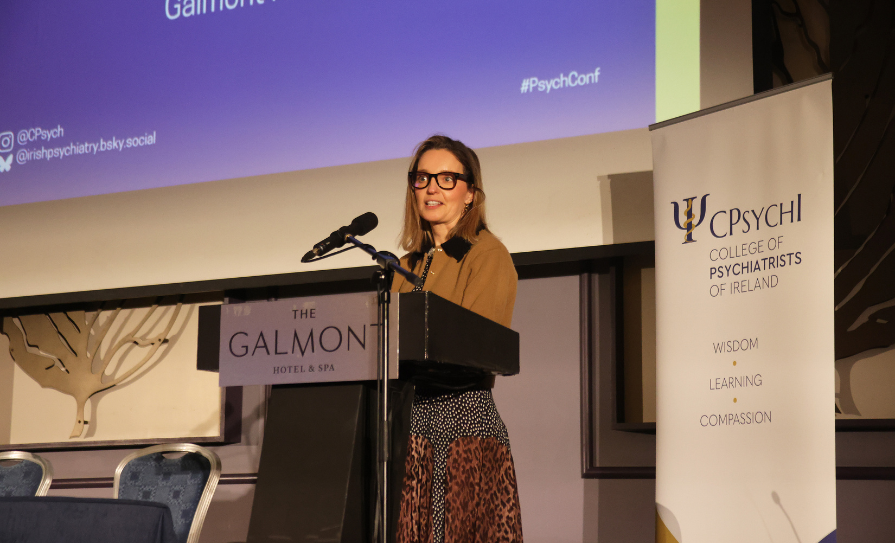
THe College of Psychiatrists of Ireland Spring Conference 2026 took place in The Galmont Hotel, Galway, on 26–27 March.
This year’s programme spanned a range of areas designed to speak directly on the challenges and opportunities facing psychiatrists working across the health service. Among the themes covered were: Early intervention; trauma-informed care; the physical health of people with mental illness; the stewardship of limited resources; digital transformation; and the ethical tensions that often accompany clinical decision-making.
The first talk of the opening session, chaired by Vice-President of the College Dr Karen O’Connor, was titled, ‘Early intervention for a dual diagnosis of personality disorder and addiction.’ The talk was delivered by Dr Eddie Mullen, Clinical Director of Community and Enhanced Care, Consultant Psychiatrist in Early Intervention and Addiction Psychiatry, Parkville Youth Mental Health Wellbeing Service, Australia.
Dr Mullen explored the relationship between substance use and emerging personality disorder using a developmental lens, framing this as a critical window for intervention.
In his talk, he made the case for an integrated, “relationally informed” approach within mental health and addiction services.
The next speaker, Dr May Van Schalkwyk, Research Fellow, Global Health Policy Unit and the Centre for Pesticide Suicide Prevention, University of Edinburgh, Scotland, discussed the commercial determinants of health and equity through a series of case studies.
President’s Address
Following Dr Van Schalkwyk’s talk, the President of the College, Dr Lorcan Martin, delivered the President’s Address.
Dr Martin began with a discussion of the Mental Health Act 2026, which he described as “the biggest challenge” currently facing psychiatry.
“This time last year we were looking at a Bill beyond unworkable, which would have left patients languishing and untreated,” Dr Martin told attendees.
“Thankfully the situation has improved somewhat, and some of the more objectionable parts have been removed or attenuated.”
Dr Martin acknowledged the part played by Minister of Mental Health Mary Butler “in resisting many outlandish amendments, which were brought forward in the Dáil and Senate”.
However, he said the College still had concerns about the legislation.
These included the potential of the courts to be involved in patient treatment, and the provision in the Act of “pharmacological restraint”.
Dr Martin then moved on to the subject of information technology, including artificial intelligence (AI).
During the Spring Conference, the College, together with the Psychological Society of Ireland and the Irish Association for Counselling and Psychotherapy, issued a statement saying that ‘therapy’ as prescribed through AI could never be viewed as an adequate substitute for a human therapist.
The statement argued that legislation was “urgently needed to protect” people from the risks that are associated with AI ‘therapy’.
“Let me be clear – we do not oppose appropriately developed and regulated technology, AI or otherwise,” Dr Martin told the meeting.
“What is concerning is the use of AI bots and companions as ersatz therapists, and this has already led to a number of tragic deaths, with artificial intelligence encouraging or assisting suicide.”
Regarding the joint statement, Dr Martin stressed that the College was committed to collaborating with its “sister organisations” to protect and enhance patient care.
In conclusion, he highlighted how the mental healthcare budget in Ireland continues to be insufficient, despite increased investment.
“The process of being asked to do more with less continues unabated and it often falls to us to shout when our patients cannot.”
Psychosis in older people
The first talk after Dr Martin’s address was on the topic of psychosis in older people. It was delivered by Prof Rob Howard, Professor of Old Age Psychiatry, University College London, and Consultant Old Age Psychiatrist, North London NHS Foundation Trust, UK.
Prof Howard pointed out that as people with schizophrenia live longer, old age psychiatrists encounter three groups of patients with psychosis: Those with early onset who have grown old; those with dementia where psychosis symptoms are very common; and those with a first onset of a non-affective, non-organic psychosis in later life
His presentation primarily focused on the latter group.
Prof Howard pointed out that these patients show an “excellent response” to antipsychotic treatment.
In terms of medication, such as risperidone, he advised it was best for patients to be put on low doses (0.25-1.0mg risperidone/day).
“Please remember, start low, and stay low,” Prof Howard said.
He acknowledged, however, that visual hallucinations can be “tough to treat”.
While clozapine is effective, monitoring is intensive, and quetiapine is “always ineffective in my experience”.
Overall, Prof Howard told attendees that the challenge is getting patients to take medication and stay on it.
“We need ways to engage patients with treatment to make them take our treatments, and we need better treatments for visual hallucinations,” he said in conclusion.
Prof Howard’s talk was one of presentations highlighted by the College’s Vice-President, to the Medical Independent (MI), as an example of the practical advice that was a core component of the meeting’s programme.
REFOCUS
Another item on the itinerary highlighted by Dr O’Connor was the session involving the REFOCUS committee, which took place on the second day of the conference. REFOCUS is the College’s patient, service user, and family member committee. The session considered how patients with mental illness are afforded or restricted “little things” during an inpatient stay at hospital. Examples given were the use of mobile phones, outdoor time, or keeping certain belongings. Personal accounts of service users were followed by a panel discussion on the challenges services encounter with restrictive practices and the need for safe recovery-focused interventions.
“That was a session that all of us could take something away from,” Dr O’Connor said.
“To maybe sometimes look at those [hospital rules] and think well, ‘is this absolutely necessary right now for this person, and is there anything else that we can do or make this a bit easier for somebody?’.”
She added the session had a “strong, reflective quality”, which was a key priority for the meeting.
Latest developments
The Spring Conference also featured numerous presentations on “cutting-edge research”, which Dr O’Connor said was important “to keep us all up to date and informed”, as well as talks on the rapidly evolving landscape of digital psychiatry.
The latter included an update from Dr Tom Foley, National Clinical Lead for the HSE Community Care Record (CCR), on the roll-out of the CCR nationally. While the dangers of AI ‘therapy’ were highlighted in the joint statement issued by the College, the technology is also becoming relevant to clinical practice. This was the focus of Dr Sudipto Das (PhD), School of Pharmacy and Biomolecular Sciences and Vice-Dean for AI and Digital/Connected Health, RCSI, who delivered a talk titled, ‘AI-driven digital health across the care continuum.’
“[AI] is already in our workflows,” Dr Das told the meeting.
“We are utilising it on a day-on-day basis – we are looking at imaging, we are looking at risk score diagnoses, as well.”
Regarding AI in healthcare, Dr Das said it was not only vital to keep “a human in the loop”, but that the right humans are empowered at the right points in the system.
“It is about what that human can actually do,” he emphasised.
Speaking about the Spring Conference in general, Dr O’Connor said she hoped a key takeaway was “that there is a lot of good work being done, and there are lots of opportunities to improve mental healthcare for patients”.
“There are definitely good things happening,” she told MI.
“But… the demand is huge. And it’s really hard to keep up with the demand. So that’s a constant challenge for us. We need to continue to advocate for more resources, and we need to continue to advocate for better care for service users.”
We need to continue to advocate for more resources, and we need to continue to advocate for better care for service users












Leave a Reply
You must be logged in to post a comment.