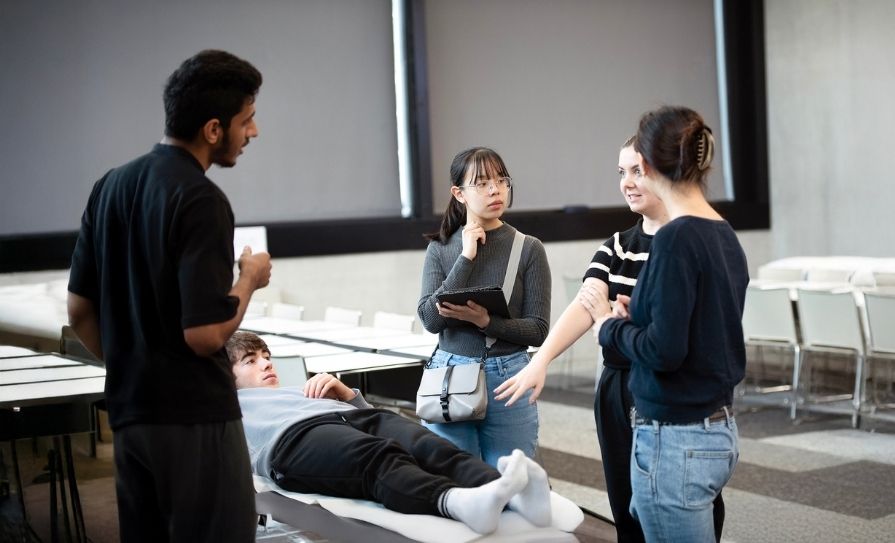
RCSI medical students take part in a ‘Preparation for Clinical Practice’ workshop at the RCSI’s Education and Research Centre, Beaumont Hospital, Dublin
(Photo credit: Ray Lohan/RCSI)
We developed a new curriculum to reflect the kind of doctors the world needs now
In 2018, when we embarked on the process of overhauling the medical curriculum at the RCSI University of Medicine and Health Sciences, we asked ourselves: “What makes a good doctor in today’s world?”
Our remit was to carry out a root and branch review of the existing curriculum and develop a new programme that would ensure the RCSI’s medical graduates are equipped to become capable, caring, and resilient doctors of the future. We wanted them to have the best possible foundation for their future careers and be able to contribute positively to healthcare systems wherever they work.
Prof John Jenkins was charged with leading colleagues in a collaborative effort to understand the changing landscape in which our doctors will practise.
At the outset, we identified three key factors which we felt should inform the development of a new curriculum.
Firstly, today’s doctors are increasingly global, so they need to be prepared not only to work anywhere in the world, but also to treat patients from all different backgrounds and cultures.
Secondly, doctors now work in a digital world, with artificial intelligence becoming an ever more important part of every aspect of their work. Patient records are increasingly online, and robotics are used in many surgical procedures. Our doctors need to be tech-savvy.
Thirdly, climate change and environmental pollution continue to impact population health. We see this in the spread of pathogenic diseases to new areas and extreme weather events leading to increased deaths. Medicine has to keep pace in a changing world.
New curriculum
As the Director of Curriculum, I am leading the implementation of our new medical curriculum programme. To date, three years have been delivered successfully and implementation of the fourth-year curriculum will commence in September 2025. Work on the fifth-year programme, which will commence in 2026, is already underway.
So far, all indications are that our newly transformed curriculum is delivering as we hoped.
The new curriculum focuses on three key pillars: Medical knowledge, clinical skills, and personal and professional identity (PPId). While the two former pillars have always been at the core of medical education, the explicit assessment of the third is new, but no less important. At the RCSI, we define PPId as the ability to self-reflect, learn, and grow. It is designed to equip graduates to both manage their own careers and bring empathy to their interactions with patients. In a demanding and sometimes stressful profession, resilience and self-awareness are key.
Other medical schools have already engaged with some of these concepts, but what makes the RCSI’s approach truly transformative is that we have chosen to implement everything in one go. In so doing, our intention is to create the future change agents of our healthcare systems, doctors who can think on their feet, learn fast, and embrace change.
Small groups
We have fundamentally changed how we teach. While we still have some large lectures, the class of 360 students is now divided into six groups of 60. Each learning community is further divided into five sub-groups of 12. This small-group format fosters collaboration and interaction across a diverse student body, reflecting the RCSI’s multicultural environment, and ensuring that students engage with peers from a wide range of backgrounds, cultures, and perspectives.
These small groups nurture a sense of community that supports individual learning styles and promotes self-awareness, resilience, and a growth mindset. In their groups, students learn through case-based scenarios, with integrated curricula and evidence-based methods driving active, engaged, and authentic learning. A patient-centred approach allows first-year medical students to explore clinical conditions from the outset, makes learning more manageable, and instils a greater understanding of practical application compared with where students learn foundational sciences in the abstract.
Assessments
We have also changed the way we assess.
Instead of the traditional high-stakes final exam at the end of the year, we have introduced programmatic assessment with multiple low-stakes assessments with feedback throughout the year. This gives students the tools to manage their own professional development.
Progress testing using an iterative approach means a first-year student can consider a case or scenario and apply learned concepts to a final-year question. This patient-centred, case-based approach allows students to explore clinical conditions from the outset, with topics being revisited over the course of their studies to facilitate the application of increasing knowledge.
Through a personal dashboard, each student can now see assessment results and feedback immediately, and know how they stand in relation to their classmates at any given time. This means students are given the opportunity to remediate earlier if they need to. Every student has a personal tutor, a senior academic, with whom they meet three times each year to review their progress and identify any areas in which they may need support.
With constant feedback, the focus shifts from grades to growth, from passing or failing to improvement and understanding. This leads to more self-reflection which, in turn, builds confidence for the lifetime of continuous professional development that comes with being a doctor.
Rigour is embedded in the assessment process with quality controls to ensure the maintenance of high standards, but with less stress for individual students.
The feedback from the students who are progressing through our new curriculum has been overwhelmingly positive. They are enthusiastic about the case-based learning approach, which brings real-world relevance and makes them feel like doctors from day one. This contrasts with the first three years of my own medical degree in the 1990s, when I often felt as though I was doing a science degree, and wondered when I would ever feel like a doctor.
The altered assessment model helps them stay engaged and – unsurprisingly – they prefer it to the pressure of a single final exam.
For the RCSI’s staff and faculty the implementation of the new curriculum has been a huge change and not without its challenges in terms of governance and workload.
However, the buy-in from colleagues across the RCSI, and from the public and community groups who have helped us with curriculum design, has been key to its smooth implementation.
Our hope is that the PPId aspect of the new curriculum will foster deeper self-awareness of their behaviour and attitudes in our graduates, making for better doctors and happier patients.
When I was studying medicine, it was all about cramming in all the information you could from massive books. Now we know that, while knowledge and clinical skills remain vital, of equal importance is the way doctors deal with patients. We hope our future graduates will have both the skillset and the growth in mindset to enable them to be more resilient. When a doctor understands themselves, their own wellbeing grows too, providing a space for empathy that places their patients at the centre of all they do.
One of the drivers of curriculum change is the set of challenges we know exist in our healthcare systems – some of which we can change, and others we cannot. But if we can equip our graduates to be capable, compassionate doctors who thrive in any setting, then we are producing truly global practitioners. Doctors who can adapt, respond, and lead – whether they are working in Ireland or anywhere else in the world.
As we prepare to implement year four of the programme, our dynamic new curriculum is continually taking on feedback to enable it to improve and evolve. While it is not yet possible to evaluate fully whether it is producing the kind of doctors we hope it will, the early signs are good. Third year is where students start to go on clinical placement and we already have received anecdotal testimonials from our clinicians that this group is different to previous cohorts. They understand better how to behave in a hospital environment because they have been exposed to clinical scenarios from day one. And from the outset the students themselves can say: “I feel like a doctor.”












Leave a Reply
You must be logged in to post a comment.