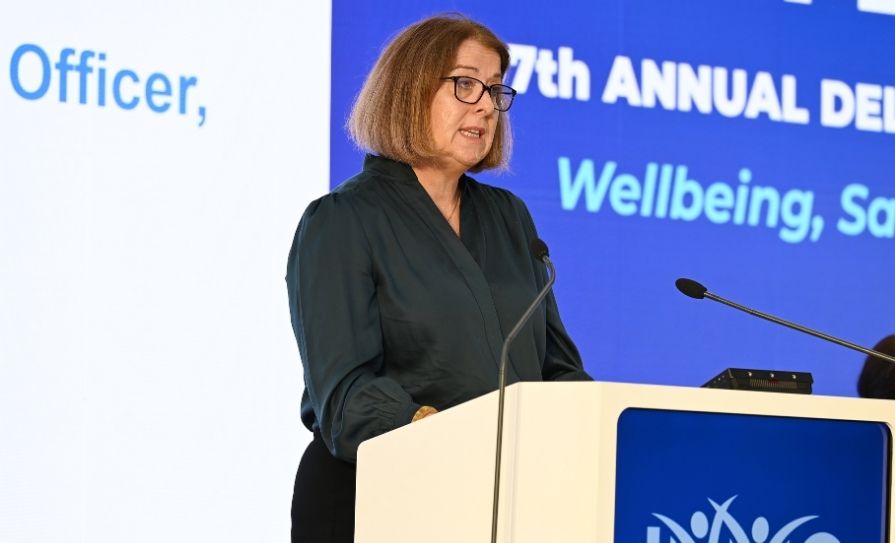
Ms Anne O’Connor
Photo credit: Lisa Moyles
Ms Anne O’Connor knew the scale of the task ahead when she was appointed as HSE Chief Executive Officer (CEO) in December.
Although Ms O’Connor joined the Executive from Vhi Health and Wellbeing, where she was Managing Director since August 2022, she had worked in the HSE for decades, including as Chief Operating Officer during the Covid-19 pandemic.
In her 27 years in the HSE, she held a number of senior clinical and executive management roles, such as National Director for Mental Health and National Director for Community Operations.
So the role of CEO, which includes the responsibility to operate within budget, probably held few surprises. And Ms O’Connor’s tenure began with a memo to senior management to pause the recruitment for non-frontline positions due to overspending.
This action was taken as a result of the significant €250 million deficit the HSE has incurred for the first three months of the year.
Due to the overspend, three HSE regions – Dublin and South East, Dublin Midlands, and the South West – have been placed in ‘tier three escalation’.
This involves the introduction of employment controls and greater oversight on expenditure.
It is understood that in these regions, a recruitment freeze will apply across all ‘non-frontline, non-critical posts’. Exceptions will require a business case to be approved by the regional executive officer.
More generally, throughout the HSE, spending on agency staff is a continuing concern.
Speaking to reporters at the recent Irish Nurses and Midwives Organisation (INMO) Annual Delegate Conference, Ms O’Connor said: “It is not uncommon to have a deficit in the first quarter of the year because that is when our health system is at its busiest.”
“We know we open all our capacity in the first quarter to deal with the demands of people coming through our doors in the winter months,” she said.
“The reality is that we have to use our money better. And we have to continue to provide high quality safe services to patients.”
She spoke about the importance of implementing the reform measures already underway across the system, such as the roll-out of the public-only consultant contract (POCC) and Sláintecare initiatives, in order not only to reduce expenditure, but to tackle problems such as emergency department crowding and lengthy waiting lists.
The importance of the POCC has become a mantra for Minister for Health Jennifer Carroll MacNeill, who also spoke at the INMO meeting.
In her conference speech, the Minister noted she had discussed the implementation of the POCC with the INMO as part of getting the union’s perspective on reform across the health service.
And later, speaking with the media, the contract was one of the first issues Minister Carroll MacNeill referenced when questioned on the HSE deficit.
“Yes, there has been increased demand, but that is not the only story,” according to the Minister.
“The real project for the HSE is the implementation of this public-only consultant contract, not just because of what it does in itself, but what else it enables in terms of efficiency in our healthcare system.”
Despite assurances that clinical services would not be cut, the INMO and the IMO have expressed concern about what the deficit means for frontline positions.
In the IMO’s statement, President Prof Matthew Sadlier made the point that the health service is not sufficiently resourced (in funding and staffing) to operate effectively.
The debate reflects a familiar divide in healthcare: Politicians and management insist on reform and efficiency, while representative bodies and unions call for additional support.
Ms O’Connor would be well aware of the nature of this dialogue. The challenge will be to find a balance between negotiating the HSE’s serious budgetary pressures and ensuring that services for patients are protected to the fullest possible extent.












Leave a Reply
You must be logged in to post a comment.