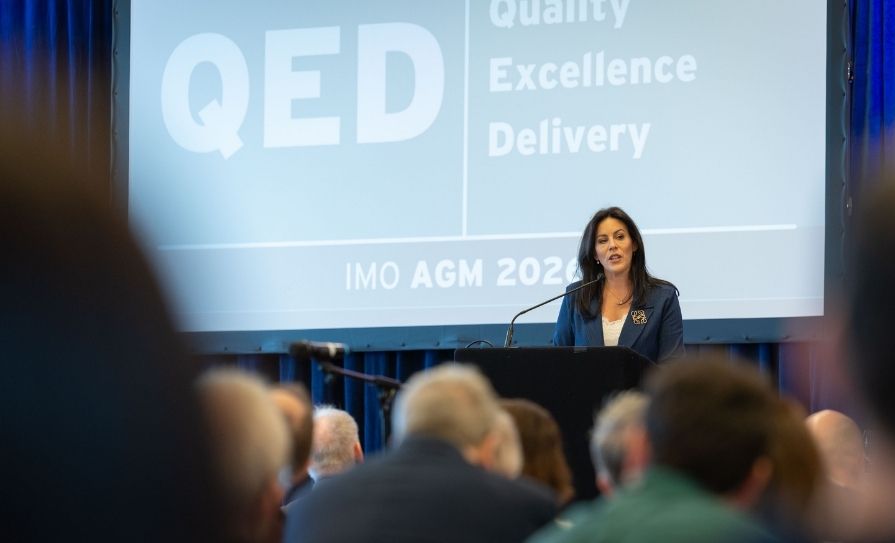
Minister for Health Jennifer Carroll MacNeill speaking at the IMO AGM
As fuel protests and blockades caused chaos across the country, the IMO AGM, held as usual in the luxuriant setting of the Europe Hotel in Killarney, was a centre of calm.
Many of the contract disputes that have affected the various craft groups over the last decade have largely been settled.
Some 69 per cent of consultants are now on the public-only consultant contract and consultant numbers have grown since the Covid-19 pandemic.
Specialists in public health have consultant status after the agreement between the Department of Health and the IMO in 2021 and the recruitment campaign for 86 such posts has been completed.
For GPs, the €210 million agreement in 2019 to reverse cuts imposed through Financial Emergency Measures in Public Interest legislation has made practices more viable and the structured chronic disease programme is widely recognised as a significant success.
Of course, challenges remain.
The national consultant meeting heard that Ireland has 1.44 consultants per 1,000 population, compared to the Organisation for Economic Co-operation and Development average of 2.45, despite recent increases.
Consultant in Public Health Medicine Dr Ina Kelly told the Medical Independent (MI) that while the recent recruitment campaign in the specialty was “a good start”, it is only making up for years of under-investment.
GPs discussed the challenge of “unresourced work” as a result of requests from secondary care colleagues. This has been a recurring theme of recent AGMs and has yet to be satisfactorily resolved. The affordability for newly trained GPs to set up in practice is another issue that needs to be addressed.
But compared to many meetings past, the progress that has been achieved for doctors was notable.
The group where progress is less apparent is NCHDs. Although the number of NCHDs has risen, there is continued frustration at the failure of the HSE to fully honour the 2022 agreement reached with the IMO.
While 24-hour shifts are not as frequent as they once were, they have yet to be eliminated.
The 2022 agreement also contained the commitment to negotiate a new NCHD contract. However, negotiations have not proved straightforward so far and talks only recently recommenced.
Chair of the NCHD committee Dr Rachel McNamara told MI that industrial action cannot be ruled out if meaningful progress is not made.
The last time NCHDs went on strike was over 10 years ago, as part of the IMO’s 24 No More campaign in 2013.
In contrast, across the water, the British Medical Association has called a series of strikes in England for resident doctors (formerly junior doctors) since 2023 as a result of pay and working conditions. The most recent of these – a six-day walkout – occurred earlier this month. Like the fuel protests here, they partially overlapped with the IMO AGM.
Whatever your opinion on them (the IMO and the Medical Council made statements highlighting their threat to the delivery of health services), the fuel protests were a forcible example of the power of mass demonstration. The protests also showed that, for the moment at least, the State can usually find additional money when needed.
As has become her mantra, the Minister for Health Jennifer Carroll MacNeill was keen to stress ‘productivity’ in her conference speech and the need for hospitals to evolve eventually to a full seven-day service. The implication was that industrial relations matters are done and dusted.
But things can change very quickly. These are very volatile times internationally. And, as we are learning again, this volatility can have consequences at home. The Irish medical world may be relatively calm for now, but how long that will continue to be the case is far from certain.












Leave a Reply
You must be logged in to post a comment.