







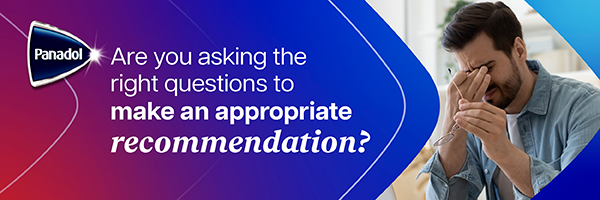
Headaches are a common symptom associated with a wide range of clinical conditions.1
The vast majority of headaches are classified as primary headaches, i.e. not associated with an underlying condition. This includes tension-type headaches and cluster headaches.1 Primary headache disorders constitute nearly 98% of all headaches.2
Secondary headaches, precipitated by another condition or disorder, and painful cranial neuropathies, are less common.1
Although headaches are not usually serious in themselves, recurring headaches can impact patients’ overall quality of life, family and social life, and productivity and employment.3
As a healthcare professional, patients experiencing headaches will ask you to recommend pain relief, and you will want to make the best possible recommendation. However, there are a number of factors to consider when making your tailored recommendation. Patient needs vary, and it’s important to take these into account when giving your advice to ensure your recommendation is suitable.
Asking the right questions
First, assess the patient for red flag symptoms that might suggest a secondary cause requiring specialist assessment.1
This can include asking:4
- Is the headache worsening?
- Is the headache sudden in onset, reaching maximum intensity within 5 minutes?
- Have you had any head trauma in the past 3 months?
- Is the headache triggered by exercise or coughing?
- Is the headache associated with fever or any other illness?
- Have you experienced acute headache with loss or alteration of consciousness?
If the patient answers ‘yes’ to any of these, you should consider referring them for specialist assessment or admission, depending on your clinical judgement of the urgency.
Once you’ve eliminated any potential red flags, assess the symptoms:5
- What is the frequency of the headache (episodic or daily, and how many days per month)?
- Where do you feel the pain (i.e. in the head, face, neck etc.)? Does it radiate (spread) to any other location?
- Can you describe the quality of pain (pressing, pulsating, stabbing, etc.)?
- Do you have any other symptoms like unusual sensitivity to light (photophobia) and/or sound (phonophobia), or nausea and/or vomiting?
It’s also important to understand the patient’s medication history:
- Are you taking any medication (prescribed or over-the-counter)? If yes, what medications are you taking and in what doses?
- What have you used in the past to treat your headaches?
- What triggers your headache?
- Is there any family history of headaches?
If headaches are on-going, you may wish to recommend the use of a headache diary to record the frequency, duration, and severity of the headaches. This can help you to discuss the condition and its impacts with your patient, and monitor the effectiveness of any interventions.6
Recommending the right pain relief option
Once you’ve established that there are no underlying secondary causes and you have made an assessment of the patient’s circumstances and condition, there is a wide range of potential headache treatments available. Non-pharmacological options include the patient doing activities to help them relax, changing their sleeping habits or using a low, firm pillow and heat or cold packs if they have neck pain and headaches.7
When it comes to pharmacological options for treatment of acute tension-type headaches, NICE guidelines suggest a simple over-the-counter analgesic like paracetamol, aspirin or a non-steroidal anti-inflammatory drug (NSAID).6
Paracetamol is suitable for use by 98% of the population,*8 meaning that you can be confident in recommending it for the majority of:9
- Elderly patients
- Patients with cardiovascular disease
- Patients with a stomach ulcer
- Patients with asthma**
Paracetamol generally has an excellent safety profile except in cases of significant overdose, with few drug interactions. This means that it is often likely to be suitable for patients who use other medications.10
Note: Please refer to the product label for full information about the product you are considering for recommendation.
Not all paracetamol tablets are the same
The specific formulation of a paracetamol tablet will have an impact on how quickly and effectively it relieves your patients’ pain.
For example, the addition of caffeine to paracetamol can significantly boost its analgesic effects.11 It works by blocking adenosine receptors, affecting pain signalling both centrally and peripherally, and may also inhibit cyclooxygenase activity, contributing to its antinociceptive and adjuvant effects.12,13
Meanwhile, formulations that promote more rapid disintegration of the paracetamol tablets allow for quicker absorption.
The Panadol range of products produced by Haleon include formulations designed to enhance the pain-relieving effects of paracetamol:
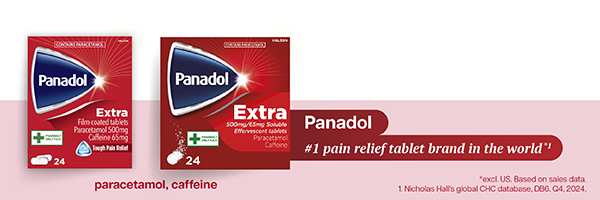
- The dual paracetamol and caffeine formulation of Panadol Extra film-coated tablets helps patients fight tough pain.14
- The unique Optizorb® technology used in Panadol 500mg Film Coated Tablets (paracetamol) and Panadol Extra film coated tablets features super-disintegrants that speed up the disintegration of the tablet in the stomach.15
Headaches are common, and can impact your patients’ quality of life. By asking the right questions and recommending a suitable, effective, over-the-counter analgesic, you can help them relieve pain so they can continue with their day.
Panadol 500mg Film Coated Tablets and Panadol Extra Film-coated Tablets contain paracetamol. Always read the label/leaflet.
*Data was collected from 107,553 patients (18–75 years) using OTC analgesics in Australia. Overall 1.9% of patients had ≥1 contraindication, warning or precaution to paracetamol use.
**Bronchospasm has been reported very rarely in patients sensitive to NSAIDs and aspirin.
References
- NICE CKS. Headache: assessment. Available at: https://cks.nice.org.uk/topics/headache-assessment/. Accessed November 2025.
- Ahmed F. Headache disorders: differentiating and managing the common subtypes. Br J Pain. 2012 Aug;6(3):124-32.
- World Health Organization. Migraine and other headache disorders. Available at: https://www.who.int/news-room/fact-sheets/detail/headache-disorders. Accessed November 2025.
- NICE Guidance. Headaches in over 12s: diagnosis and management. Available at: https://www.nice.org.uk/guidance/cg150/chapter/Recommendations#assessment. Accessed November 2025.
- Speciali JG, Eckeli AL, Dach F. Tension-type headache. Expert Rev Neurother. 2008 May;8(5):839-53.
- NICE CKS. Management of tension-type headache. Available at: https://cks.nice.org.uk/topics/headache-tension-type/management/management/. Accessed November 2025.
- NHS. Tension headaches. Available at: https://www.nhs.uk/conditions/tension-headaches/. Accessed January 2026.
- Clarke GD, et al. Int J Pharm Pract. 2008;16:1-4.
- Graham GG, Scott KF, Day RO. Drug Saf. 2005;28(3):227-40.
- Sharma CV, Mehta V. Paracetamol: mechanisms and updates. Continuing Education in Anaesthesia Critical Care & Pain. 2014;14(4):53–158.
- Laska EM, Sunshine A, Mueller F, Elvers WB, Siegel C, Rubin A. Caffeine as an Analgesic Adjuvant. JAMA. 1984;251(13):1711–1718.
- Baratloo A et al. Anesth Pain Med 2016;6(3):e33193.
- Fiebich BL et al. Neuropharmacology 2000;38:2205–13.
- Wilson CG, et al. Drug Dev Ind Pharm 2011.
- Haleon Data on File, Study A1900265.
Product Information
Panadol 500mg Film Coated Tablets (paracetamol). Indications: Short-term management of headaches, musculoskeletal disorders, menstrual pains, toothache, symptoms of colds and flu, mild to moderate pain associated with diagnosed osteoarthritis. Dosage: Adults (including the elderly) and children 16 years and over: 1–2 tablets, up to 4 times daily, as required. Children aged 10–15 years of age: 1 tablet, up to 4 times daily as required. Max 4 doses in 24 hours. Do not give to children for more than 3 days without consulting a doctor. Do not give to children under 10 years. Minimum dosage interval is 4 hours. Contraindications: Hypersensitivity to paracetamol or any of the other ingredients. Precautions: Do not use with any other paracetamol-containing products. Use with caution in patients with depleted glutathione levels / glutathione depleted states. Those diagnosed with liver or kidney impairment must seek medical advice before use. Caution, regarding paracetamol, if used at therapeutic doses for a prolonged period or administered concomitantly with flucloxacillin due to increased risk of high anion gap metabolic acidosis (HAGMA), particularly in patients with severe renal impairment, sepsis, malnutrition and other sources of glutathione deficiency (e.g. chronic alcoholism). If suspected, discontinue use promptly and monitor closely, including measurement of urinary 5-oxoproline. Do not exceed the stated dose. Prolonged use, except under medical supervision, may be harmful. Side effects: Very rare: Hypersensitivity reactions including anaphylaxis and skin rash, thrombocytopenia, angioedema, Stevens-Johnson syndrome, Toxic Epidermal Necrolysis, serious skin reactions, bronchospasm, hepatic dysfunction. Not known: High anion gap metabolic acidosis. Legal Category: 12 Tablets GSL; 24 Tablets Pharmacy Only. MA Number: PA 678/107/1. MA Holder: Haleon Ireland Limited, Clocherane, Youghal Road, Dungarvan, Co. Waterford, X35 Y983, Ireland. Text prepared: June 2025. Further information available on request.
Panadol Extra Film-coated Tablets (paracetamol 500mg, caffeine 65mg). Indications: Mild to moderate pain including rheumatism, neuralgia, musculoskeletal disorders, headache, toothache, menstrual pain, discomfort of flu, fever and feverish colds. Dosage — Adults and children 16 years and over: 2 tablets up to 4 times a day. Do not exceed 8 tablets in 24 hours. May need a lower dose if underweight (<50kg), malnourished, dehydrated or have alcohol problems. Children aged 12–15 years: 1 tablet up to four times daily. Do not exceed 4 tablets in 24 hours. Do not give to children under 12 years. Minimum dosage interval: 4 hours. The lowest dose necessary to achieve efficacy should be used. Contraindications: Hypersensitivity to paracetamol, caffeine or any of the other ingredients. Precautions: Do not use with any other paracetamol-containing products. The concomitant use with other products containing paracetamol may lead to an overdose. Paracetamol overdose may cause liver failure which can lead to liver transplant or death. Use with caution in patients on concomitant treatment with drugs that induce hepatic enzymes and in patients with risk factors for hepatotoxicity (see SPC for further details). Patients diagnosed with liver or kidney impairment must seek medical advice before use. Caution, regarding paracetamol, if used at therapeutic doses for a prolonged period or administered concomitantly with flucloxacillin due to increased risk of high anion gap metabolic acidosis (HAGMA), particularly in patients with severe renal impairment, sepsis, malnutrition and other sources of glutathione deficiency (e.g. chronic alcoholism). If suspected, discontinue use promptly and monitor closely, including measurement of urinary 5-oxoproline. Do not exceed the stated dose. Prolonged use except under medical supervision may be harmful. If high fever, or signs of secondary infection occur or if symptoms persist for longer than 3 days, consult your doctor. Contains parahydroxybenzoates, which may cause allergic reactions (possibly delayed). Avoid excessive concurrent caffeine intake. Side effects: Very rare cases of serious skin reactions have been reported. (paracetamol) Very rare: Hypersensitivity reactions including anaphylaxis and skin rash, thrombocytopenia, angioedema, Stevens-Johnson syndrome, Toxic Epidermal Necrolysis, bronchospasm, hepatic dysfunction. Unknown: High anion gap metabolic acidosis. (caffeine) Frequency unknown: Nervousness, dizziness, insomnia, restlessness, anxiety, irritability, gastrointestinal disturbances and palpitations. MA Holder: Haleon Ireland Limited, Clocherane, Youghal Road, Dungarvan, Co. Waterford, X35 Y983, Ireland. MA Number: PA 678/27/1. Legal Category: 12 Tablets GSL; 24 Tablets Pharmacy Only. Text revised: Jan 2026. Further information available on request.
PM-IE-PAN-25-00075








Leave a Reply
You must be logged in to post a comment.