


Related Sites

Related Sites

medical news ireland medical news ireland medical news ireland

NOTE: By submitting this form and registering with us, you are providing us with permission to store your personal data and the record of your registration. In addition, registration with the Medical Independent includes granting consent for the delivery of that additional professional content and targeted ads, and the cookies required to deliver same. View our Privacy Policy and Cookie Notice for further details.


Don't have an account? Register

ADVERTISEMENT

ADVERTISEMENT

Mater becomes first in Ireland to introduce new precision cancer tests

By Mindo - 18th Dec 2025

Credit: istock.com/LightFieldStudios

The Mater Misericordiae University Hospital (MMUH) has become the first hospital in Ireland to successfully introduce new cancer tests for personalising treatment for patients with aggressive forms of gastrointestinal and ovarian cancers.

Claudin-18 (CLDN18) and Folate Receptor-1 (FOLR-1) companion diagnostic and therapeutic testing enables clinicians to determine whether patients with certain aggressive cancers may benefit from highly targeted and potentially life-extending cancer immunotherapies.

The newly validated tests, completed by Medical Scientists and Histopathology Consultants in the hospital’s Cellular Pathology Department, identify the presence of specific proteins in tumour tissue, helping to discern whether new, specialised cancer treatments could improve outcomes for individual patients.

“Pathology laboratories play a central role in clinical decision-making. Approximately 70 per cent of all medical decisions are informed by pathology test results,” said Dr Ann Treacy, Consultant Histopathologist at the Mater Hospital.

“By expanding our precision diagnostic capabilities, patients in Ireland can benefit from advanced testing that helps us match the right patient to the right treatment. This level of precision is vital for improving outcomes, particularly for patients with few remaining treatment options.”

Claudin-18 testing helps identify patients with upper gastrointestinal cancers who may benefit from novel immunotherapies. FOLR-1 testing supports precision treatment decisions for epithelial ovarian, fallopian tube or primary peritoneal cancers by determining whether a patient may be suitable for targeted therapies in cases of recurrent or chemotherapy-resistant disease. Together, these tests offer new possibilities for patients who have exhausted conventional treatment options.

“The introduction of these biomarkers represents a meaningful step forward for patients facing some of the most challenging cancers,” said Dr Darren Cowzer, Consultant Medical Oncologist at the Mater Hospital.

“Having rapid access to high-quality local Claudin-18 and FOLR-1 testing allows us to identify candidates for targeted therapies much earlier, ensuring treatment decisions are timely, and precise. These advances give more patients the opportunity to benefit from standard and experimental therapies that may significantly improve outcomes and quality of life.”

ADVERTISEMENT

Latest mater

ADVERTISEMENT

MMUH launches Ireland’s first AI centre in a clinical setting

By Reporter - 17th Jun 2025

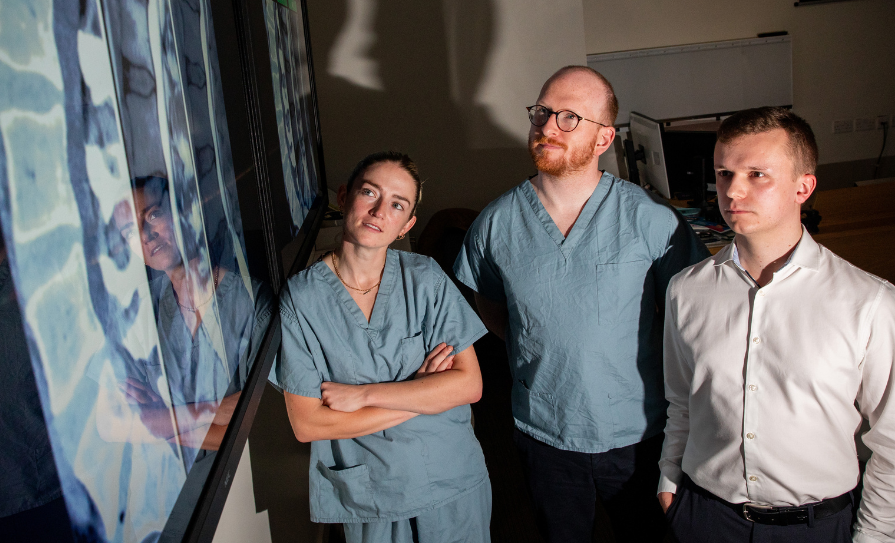
Pictured L-to-R at the Mater Hospital are Ms Siobhan Killeen, Radiographer; Dr Edward McDermott, Specialist Registrar in Radiology; and Mr Paul Banahan, Senior AI Research Fellow

The Mater Misericordiae University Hospital (MMUH) in Dublin has become the first hospital in Ireland to establish a Centre for AI and Digital Health.

The new hub, which will be based at the Pillar Centre for Transformative Healthcare, will utilise artificial intelligence (AI) to solve clinical problems across the hospital. Through research, it will develop AI-driven solutions to improve patient care and outcomes.

The Mater Hospital’s Centre for AI and Digital Health has been brought about through the collaboration of consultants, researchers and hospital leadership. The hospital said it will make a “tangible difference in patient care”.

“AI has the power to transform how we deliver healthcare,” said Ms Erin Daly, Operations Manager for the Pillar Centre for Transformative Healthcare. “At the Mater Hospital, we are developing AI solutions that directly improve clinical processes, whether it’s streamlining workflows, assisting in medical research, or helping doctors make faster, data-driven decisions.”

The Mater Hospital’s new hub for AI-driven medical advancements is overseeing the adoption of AI and engaging in research across multiple medical specialties, including radiology, oncology, cardiology, and ophthalmology.

“This centre offers a unique opportunity to bring together clinical and technical expertise to adopt and innovate with AI in Irish healthcare,” said Mr Paul Banahan, Senior AI Research Fellow at the Mater.

Among some of its pioneering research projects are:

  • AI-driven automation which will help to identify suitable patients for clinical trials in oncology. This will significantly reduce the 16 hours per week it currently takes a nurse to manually scan these lists, speeding up patient access to clinical trials.
  • The reduction in the number of cardiac fluoroscopy video x-ray images, and subsequently the radiation exposure to both the patients and clinical staff, through real-time AI generated images.
  • The synthetic spinal imaging project, which has developed a generative AI that can convert lumbar spine CT images into synthetic MRI images for cauda equina syndrome presentations, allowing for better and more robust out-of-hour or emergency care planning and treatment.

Speaking on the potential applications of AI in cardiology, Prof Joe Galvin, Consultant Cardiologist, said: “AI has the potential to enhance the accuracy of ECG and radiology scan analysis, reducing the time that a patient has to wait for the results of their diagnosis and, if required, starting their treatment sooner.  If a patient suffers from cardiovascular disease, stroke or cardiac arrest, every minute counts. AI’s ability to increase accuracy and speed may be lifesaving.”

While AI promises significant benefits, the Mater stated it is equally focused on responsible and ethical implementation. According to the hospital, “robust data protection and management frameworks” are being developed to ensure patient safety and privacy, as well compliance with best practices.

“AI in healthcare must be implemented with care, accountability, and a clear focus on improving patient outcomes,” said Ms Josephine Ryan Leacy, CEO of the Mater Hospital. “The Mater Hospital’s Centre for AI and Digital Health is focused on ensuring that AI is developed and deployed in a way that prioritises patient safety, transparency, and real clinical benefits.”

The Centre’s work is already proving valuable, with AI solutions contributing to the reduction of emergency department waiting times and optimising hospital workflows.

In the Mater’s radiology department, AI is assisting in the rapid notification of suspected pathologies, like stroke and fractures, which are being correctly flagged by AI within two-to-three minutes of the scan being completed, with an accuracy rate of over 90 per cent. Consultant Radiologist Prof Peter MacMahon said: “Our experiences have underscored the tangible benefits of AI, notably in expediting critical diagnoses and reducing turnaround times by rapidly flagging anomalies detected in scans.”

“Bringing AI into clinical practice is not just about innovation, it’s about making healthcare more efficient, effective, and accessible,” said Prof Brendan Kinsley, Clinical Director of the Pillar Centre for Transformative Healthcare. “The Mater Hospital’s Centre for AI and Digital Health is laying the groundwork for a smarter, more responsive healthcare system, and I am incredibly proud to see this vision come to life.”

For more information visit the Centre’s website: https://thepillarcentre.ie/ai/

ADVERTISEMENT

Latest mater

ADVERTISEMENT

ADVERTISEMENT

ADVERTISEMENT

Latest Issue
Medical Independent 10th March 2026

You need to be logged in to access this content. Please login or sign up using the links below.

ADVERTISEMENT

Trending Articles

ADVERTISEMENT

ADVERTISEMENT

ADVERTISEMENT