







A new training programme to improve the quality of cardiopulmonary resuscitation (CPR) has been introduced by The National Rehabilitation Hospital (NRH) in Dun Laoghaire. It is the first in the country to adopt Resuscitation Quality Improvement (RQI) – a digital CPR training programme with the Irish Heart Foundation.
The programme is designed to help healthcare workers achieve, master, and sustain high-quality CPR skills and competence, ultimately resulting in improved outcomes for patients in cardiac arrest.
For decades, the CPR training standard for healthcare providers has been an instructor-led ‘Basic Life Support’ (BLS) CPR course. Most institutions have a requirement in place to renew credentials annually or every two years. However, the evidence would indicate that skills can be lost within three to six months following BLS training.
The new programme will see an estimated 350 health professionals enrol in RQI at the NRH this year. Co-developed by the American Heart Association and Laerdal Medical, RQI is self-directed, simulation-based training provided through quarterly cognitive and hands-on CPR quality improvement sessions which measure and verify competence.
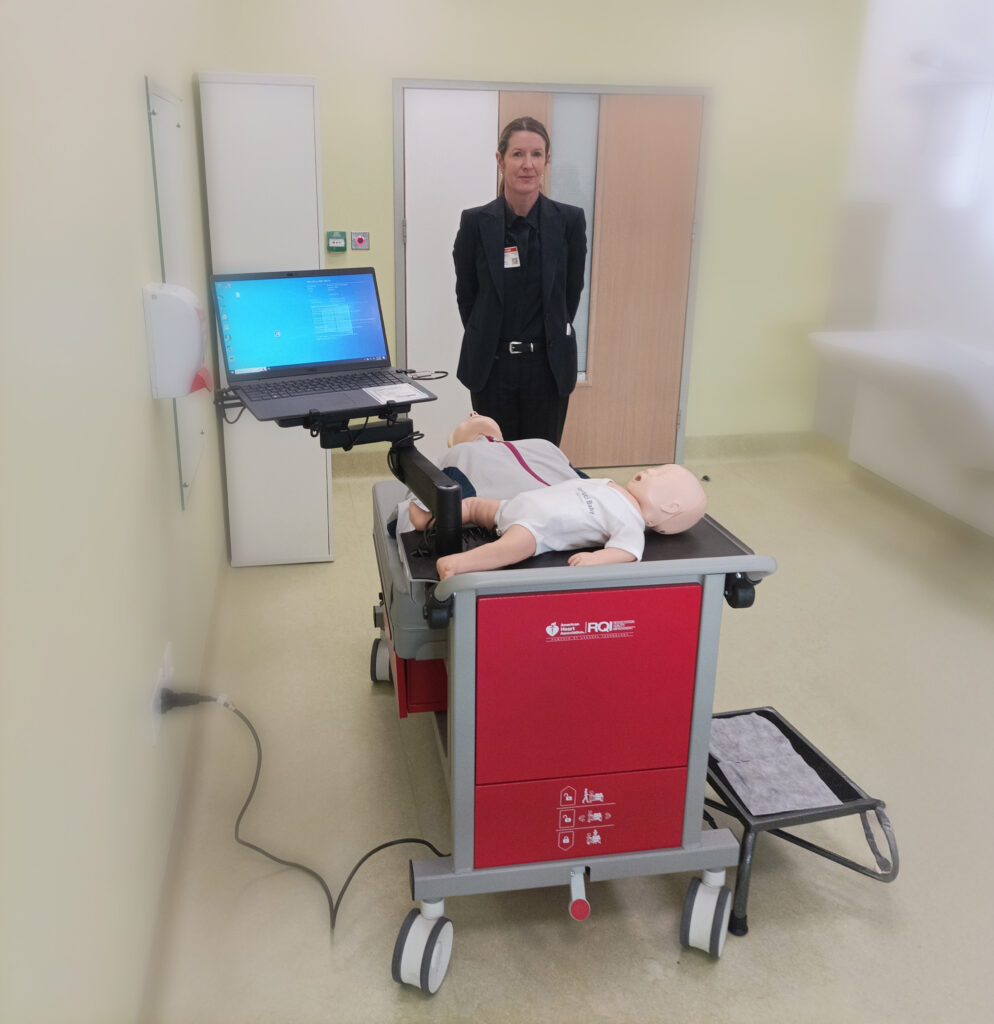
Courses are delivered through an RQI simulation station which is positioned within the hospital, giving learners greater flexibility and 24/7 access to training. Studies show a significant improvement in CPR quality and performance when staff are retrained three times over six months by using an automated mannequin with real-time feedback.
“The RQI programme brings game-changing innovation to how we teach and learn critical, lifesaving CPR skills,” said Geraldine Leete, who oversees RQI for the Irish Heart Foundation.
“The RQI programme raises the bar in how organisations develop and elevate their healthcare training. Research shows that better quality CPR can have a positive impact on survival. Other public and private hospitals and nursing and medical schools are encouraged to sign up to the programme.”
Current face-to-face programmes entail staff leaving the clinical area for periods of at least four to five hours. RQI is designed to be accessible to all healthcare staff and only requires a shorter period of practice.
Attracta Kennedy, Resuscitation Officer at the NRH, said: “This is a significant and exciting milestone for the NRH. Delivery of high-quality CPR training has always been a key priority for the NRH, as is innovation and finding new ways to achieve continuous improvements in our service delivery, and education and training. The move to digital CPR training is another step forward in our digital transformation journey at the NRH.
“We look forward to streamlining and sustaining CPR skills and competence as we transition from instructor-led Basic Life Support CPR training to the RQI digital training programme in collaboration with
the Irish Heart Foundation.”
The RQI programme is marketed, sold, and supported in Ireland by the Irish Heart Foundation. If you or your management team would like to enquire about the RQI programme, visit irishheart.ie.
“We are excited the National Rehabilitation Hospital is embracing the RQI programme to shift to a new standard of resuscitation care – competence,” said Gareth Patrickson, RQI Partners’ senior Vice-President of International Customer Impact.
“High-quality CPR delivery is a priority, and the hospital joins our commitment to ensuring all healthcare providers in every community are competent and confident in their resuscitation skills to help save more lives from cardiac arrest. We celebrate NRH marking a first in Ireland and look forward to nurturing a collaborative relationship rooted in resuscitation excellence.”



Leave a Reply
You must be logged in to post a comment.