







In this and future editions of the IAANMP Advanced Practice Supplement, we feature poster abstracts from our members, highlighting the outstanding work, research, and innovation being led by ANMPs across Ireland.
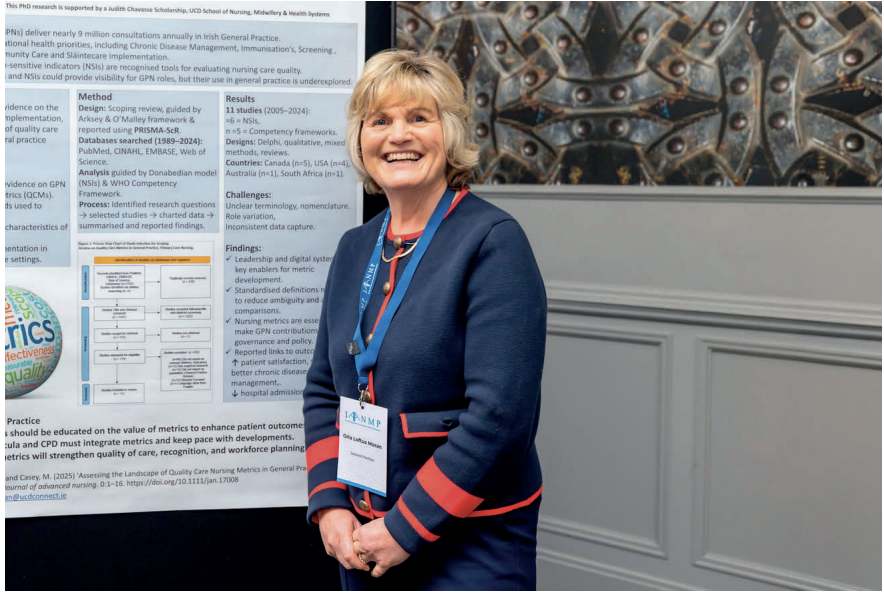
her poster at the IAANMP Conference 2025
These abstracts represent the strength, depth, and diversity of advanced practice, capturing clinical excellence, research innovation, service development, and leadership in action.
Each submission reflects the ongoing commitment of our members to evidence-based practice, professional advancement, and improved patient outcomes. By highlighting this exceptional body of work, we aim not only to recognise the achievements of individual practitioners but also to promote shared learning, collaboration, and the dissemination of best practice throughout the ANP/AMP community.
This platform offers an opportunity to showcase the real impact of advanced practice on healthcare delivery and to inspire continued innovation, scholarship, and excellence in every area of advanced nursing and midwifery.
Quality care nursing metrics in general practice: Outcomes from a scoping review
Authors: Orla Loftus Moran, Advanced Nurse Practitioner (General Practice), PhD Candidate, School of Nursing, Midwifery and Health Systems, University College Dublin; Mary Casey, Associate Professor, School of Nursing, Midwifery and Health Systems, University College Dublin
Background: In Ireland, approximately 2,430 general practice nurses (GPNs) provide close to nine million consultations each year, supporting enhanced community care and Sláintecare policy implementation. Despite this workforce and workload, little is known about the quality or impact of their contribution. While nursing metrics and nurse-sensitive indicators (NSIs) are well-established quality measurement tools in secondary care, their use in general practice is under-explored.
Aims/objectives: To synthesise current evidence on the development, implementation and evaluation of quality care metrics for nurses working in general practice areas.
Methods/approach A scoping review was conducted using Arksey and O’Malley’s framework and PRISMA ScR guidelines. PubMed, CINAHL, EMBASE and Web of Science were searched (1989 2024).
Results/outcomes: Eleven studies (2005–2024) met the inclusion criteria: Six focused on NSIs and five on competency frameworks. Most were conducted in Canada (n=5) and the USA (n=4), with one each from Australia and South Africa. The results demonstrate links between nursing interventions and outcomes such as patient satisfaction, chronic disease management, and reduced admissions. Key challenges included ambiguity in terminology, variation in nursing roles, and barriers to consistent data capture.
Discussion and conclusion: Leadership and digital systems are critical enablers to the development of nursing metrics, while standardising definitions will reduce ambiguity and allow reliable comparisons. Nursing metrics are essential to provide insight into GPN contributions, strengthen governance and policy, and ensure their essential role is visible.
Implications for practice: Nurses and GPs should be educated on the value of nursing metrics in general practice to enhance patient outcomes, with nursing curricula embedding this knowledge and CPD ensuring both groups are aware of, and informed about, ongoing developments in nursing metrics.




Leave a Reply
You must be logged in to post a comment.