








The IAANMP is committed to promoting excellence, innovation, and leadership in advanced practice across Ireland. Each year, the IAANMP National Conference provides a unique platform for ANMPs to share clinical expertise, research, and evidence-based innovations that advance patient care and professional practice.
A highlight of the annual conference is the national poster competition, which showcases the outstanding scholarly and clinical work of ANPs and AMPs nationwide. The competition celebrates original research, quality improvement initiatives, and innovative models of advanced practice that demonstrate the impact and evolving scope of advanced practitioners in Irish healthcare.
This section features the winning abstracts from the IAANMP National Conference 2025 poster competition. These exemplary submissions reflect the depth of clinical inquiry, leadership, and commitment to excellence that define advanced nursing and midwifery practice in Ireland. Through their work, these advanced practitioners continue to influence policy, enhance patient outcomes, and contribute to the advancement of healthcare delivery across all settings.
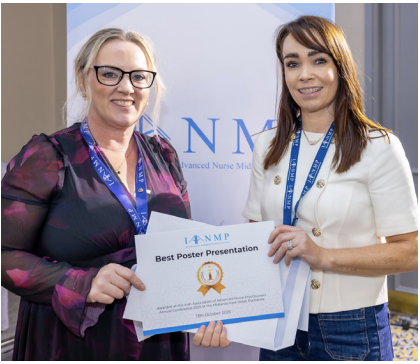
Poster competition winners: 1st place
ABSTRACT
Research question: What is the current level of nurses’ knowledge regarding paediatric fever, and how do nurses in a general hospital paediatric setting approach its management in clinical practice?
Background: Fever is a leading cause of paediatric healthcare visits globally. Despite extensive research demonstrating the benefits of mild to moderate fever in children, and the availability of updated clinical guidelines, misconceptions portraying fever as harmful persist, contributing to significant fear and anxiety among both parents and healthcare professionals. Nurses caring for children play a critical role in assessing febrile patients, implementing interventions, and educating caregivers. Comprehensive knowledge of fever and its management is therefore essential to ensure safe, evidence-based practice and effective caregiver education.
Aim: To examine the knowledge and attitudes of nurses caring for children in an acute general hospital setting regarding fever and its management.
Design: An anonymous, cross-sectional, descriptive, quantitative study.
Methods: The study was undertaken in a mixed tertiary general hospital. Participants were nurses working in paediatric settings within this hospital. Data were collected using an anonymous, pre-validated questionnaire, distributed via QR code. Of 81 nurses invited, 63 responded (78 per cent response rate). Responses were gathered through Smart Survey and analysed using the Statistical Package for Social Sciences (SPSS) version 28. Data were coded, transformed, and statistically analysed to explore knowledge levels and attitudes.
Findings: The study identified significant gaps in knowledge, particularly concerning febrile seizures, antipyretic use, and adherence to best practice guidelines. Inconsistencies were evident between reported beliefs and actual practices. Strengths were noted in understanding fever pathophysiology and the pharmacology of antipyretics.
Recommendations: These findings highlight the need for ongoing, targeted education for nurses in acute paediatric care. Enhancing professional knowledge and addressing misconceptions may improve clinical practice and strengthen caregiver education, thereby increasing parental confidence and competence in managing childhood fever.
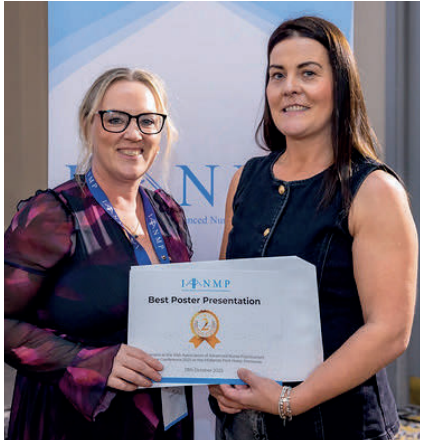
Poster Competition Winners: 2nd place
Project lead: Avril Gannon, Candidate Respiratory ANP
Other team members: Claire Connor, Senior Respiratory Physiotherapist; Chithra Varghese, Respiratory Consultant, patientMpower
Project title: COPD admission avoidance winter initiative
Organisation: HSE, Respiratory Department, Midland Regional Hospital Tullamore
ABSTRACT
Aims: To reduce winter pressures and prevent avoidable hospital admissions, a targeted initiative was launched for high-risk chronic obstructive pulmonary disease (COPD) patients with a history of frequent exacerbations. A total of 10 patients were selected for the programme based on having three or more hospital admissions for acute exacerbation of COPD (AECOPD) in the previous 12 months. The aim was to provide early intervention, enhanced self-management, and continuous monitoring to support patients at home and avoid further admissions.
Methods/approach: All selected patients consented to participate and were provided with a pulse oximeter linked to a digital portal. This portal transmitted real-time oxygen saturation and heart rate data to a dedicated respiratory team who monitored the readings twice daily. The system enabled early identification of clinical deterioration, allowing prompt clinical review and intervention.
In addition, each patient received a personalised COPD self-management plan and a rescue prescription containing antibiotics and oral corticosteroids. The action plan guided patients on recognising symptom changes, when to use rescue medication, and when to seek further medical support. Respiratory clinicians maintained regular virtual contact, offering advice, support, and timely adjustments to care as needed.
Results/outcomes: This initiative empowered patients to manage their condition more confidently during the high-risk winter period. It promoted early treatment of exacerbations and improved continuity of care, while significantly reducing reliance on emergency services.
Discussion: A total of 9 patients (66.67% female, n=6), aged between 59 and 86 years, were enrolled in the remote monitoring programme. Five patients were on long-term oxygen therapy, and one was on ambulatory oxygen therapy. Prior to the intervention, from December 2023 to November 2024, this cohort had a combined total of 50 hospital admissions and 15 emergency department (ED) attendances, all related to COPD exacerbations.
During the 12-week remote monitoring period, these outcomes were reduced to one hospital admission (due to an unresolved chest infection) and one ED attendance which did not require admission. Notably, none of the participants required GP visits during this period. The results strongly suggest the initiative is a promising, scalable model for managing high-risk COPD patients during seasonal pressure periods.
Implications for practice:
- Remote monitoring + personalised care reduced admissions and ED use
- Digital tools empower patients in self-management
- Early intervention prevents exacerbation escalation
- Winter pressure relief on acute services
- Scalable model for chronic disease management in the community.
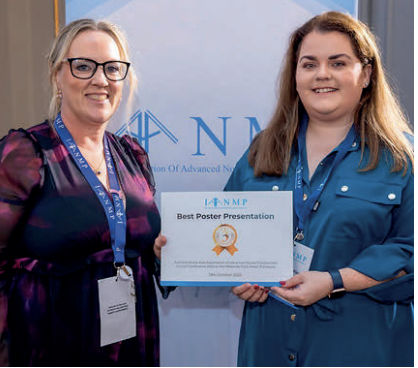
Poster competition winner: 3rd place
ABSTRACT
Author: Niamh Orla Finan
Organisation: Brothers of Charity Services Ireland – West Region
Role: Advanced Nurse Practitioner
Clinical innovation abstract title: Advanced nurse practitioner: Transforming care for adults with intellectual disabilities
Aims and objectives:
1. Minimise unnecessary primary and secondary care visits.
2. Improve access to timely, person-centred care by reducing delays and enhancing service capacity.
3. Enhance staff knowledge to support compliance with prescribed clinical interventions.
Background: Adults with intellectual disabilities (ID) face multiple health challenges requiring frequent care. Access barriers often lead to preventable hospital visits, increasing strain on healthcare systems.1,2 The ANP role offers timely, person-centred care through reasonable adjustments. This approach supports the Sláintecare Action Plan (2023)3 by promoting community-based, integrated services. ANPs also upskill frontline staff with condition-specific training, improving early intervention, treatment compliance, and service efficiency.
Methodology: In 2024, the ANP role was introduced in Brothers of Charity Services Ireland – West Region (BOCSI-WR), serving over 1,900 individuals. Inclusion criteria: Adults using BOCSI-WR services with conditions within ANP scope (eg, diabetes, asthma, hypertension, gastrointestinal disorders, weight management, infections, and wounds). Exclusion criteria: Individuals under 18, non-BOCSI-WR users, and emergency/surgical cases. The ANP delivered training in epilepsy, diabetes, constipation, enema use, and clinical skills. A retrospective quantitative analysis was completed for all interventions and training from January-December 2024.
Results:
- 276 assessments conducted for 82 individuals, replacing GP/hospital visits
- 30 per cent reduction in external healthcare usage
- Average wait time reduced to 9.7 days (vs 14+ days for GP)
- Service capacity increased by 85 per cent
- 26 training sessions were delivered to 322 BOCSI-WR staff and four with local CNME
- Feedback showed increased clinical confidence and reduced healthcare anxiety.
Discussion: The ANP model improved access, reduced wait times, and strengthened frontline care. Service users benefited from quicker, more personalised care. Staff confidence and clinical outcomes improved. Plans include expanding the ANP service, enhancing training, and building partnerships with external providers for broader impact.
References
- Doody O, McMahon J, Lyons R, et al. Presenting problem/conditions which result in people with an intellectual disability being admitted to acute hospitals in the Republic of Ireland: An analysis of NQAIS clinical data from 2016-2020. Limerick, Ireland: University of Limerick and Office of the Nursing and Midwifery Service Director, Health Service Executive; 2021.
- Department of Health. Sláintecare Action Plan. Dublin, Ireland: Department of Health; 2023.
- Grunwald M, Nadolny S, Groendahl A, et al. Advanced nursing practice as a preventive approach for adults with intellectual disabilities. Eur J Public Health. 2024;34(Suppl 3):ckae144.1613. doi:10.1093/eurpub/ckae144.1613.








Leave a Reply
You must be logged in to post a comment.