







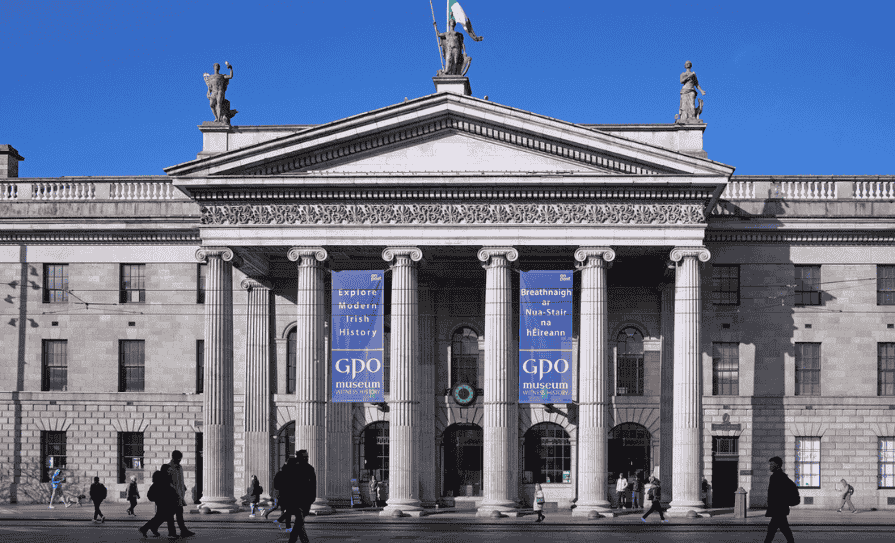
With all of the tumultuous events going on around the world, it’s natural to wonder about the difficulties in providing care in the midst of military conflict. Readers with an interest in medical history are also often curious about the struggles of providing care in these conflicts in centuries gone by. With the season that’s in it, it seems timely to cast an eye back to 110 years ago closer to home and a major figure in providing medical care during the 1916 Easter Rising.
It’s impossible to talk about this topic without discussing Dr Kathleen Lynn. Born in Mayo in January 1874 and laid to rest in Dublin in September 1955, Dr Lynn was imbued from her early years with a passion for helping the disadvantaged. Despite a comfortable home environment and even aristocratic family members, she was most interested in doing her bit to tackle the poverty and social deprivation that was rampant at the time.
Dr Lynn was educated in Manchester, Dusseldorf, and Alexandra College, Dublin, before graduating from the Catholic University Medical School in Cecilia Street in 1899, followed by postgraduate work in the US. She became a Fellow of the Royal College of Surgeons in 1909, but was refused a post in the Adelaide Hospital because of her gender. She eventually served in positions in Sir Patrick Dun’s Hospital, the Rotunda Lying-In Hospital, and the Royal Victoria Eye and Ear Hospital, where she was the first female resident doctor.
As time went by Dr Lynn took a greater interest in politics, namely nationalism and socialism, and was also an active suffragist. She was greatly impacted by the close contact she had with poverty-stricken families while working in the ‘soup kitchens’ during the 1913 lock-out of workers. Also, Dr Lynn was influenced by the thoughts and deeds of people like Constance Markievicz and James Connolly.
As time went by Dr Lynn took a greater interest in politics, namely nationalism and socialism, and was also an active suffragist
Her achievements and positions of prominence are too numerous to list here. But she went on to co-found St Ultan’s Hospital for Infants, was elected to Dáil Éireann (but didn’t take her seat), was a Council Member of the Irish White Cross, an honorary Vice-President of the Irish Women Workers’ Union in 1917 – the list goes on.
Dr Lynn was Chief Medical Officer for the Irish Citizen Army, where she instructed in first aid, and also provided training to members of Cumann na mBan. Prior to the Easter Rising, historical reports show that she stored weapons in her home and used her car to covertly smuggle arms into Dublin in the weeks leading up to the Rising.
During the conflict, she was stationed in City Hall and treated many wounded soldiers with authority and a cool head. City Hall was recaptured by the British on the evening of Easter Monday and she was arrested and imprisoned in Ship Street and Richmond Barracks, Mountjoy, and Kilmainham Gaols.
During her imprisonment, Dr Lynn kept a diary that provides precious insights into the conflict and her thought processes. The RCPI Heritage Centre contains some fascinating excerpts from her diary at that time, transcribed from Dr Lynn’s handwriting.
Following her incarceration, she was deported to England, where she was sent to work with a doctor in Bath, but she was back home in Ireland within a year, where she established her practice in Rathmines. This is where she lived until her death in 1955, which was accompanied by a full military funeral.
An extraordinary person and doctor, it’s fitting to give Dr Lynn a tip of the cap 110 years on.










Leave a Reply
You must be logged in to post a comment.