







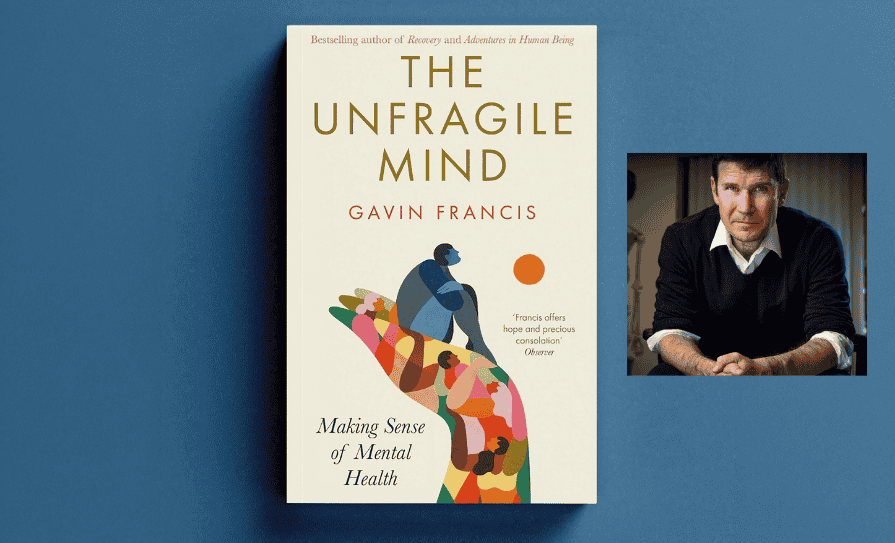
Title: The Unfragile Mind: Making Sense of Mental Health
Author: Dr Gavin Francis
Publisher: Profile Books Ltd in association with Wellcome Collection
Reviewer: Prof Brendan Kelly
Over the past 20 years, mental health has become a topic of widespread discussion. There are books, websites, and radio debates about diagnosis, over-diagnosis, under-diagnosis, treatments, and lifestyle changes for better mental health.
There is an ocean of advice, some of it sensible, some questionable, and some deeply unhelpful. The language of mental health has entered everyday conversation, but clarity has not always followed.
Against this somewhat chaotic background, Dr Gavin Francis makes a thoughtful contribution in The Unfragile Mind: Making Sense of Mental Health. Francis is a GP with a longstanding interest in mental health.
He is an accomplished writer, author of Adventures in Human Being, Intensive Care, and Recovery, and a regular contributor to The Guardian, London Review of Books, and The Times.
His clinical experience and literary sensibility are both evident in this new book.
Evolution
Drawing on history, literature, philosophy, and clinical encounters, Francis explores how ideas about mental health have evolved and are reflected in contemporary discourse. He moves across a wide terrain: Anxiety, depression, trauma, diagnosis, medicalisation, and the boundaries between distress and disorder.
Much of this will be familiar to people who work in healthcare, but it is still valuable. Francis has a gift for synthesis. Readers new to the field will find a sensible guide to key issues, laced with references to history and enlivened by clinical case stories.
The range of sources is impressive, yet lightly worn. Francis moves easily from ancient philosophy to modern epidemiology, from personal narrative to public policy, without losing coherence.
Perspective
Importantly, Francis does not romanticise suffering and nor does he dismiss the benefits of treatment. Instead, he argues for proportion and perspective. Not all distress is disorder; not all unhappiness requires medical intervention. At the same time, serious mental illness demands recognition and care. The challenge is to hold both truths at once.
Certain key issues recur in public discussions about mental health. For example, there is widespread criticism of diagnostic systems such as ICD [International Classification of Diseases] and DSM [Diagnostic and Statistical Manual of Mental Disorders], but it is worth noting that many commentators focus on misuse of these systems, rather than their correct use.
Those diagnostic guides are designed to be held lightly and used as tools for understanding, connection, and treatment discussions, rather than rigid categorisation.
This is clearly stated in the introduction to DSM, which explicitly warns against a tick-box approach or overinterpretation, and advises taking all aspects of a patient’s life into account.
DSM and ICD have revisions built into their systems and, if used with compassion, hold deep value. For example, if a person meets DSM criteria for depression, there is strong evidence that cognitive behavioural therapy or antidepressant medication will substantially alleviate their suffering.
We only know this because clinical trials were performed with people with similar symptoms, as outlined in DSM. Without such diagnostic systems, clinical trials and evidence-based care would be impossible. ICD and DSM are not truths; they are tools.
In addition, there are signs of positive change in mental health. Last year, the Global Burden of Disease Study 2021 in the Lancet Public Health showed that, between 1990 and 2021, the global rate of suicide fell by half in women and a third in men. While even one suicide is one too many, this is an enormous advance in public mental health.
There is much to value in Francis’s book. It has a quiet moral seriousness that sets it apart from many others. Like most psychiatrists and GPs, Francis is concerned not only with individual wellbeing, but also with social conditions that shape mental health: Inequality, insecurity, isolation, and the pressures of contemporary life. While he does not offer simple solutions, he encourages readers to think beyond individual coping strategies towards broader cultural and structural questions.
The Unfragile Mind is an extended reflection on how we understand mental health and how we might do so more wisely. In an era inclined to see minds as brittle, Francis offers a counter-narrative of resilience – not invulnerability, but capacity. That distinction matters.
In an era inclined to see minds as brittle, Francis offers a counter- narrative of resilience – not invulnerability, but capacity
Prof Brendan Kelly is Professor of Psychiatry at Trinity College Dublin and author of Buddhism and Psychiatry: Moving Beyond Mindfulness in Mental Health Care (Open access: https://link.springer.com/book/10.1007/978-3-031-96045-1).








Leave a Reply
You must be logged in to post a comment.