








Title: Dr Bot: Why Doctors Can Fail Us – and How AI Could Save Lives
Author: Charlotte Blease
Publisher: Yale University Press
Reviewer: Prof Brendan Kelly
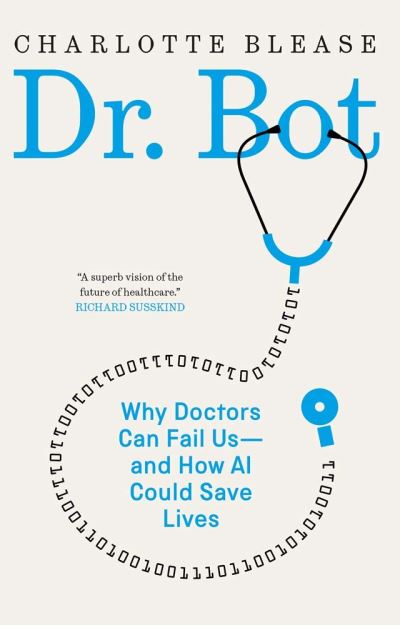
Charlotte Blease’s Dr Bot arrives at a critical juncture in the evolving conversation about medicine, technology, and what it means to care. With a blend of philosophical insight, psychological nuance, and rigorous evidence, Blease offers a compelling exploration of the limits of traditional medicine and the emerging possibilities of artificial intelligence (AI). It is well worth a read.
From the outset, Dr Bot refuses to flatter the status quo. Myriad structural, cognitive, and emotional challenges define the modern medical encounter. Diagnostic error, systemic bias, burnout, and outdated infrastructures are not just symptoms of a strained system, but signs of a mismatch between human capacities and the demands of contemporary healthcare. These issues will resonate with many medical readers.
The problems outlined are not new, but they run deep in medicine. As Blease writes, the “art of medicine” is like “a complex abstract painting – elegant in its intention, yet chaotic in its execution”.
What distinguishes Dr Bot is not simply its critique of current medical practice, but its non-utopian, non-nihilistic exploration of the possibilities offered by AI. This is not a techno-fantasy or a call to banish doctors in favour of algorithms, but neither is it a hysterical reaction to the challenges of new technology.
Rather, Dr Bot is a sober, carefully reasoned invitation to think differently about who or what might be best suited to perform various essential tasks in healthcare delivery in the 21st Century. Neither doctors nor AI algorithms alone are perfect for the job. Blease writes: “Doctors differ widely in their clinical competency. Commercial chatbots are not uniform either, but the spread of variation is considerably less.”
Current AI tools clearly have many limitations, such as bias in training data, lack of regulatory clarity, and potential loss of human nuance. But there are already areas where AI is quietly improving care, ranging from clinical decision support systems to natural language processing of patient narratives. Digital tools are beginning to bridge gaps that were long accepted as inevitable.
Dr Bot is not merely critical of medicine. It is also remarkably hopeful. What makes the book especially readable is its human dimension. Woven through the text are personal stories, professional anecdotes, and moments of reflection. These stories add warmth and depth to Blease’s rigorous, evidence-based writing.
At all times, we are talking about humans who suffer, humans who provide care, and everyone who seeks better ways to do this. Caring for people lies at the heart of all of this, every time, no matter how much AI is involved.
For medicine, Dr Bot is less a manifesto than a mirror. It reflects the uncomfortable realities of modern medicine while gently encouraging us to imagine what might lie beyond them. In that sense, its real contribution may be philosophical: It helps us see the medical encounter not as a fixed, unchanging ritual, but as a dynamic human practice in need of rethinking – possibly with the added efficiencies that AI can bring.
Ultimately, Blease’s message is clear, but not heavy-handed: If we want better healthcare, we must be willing to question some of our oldest assumptions. This is true. In medicine, we must take seriously the idea that new tools can help us do much, much better – provided these tools are thoughtfully designed, ethically deployed, and guided by human values, such as empathy and compassion.
The meta-history of medicine is filled with the adoption and adaptation of new technologies over many centuries. Medicine rarely stays still for long. AI is another twist in this tale, another revolution of the hands of the clock.
Dr Bot is a timely, engaging, and quietly radical book. It offers a provocative, compelling exploration of the limits of traditional medicine and the emerging possibilities of AI.
Whether you are a healthcare professional, patient, policymaker, or simply someone interested in the future of care, Blease’s arguments deserve attention. She may not have all the answers, but she’s asking the right questions and pointing in valuable directions.
Whether you are a healthcare professional, patient, policymaker, or simply someone interested in the future of care, Blease’s arguments deserve attention
A bold, brilliant diagnosis of medicine’s blind spots, Dr Bot is the second opinion that medicine didn’t ask for, but desperately needs. It is sharp, savvy, and impossible to ignore.
Prof Brendan Kelly is Professor of Psychiatry at Trinity College Dublin and author of Buddhism and Psychiatry: Moving Beyond Mindfulness in Mental Health Care (Open access: https://link.springer.com/book/10.1007/978-3-031-96045-1)






Leave a Reply
You must be logged in to post a comment.