







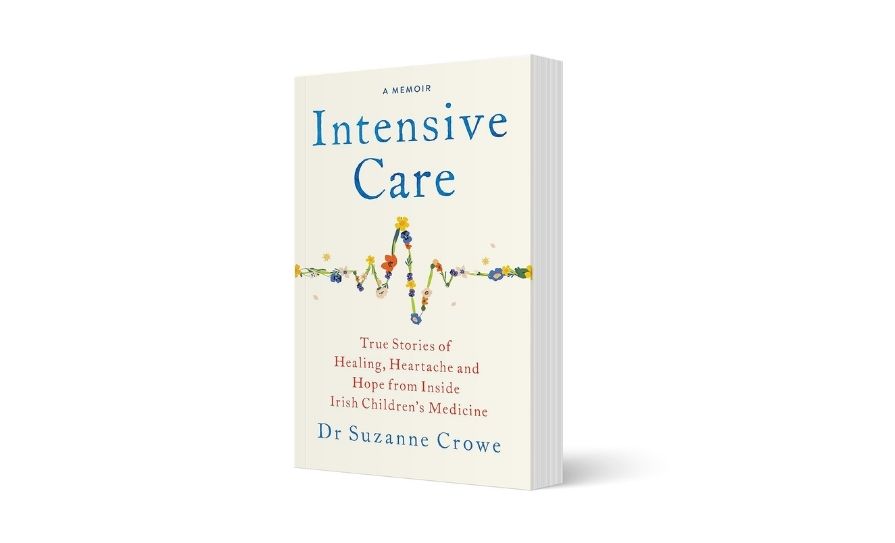
Title: Intensive Care: True Stories of Healing, Heartache and Hope from Inside Irish Children’s Medicine
Author: Dr Suzanne Crowe
Publisher: Hachette Books Ireland Reviewer: Prof Brendan Kelly
Dr Suzanne Crowe’s Intensive Care: True Stories of Healing, Heartache and Hope from Inside Irish Children’s Medicine is a moving, thoughtful, and deeply human account of a life in paediatrics. Blending personal reflection with professional insight, the book invites readers into the delicate world of children’s intensive care medicine, where decisions are made in moments, and emotions are lived on the sharp edge between despair and joy. It is a story that avoids sensationalism, offering instead a clear, compassionate voice, and a profound respect for patients, families, and staff.

Most readers will be familiar with Dr Suzanne Crowe. She is a Consultant in Paediatric Intensive Care Medicine and President of the Medical Council. She has a particular interest in children’s rights and contributes regularly to the Irish Independent (as well as the Medical Independent).
At its core, Dr Crowe’s book is about stories: The stories of children and parents, of doctors and nurses, and of the fragile, but resilient human body. She writes with care and attentiveness, balancing clinical detail with the emotional textures that inevitably accompany work with critically-ill children. Her account never feels heavy-handed, nor does it dwell unnecessarily on suffering. Rather, she paints a portrait of medicine that acknowledges heartbreak, but remains rooted in evidence, hope, and – above all – humanity.
Dr Crowe’s writing is accessible and aware. She reflects on the many lives she has encountered, describing moments of tragedy alongside moments of triumph. In this way, the book communicates not just the technical challenges of paediatric intensive care, but also the wider emotional and ethical terrain in which doctors operate. Readers with experience in healthcare will recognise the authenticity of her voice.
One of the most striking features of the book is its capacity to portray medicine as a profoundly human endeavour. While medical memoirs often risk being either overly clinical or overly personal, Dr Crowe strikes a delicate balance. She weaves her narrative between medical life and non-medical life in a way that feels honest, reflective, and generous. This allows the reader to see not only the immense responsibilities that come with her role, but also the resilience and humour that sustain it.
What lingers most, however, is the compassion at the heart of the writing. Dr Crowe presents medicine not as an abstract science, but as a vocation rooted in empathy and trust. Her reflections on communication, on sitting with uncertainty, and on supporting families through their darkest moments reveal as much about human nature as they do about paediatric medicine. The stories she tells are reminders that every clinical decision has an emotional dimension, and that healing involves more than technology or expertise.
What lingers most, however, is the compassion
at the heart of the writing
There is also a subtle exploration of what it means to be a doctor in such a high-stakes environment. This will resonate with many medical readers. Dr Crowe acknowledges the toll that this work can take and the challenge of sustaining one’s own wellbeing while caring for others. Yet she writes about these realities with a sense of perspective and balance. She shows how the bonds between colleagues, and the trust built with families, help create a shared resilience that allows the work to continue.
This is not a book that seeks to shock or overwhelm. Instead, Dr Crowe offers a steady, compassionate voice, guiding the reader through challenging terrain. It is both intimate and universal; professional and personal. It can be read by those with a deep interest in medicine, but also by anyone seeking insight into resilience, empathy, and the power of human connection.
Overall, Intensive Care is both a memoir and a meditation, one that avoids easy answers but insists on the importance of care in its truest sense. It is a reminder that medicine is not only about curing disease, but about accompanying people – children, parents, families, colleagues – through some of life’s most challenging passages. It is a moving, hopeful, and beautifully written contribution to the growing body of literature on the human side of healthcare.
Prof Brendan Kelly is Professor of Psychiatry at Trinity College Dublin and author, with Dr Caragh Behan, of Handbook of Compassion in Healthcare: A Practical Approach (Open access: www.cambridge.org/core/books/handbook-of-compassion-in-healthcare/4B98BECD58FAA99F62F8C4B0BB39663D).








Leave a Reply
You must be logged in to post a comment.