







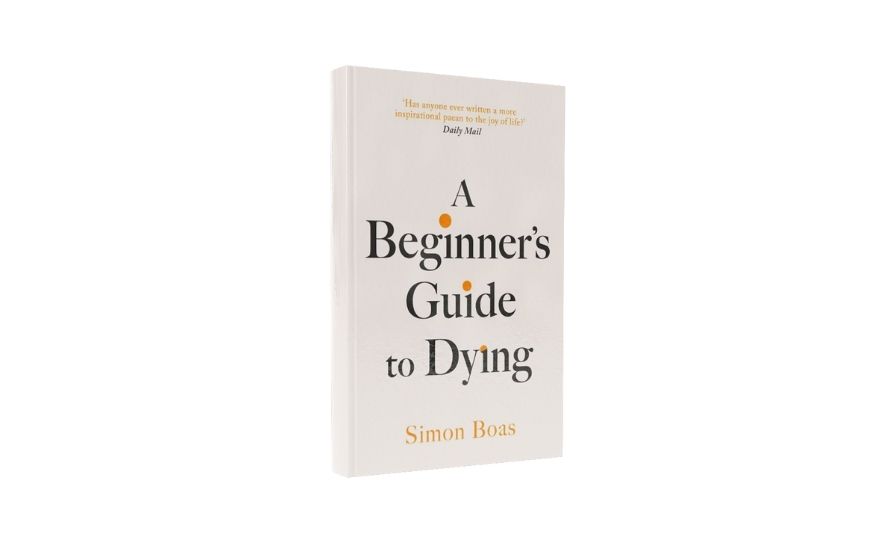
Title: A Beginner’s Guide To Dying
Author: Simon Boas
Publisher: Swift
Reviewer: George Winter
In his Diaries of a Dying Man (1954), Scots poet William Soutar (1898-1943), bed-bound from 1930 with ankylosing spondylitis, notes that on 5 June 1943, Dr Low examined his tubercular “corrugated wheeze-box” chest. Low “was listening in to a grave” but Soutar didn’t ask how long he might live, “because I was not quite certain that I wished to know just yet.” Four months later, aged 45, he died.
Like Soutar with ankylosing spondylitis and tuberculosis, Australian poet Philip Hodgins (1959–1995) knew that the premature death he faced from chronic myeloid leukaemia was creeping, not racing, towards him – “No one can say when. It’s a bit like flying standby” – and their respective works explore landscapes beyond illness. But whereas the writings of Soutar and Hodgins have range, Simon Boas (1977–2024) has focus. And it is his laser-like concentration on death and dying that reveals the intensity with which Boas valued the joy of life right up to the moment he lost it.
Two diseases, wrote Susan Sontag (1933–2004) in Illness as Metaphor (1978), have been spectacularly, and similarly, encumbered by the trappings of metaphor: Tuberculosis and cancer. Sontag’s view is that the healthiest way of being ill is to resist metaphorical thinking. And when Bingham et al in Palliative Medicine (2006;20: 183-195) undertake “a review of narratives written since 1950 by people facing death from cancer and other diseases”, they note that such ‘pathographies’, as they have been dubbed, are “being explored from sociological, feminist, and psychological perspectives by several influential theorists”.
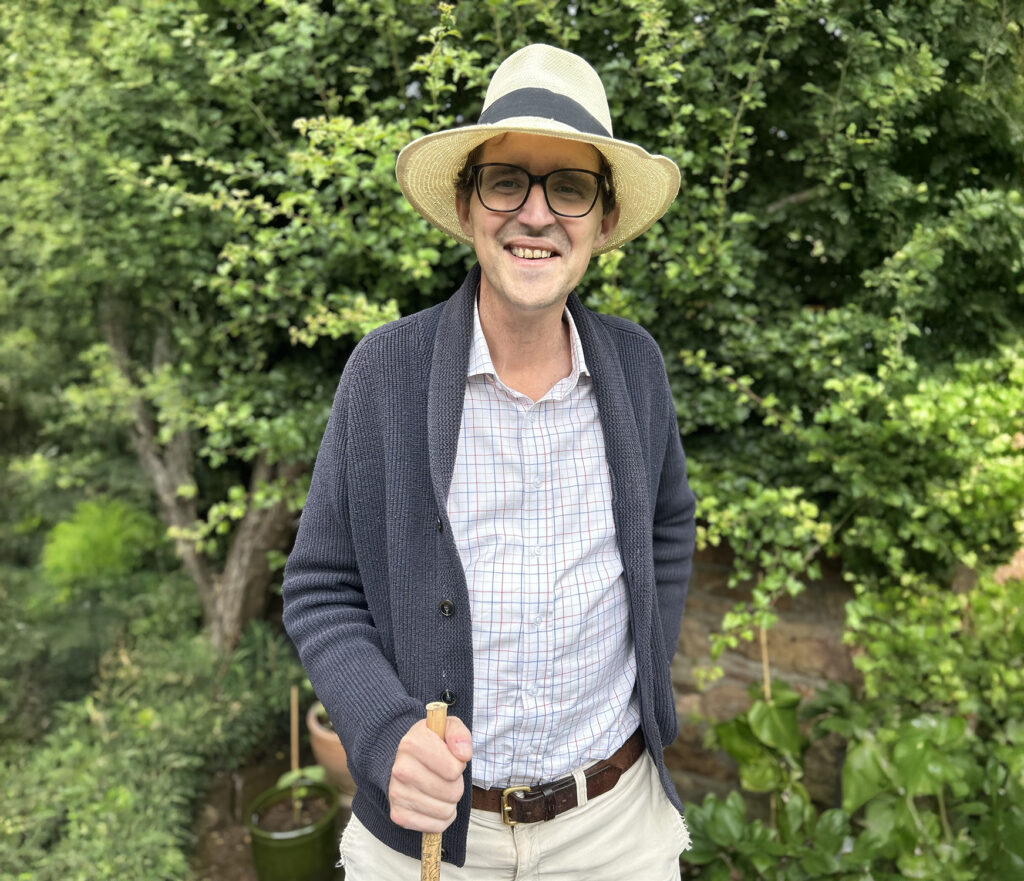
But rather than adding to progressive “pathographical” theorising, the Oxford-educated aid worker, who helped write the Gaza reconstruction plan in 2008, resists an over-intellectualising approach. Thus, his book is “rather short and scrappy – Montaigne it ain’t – but I hope it gives a flavour of how I have approached my illness and death … ”. Given the circumstances, however, A Beginner’s Guide is neither short at 140 pages, nor scrappy since the author is blessed both with the gift of speech and the gift to give it shape.
Favouring plain-spoken observations laced with humour, Boas reveals at the outset his diagnosis of throat cancer: “Three decades of smoking and a few periods of fairly Churchillian boozing can’t have helped …” The first three chapters comprise articles he wrote for the Jersey Evening Post where, shortly after his diagnosis, he raises the tentative hope of a possible cure. Five months later, in his second article, Boas parodies Emperor Hirohito’s 1945 broadcast on the “war situation” after Japan’s nuclear conflagration: “I’m sorry to have to announce that my cancer situation has also developed not necessarily to my advantage.” I didn’t expect to encounter laugh-out-loud moments in this book, but their presence confirms the extent to which a sense of humour was an important element in Boas’s life, even as the light continued to fade.
The section, on ‘Death and Equanimity’, has 12 chapters, including those on ‘Gratitude’, ‘Counselling’, and ‘Others’ Grief’. On others’ grief, Boas concedes that this “may be the hardest topic to write about … and still makes me cry when I think about it”. Citing the late Queen Elizabeth’s observation that “grief is the price we pay for love”, Boas acknowledges that while he’s happy to discuss almost any aspect of his dying, “the hardest question I get asked is ‘how is Aurélie [his wife] doing?’.” And while Boas is trying to do some of what he calls the “deathmin in advance so that Aurélie doesn’t have to”, he finds that spending two afternoons chatting with call centres “exhausted even my normally healthy reserves of patience and good humour”.
The section ‘A Beginner’s Guide to Interacting with the Dying’ is freighted with wisdom and good advice, produced “after discussion with a few fellow one-way visitors to Cancerland”. At least one reader whose friend is approaching the end has been steered away from further faux pas by reading the chapter ‘Some Don’ts and Dos’. Examples include “do get in touch”; “don’t just turn up unannounced”; and don’t minimise things.
Underpinning the apparent lightness of touch that characterises this life-enhancing book is a profound breadth and depth of learning that Simon Boas brings to its writing. Stylish in presentation, well copyedited, and printed on high-quality paper, one can readily infer that the author’s creativity was wrought from an inexhaustible and disciplined self-criticism that lasted all the way to the end. A Beginner’s Guide to Dying invites us to start a conversation with ourselves which may prompt insights that will stay with us for the rest of our lives.
Underpinning the apparent lightness of touch that characterises this
life-enhancing book is a profound breadth and depth of learning that
Simon Boas brings to its writing







Leave a Reply
You must be logged in to post a comment.