







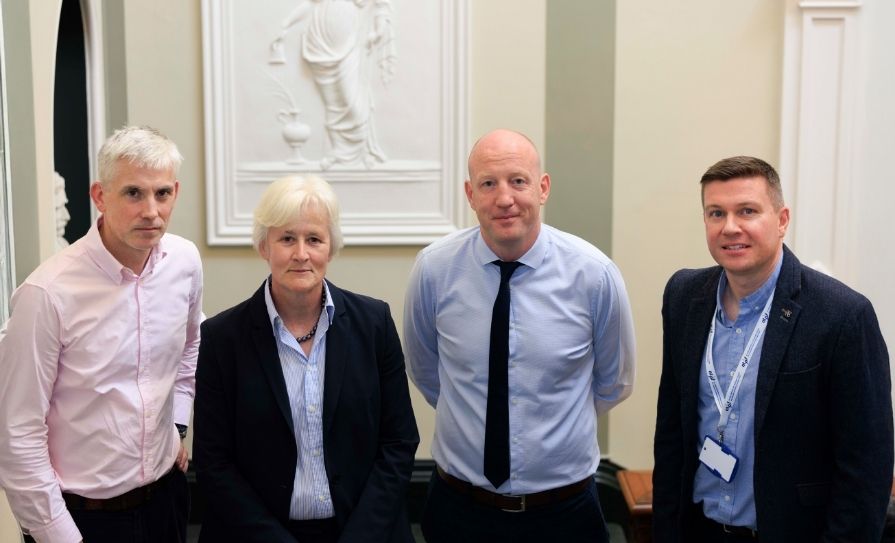
Catherine Reilly examines findings from the first ever Irish capsule endoscopy registry report
The inaugural Irish Capsule Endoscopy Registry (ICaRe) Report was launched at a recent event in Dublin. The report demonstrated strong overall performance in capsule endoscopy services and identified areas for improvement.
Data was submitted by six of the 10 capsule centres nationally. This data related to 1,172 small bowel capsule endoscopy (SBCE) and 704 colon capsule endoscopy (CCE) procedures conducted in 2024.
Pill-sized capsule
Capsule endoscopy is a non-invasive diagnostic test using a small, ingestible video capsule to visualise the inside of the bowel.
SBCE is a well-established investigational tool for small bowel pathology. The European Society of Gastrointestinal Endoscopy (ESGE) recommends SBCE as the first-line investigation for suspected small bowel bleeding, citing its excellent safety profile, patient tolerability, and potential to visualise the entire small bowel mucosa.
CCE is a relatively newer diagnostic tool. The HSE Endoscopy Programme has been supporting its wider roll-out against a background of stretched colonoscopy capacity.
According to the Programme’s clinical guidance (2023): “Colonoscopy is considered the gold standard for examining the colon and detecting significant colonic pathology. CCE is a minimally invasive and safe method of visualising the colon and represents an alternative to standard colonoscopy.”
The HSE guidance refers to growing evidence of its accuracy for polyp detection.
“Two systematic reviews and meta-analysis, one published in 2016 and one in 2021, have shown that the second-generation capsule has high sensitivity and specificity in the detection of advanced colonic lesions – polyps >10mm diameter and colorectal cancer.” The ESGE has “recommended CCE as a safe alternative to colonoscopy in average risk individuals”, it notes.
The guidance also states that the capsule endoscopy service at Tallaght University Hospital (TUH), Dublin, had demonstrated that CCE is a “safe and effective alternative to colonoscopy in symptomatic average risk patients with or without the addition of biomarker screening”.
The document lists several indications where CCE may be appropriate, as well as contraindications.
Capsule registry
ICaRe is a national initiative established to monitor and enhance the quality of Irish capsule endoscopy services. It is designed as a centralised, anonymised, web-based database that collects key performance and procedural data from capsule endoscopy services.
The registry is a collaboration between TUH, Trinity College Dublin (TCD), the capsule endoscopy centres, and the HSE Endoscopy Programme.
Prof Deirdre McNamara, ICaRe Chairperson and Consultant Gastroenterologist at TUH/TCD, described the first ICaRe annual report as an “important milestone” for bowel diagnostics in Ireland.
Prof McNamara told the Medical Independent (MI) she was hopeful that the report would “enhance awareness” of capsule endoscopy among clinicians and patients nationally.
She explained that a capsule endoscopy working group was established under the auspices of the HSE Endoscopy Programme.
The group agreed on the importance of establishing a quality assurance programme for capsule endoscopy. Capsule endoscopy procedures are not captured in the National Quality Assurance and Improvement System for Endoscopy, which receives data from hospital endoscopy reporting systems (whereas capsule endoscopy data is reported onto isolated systems within each hospital).
To facilitate the ICaRe registry, anonymised data from these systems is now uploaded to a central repository. The ICaRe generates quarterly reports detailing both national and centre-level outcomes.
The development of ICaRe has been welcomed by the National GI Endoscopy Quality Improvement (QI) Programme. ICaRe is built around the ESGE’s quality standards for capsule endoscopy practice. To date, there are no well-established performance indicators for CCE, therefore the quality indicators for standard colonoscopy and HSE guidance are used.
CCE data
The six centres that submitted data met the parameters for appropriate referral for CCE under the HSE clinical guidance, according to the ICaRe report.
There was a high overall detection rate for significant polyps. The ICaRe data showed polyps were found in 45 per cent of procedures (range across centres: 15-73 per cent). The minimum target (any age) was ≥15 per cent, which was derived from colonoscopy standards.
“As such CCE can be considered highly accurate,” the report stated. “Further analysis may refine CCE practice, to maintain accuracy, but avoid over detection with the need to proceed to colonoscopy in the majority of CCE cases.”
Some 39 per cent of cases were referred onward to colonoscopy or sigmoidoscopy, which suggested patient selection for CCE needed some refinement, stated the report.
In a section on ‘Insights and future directions’, Prof McNamara noted that clinicians could be confident that CCE will find pathology. However, simply employing CCE to detect pathology that required a subsequent interventional colonoscopy would be “counterproductive”, adding another unnecessary layer to the pathway.
She wrote that the data supported the preferential use of CCE for the investigation of patients with new symptoms, while avoiding CCE as a surveillance investigation.
Prof McNamara told MI that an individual who previously had polyps is more likely to have them again – requiring removal by polypectomy. “So doing a colon capsule instead of a colonoscopy at 10 years [surveillance] in a person who has already had polyps is, in my mind, likely to be futile because it is going to find polyps and we are going to end up referring them on for colonoscopy. So I think that person should have had a surveillance colonoscopy, not a capsule.”
However, Prof McNamara also emphasised the importance of patient choice. She said if a patient declined a recommended colonoscopy, findings from a CCE may encourage them to proceed with the colonoscopy procedure.
In terms of identifying candidates for CCE, Prof McNamara gave the example of a 50 to 55 year-old with new symptoms (eg, change in bowel habit, blood in stool). She said the HSE Endoscopy Programme has made faecal immunochemical tests (FIT) available to all public gastroenterology services and this test should be used to stratify risk. Following a FIT test, many of these patients fall into a “grey area” whereby their FIT result is not normal, but not high-risk for cancer or a polyp.
In this cohort, the chances of having cancer or a polyp requiring removal is 13 per cent. “So 87 per cent of the time, we find a non-cancer, non-polyp cause for their symptoms that we can treat. And we can avoid the colonoscopy altogether [through CCE]. So that is a big cohort of patients.”
Prof McNamara emphasised that there was “no rationale” for failing to risk-stratify patients based on FIT. “And yet, a lot of people coming in for colonoscopies haven’t had one,” she told MI.
The scale of colonoscopies conducted with normal results was “scandalous” in terms of appropriate use of healthcare resources, according to Prof McNamara.
She also believed the option of CCE needed to be communicated more clearly in the national GI endoscopy triage algorithm. A proposal will be submitted to the HSE Endoscopy Programme on this issue, she added.
Prof McNamara also underlined the importance of patient empowerment and choice in the selection of bowel exam, which can positively impact attendance rates, compliance with bowel preparation regimens, and overall patient satisfaction.
Bowel prep
The ICaRe report stated that the adequacy of bowel preparation was a foremost consideration in CCE. Unlike conventional colonoscopy, where suboptimal bowel preparation could potentially be addressed interprocedurally, any inadequate cleansing in CCE could “significantly impact diagnostic yield” and may require patients to undergo repeat or alternative procedures.
For context, the report noted that the largest meta-analysis to date of 3,789 CCE procedures found an overall adequate cleanliness rate of 77 per cent.
In the ICaRe data, adequate bowel preparation was found in 83 per cent of procedures, with a broad range across centres of 79-94 per cent. One centre (94 per cent) exceeded the minimum target of 90 per cent or greater.
Factors such as variations in preparation regimens, and differences in patient instructions and protocols, may contribute to inconsistencies in bowel cleanliness, as well as patient compliance with bowel preparation. The report referred to “significant opportunities” to use the registry data to develop QI initiatives to improve bowel cleanliness scores.
Prof McNamara noted that bowel preparation was identified in the ICaRe data as an area for improvement. However, she said the latest Irish quality data indicated that this was also an issue with colonoscopy.
Bowel preparation was a “key challenge” whether it was for a CT colonography, standard colonoscopy, or CCE. “It is an area of ongoing focus and research [internationally],” she said. Bowel preparation regimens were associated with side-effects that were understandably difficult for some patients.
“I think it is probably a bigger piece – I think we need to work on improving bowel preparation regimens across the board for all colon examinations…. But we have included a new medication called prucalopride recently into the protocol across most of our centres, with the colon capsule, and it has improved matters. I don’t have the full annual data yet, but it is definitely having an impact.”
I think we need to work on improving bowel preparation regimens across the board for all colon examinations
She said adequate bowel preparation was “vital”, and its importance must be stressed to patients.
The ICaRe report also showed variability between centres in the complete transit rate in CCE – defined as the percentage of capsules successfully reaching the end of the bowel.
It is equivalent to the caecal intubation rate in colonoscopy standards and an indication that the entirety of the colon has been visualised.
With a minimum target of ≥90 per cent, complete transit was found in 82 per cent of capsule procedures (range: 60-94 per cent). This variability suggested an opportunity to learn from high-performing centres on “possible improvement in patient preparation, protocols, and procedural standardisation”.
SBCE
SBCE is most commonly used to investigate obscure GI bleeding, iron deficiency anaemia, suspected Crohn’s disease and small bowel tumours. SBCE was used appropriately in the vast majority of cases in the ICaRe data (five centres submitted data on SBCE).
The overall bowel preparation scores were acceptable in 94 per cent of procedures, with all centres meeting the target. The range of 81-100 per cent may reflect the variation in bowel preparation used between sites and warranted further investigation, stated the report.
More broadly, the report noted that cleansing scales were not universally employed and reporting remained somewhat subjective. “While oral purgatives are recommended and have been shown to improve image quality, their impact on diagnostic yield, particularly for significant pathology, remains controversial.”
Capsule retention
Capsule retention, while rare, is the most significant adverse event associated with SBCE.
Retention occurs when the capsule fails to pass through the GI tract within 14 days of ingestion or the patient presents with obstructive symptoms, which may require medical or surgical intervention.
In most cases, retention can be avoided by identifying patients at increased risk and offering a patency (dummy) capsule before the capsule procedure.
In the ICaRe data, the target for appropriate patient selection for patency assessment was met.
However, data on the capsule retention rate was submitted by only one centre, which met the key performance indicator.
Prof McNamara said capturing procedural data on retention can be difficult, as it relates to an issue that becomes evident sometime after the procedure. However, it is planned to have more data available in next year’s report.
Caecal visualisation was achieved in 95 per cent of small bowel procedures, with all the reporting centres achieving high completion rates. There was some variability noted across institutions, with a range of 81-98 per cent.
Overall, the diagnostic yield was “acceptable” at 36 per cent, ranging from 31-55 per cent between centres. “A higher diagnostic yield is desirable, as it indicates the procedure’s effectiveness in detecting pathology, reducing the need for further testing and expediting clinical decision-making,” according to the report.
“However, setting overly ambitious targets risks limiting access to minimally invasive capsule services where a negative result can still carry important clinical value. Therefore, the current rates likely reflect appropriate and judicious use of capsule technology.”
DAE
Device-assisted enteroscopy (DAE) is a specialised advanced endoscopic procedure used to examine the small bowel. It enables tissue sampling and therapeutic interventions. When used appropriately after a SBCE, DAE offers “strong diagnostic value and can lead to meaningful treatment decisions for patients”, according to the ICaRe report.
At 53 per cent, the referral rate for DAE was below the minimum standard (≥75 per cent), with significant variation between centres (range: 33-72 per cent). The report stated that DAE continued to be underused due to “limited access” and a “lack of awareness about its diagnostic and therapeutic value”. Increasing understanding of when and how DAE can benefit patients was “essential” to improving referral patterns. It was also important to recognise that not all patients with positive findings on SBCE would benefit from DAE, the report added.
DAE is currently available at TUH and Connolly Hospital, Blanchardstown. Prof McNamara told MI more practitioners are now trained in the procedure and she expected that access would continue to improve.
Next steps
Expanding ICaRe registry involvement to include all capsule centres and the development of tailored CCE-specific metrics are among the report’s proposals. The report also noted that future advancements, including artificial intelligence and refined quality assurance frameworks, can only “further solidify” the role of capsule endoscopy in modern gastroenterology.










Leave a Reply
You must be logged in to post a comment.