








Plans for Ireland’s national electronic health record finally appear to be gathering momentum. David Lynch reports
There is significant industry interest in the procurement of a national electronic health record (EHR) system, the HSE Chief Clinical Information Officer said last month.
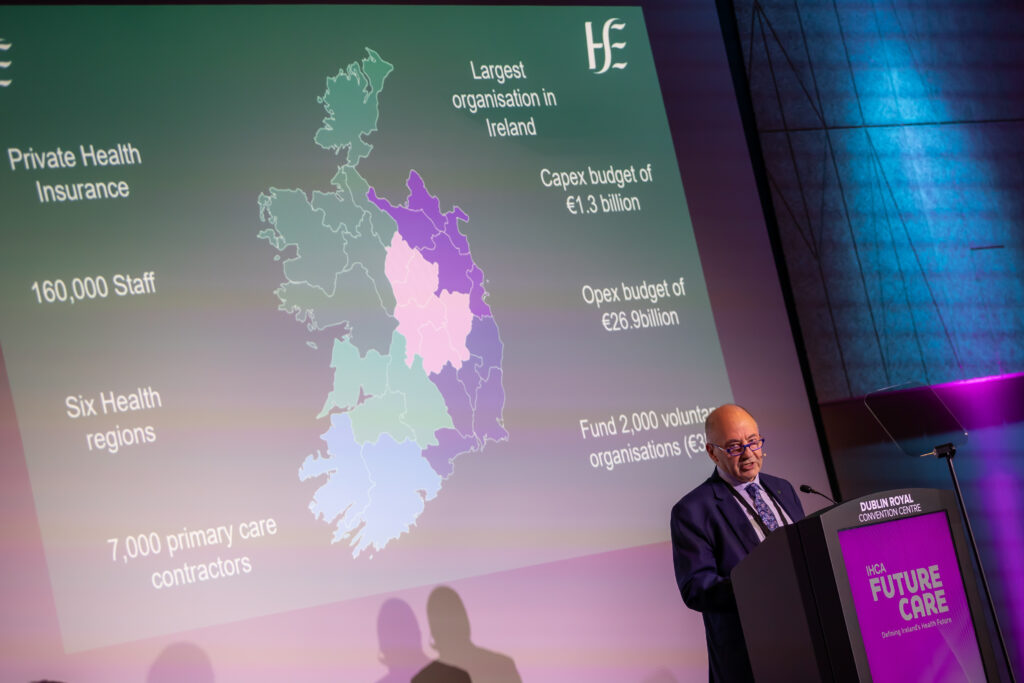
Prof Richard Greene was speaking at the IHCA’s FutureCare conference in Dublin on the topic of governance and digital health.
In early February, the Government approved plans to proceed with the procurement of an EHR system. The decision followed completion of the preliminary business case and independent external assurance processes, which confirmed compliance with the State’s infrastructure guidelines. Minister for Health Jennifer Carroll MacNeill described the development as a “landmark step”.
According to the Department of Health, the national EHR is the largest digital transformation project in the history of the health service. It will deliver “one secure, integrated digital health record for every patient” in Ireland.
“This will ensure that clinicians have timely access to accurate information, improving safety, reducing duplication, and enabling care that is better coordinated across hospitals, GPs, and community services,” according to the Department.
A HSE spokesperson told the Medical Independent (MI) that it anticipated the procurement process will be “completed by early next year”.
The spokesperson said it welcomed “the interest from EHR vendors in helping us with this transformative national programme”.
Speaking at the IHCA FutureCare conference, Prof Greene said there had been “a phenomenal amount of interest from industry” in the national EHR.
‘Generational’
Prof Greene, who is also Director of the National Perinatal Epidemiology Centre and Professor of Clinical Obstetrics, told the FutureCare conference that digital care will involve change and transformation of the “whole organisation”.
It would be a “generational project” with real benefits for patients and staff.
“Digital care is not just digital. It is about transformation across the whole organisation. We are doing this on the back of multiple changes, such as the six regions which are now just over a year old and they are doing a lot of the transformation internally,” he said.
He noted that the health service is the largest organisation in the country, and there were “significant reasons” why it required digital change.
These included higher patient expectations, legislative requirements, as well as the working needs of doctors.
Clinicians
“It is clinically difficult to work [digitally] in our organisation,” said Prof Greene. “Clinicians can all understand how difficult it is for our technology colleagues. They have thousands of different systems; most of them don’t talk to each other. It takes an enormous amount of work to keep what we have going.”
He said implementation of HSE’s ‘digital for care’ programme was now the most important area of focus. This is the “part that clinicians, and particularly senior clinicians and consultants, can get very involved in”.
“Yes, it will be hard to change; yes, there will be lots of problems and hurdles along the way. But actually, as the most senior people in the health service [consultants], we can actually drive this.”
Prof Greene outlined details of the ‘digital for care’ governance structure. He noted that clinicians are represented on a number of relevant bodies, including an oversight group and the technological and transformation executive group.
There will also be a specific clinical advisory group which will be “very important” to the implementation process.
The HSE spokesperson told MI that “we want to ensure that our national EHR system – known as the HSE ‘One Health Record’ – is patient-centred and clinician-driven”.
“We expect the clinical advisory group to be established in the coming weeks.”
The spokesperson said this group will have a multidisciplinary membership with “as many clinical specialties” as possible.
The group’s central role will be assuring clinical input into digital for care initiatives, including the HSE One Health Record programme.
The overarching governance structure was an “enabling one, not a controlling one”, said Prof Greene.
“What would we like to get from our very senior clinicians? We really want you to become involved. Ultimately, this is a generational project. We can actually leave something really valuable [behind] for the future health system, and we can do that by getting involved at different levels.”
Beyond data
Also speaking at the conference was Prof Brian Pickering, Vice-Chair for Practice, Division of Critical Care Medicine at the Mayo Clinic, US.
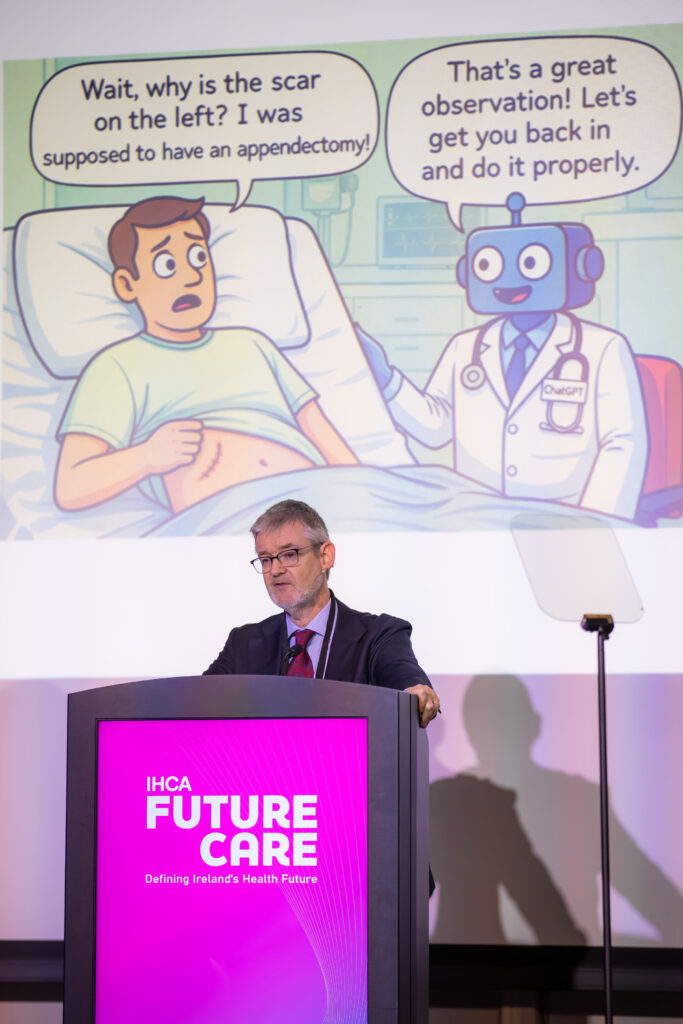
While emphasising the importance of having an established EHR infrastructure, Prof Pickering advised Ireland to ensure its system is designed for clinically based reasoning, not just data capture and collection.
An effective EHR system must be developed around clinical decision-making, not purely information collection.
A “cognitive layer” was important, which is “optimised for relevance rather than completeness”.
EHR information can sometimes be fragmentary and does not tell a medical “story” or “journey” of the patient. As a result, the “information might be there, but the [clinical] insight is missing”.
Prof Pickering told the meeting that while EHRs may provide data, they do not always provide this perspective.
The challenge for the health system, as well as for individual clinicians, is to avoid getting “lost” in the data. He said Ireland has the possibility of building a system where data is presented according to clinical relevance, rather than just statistical completeness.
Wider plans
During his presentation, Prof Greene pointed to other areas of recent progress in the HSE digital transformation programme.
He noted that the HSE Health App now has over 122,000 people registered and more than 200,000 downloads since its launch last year.
The national shared care record programme will continue to develop, with a scheduled April 2026 release delivering new functionality. This phase aims to better connect patient information across services.
There is also a programme of work underway to upgrade IT infrastructure to ensure it is fit for purpose for the EHR.
Prof Greene added that national systems for ordering and viewing laboratory and radiology test results are also being rolled out and will be connected to the EHR.
According to the EHR tender document, the “One Health Record Application Service will deliver a unified, lifetime electronic healthcare record”.
The service is currently envisaged as being available to all patients and their carers (where appropriate), as well as all HSE healthcare staff across the six health regions, including those in community and acute care in clinical, operational, and administrative roles. It will also extend to all publicly funded healthcare services – now and in the future – including the HSE, section 38 providers, and some section 39 providers, including specialist care services.
“The scope of the services required from the successful tenderer will be finalised and further defined during the dialogue phase,” according to the tender.
“It includes, but is not limited to, the provision of managed software services, configuration services, installation services, integration services, implementation services, data migration services, training, hosting services and post-implementation support (including support and maintenance services).”
Separately, earlier this month, Ireland’s first national strategy dedicated to the application of artificial intelligence (AI) in health and social care – AI for Care – was launched.
The HSE said it will soon publish an implementation framework to complement AI for Care and ensure consistent roll-out of AI across all health regions.










Leave a Reply
You must be logged in to post a comment.