








Hundreds of doctors recently gathered in Dublin for a medical football championship and international symposium of medicine in sport. David Lynch tracks the wider growing interest in physical activity and health
Recent weeks have witnessed the final matches of the hurling and football championships, the UEFA Women’s Euros and Wimbledon, among many other summer sporting occasions.
Local doctors have also been involved on the global sporting stage. Hundreds of international and Irish doctors took part in the World Medical Football Championships (WMFC) in University College Dublin (UCD) last month in high heat and excitement
(see panel).
The 29th International Symposium of Medicine and Health in Sport ran alongside the WMFC. Doctors from around the world and Ireland presented updates and research on the interactions between health, sport, and physical activity.
“The event brought over 1,200 doctors with an interest in sports medicine and football to Dublin,” said Dr John Seery, Consultant Physician, St Vincent’s University Hospital, Dublin, who has a long connection with medical football in Ireland.
Matches were held in the morning and the conference took place in the afternoon. Over 40 presentations covered areas as diverse as dealing with a cardiac arrest in a teammate to the role of participation in sport in preventing chronic disease.
Kilkenny GP Dr Padraic McCarthy, who was also the goalkeeper for the Irish men’s team, described the event as a “top-class medical conference”.
Physicians shared research, debated emerging healthcare challenges, and celebrated “the intersection of sport and medicine”, he told the Medical
Independent (MI).
Sessions were chaired by Dr Mark Rogan and Mr Frank O’Brien, both of whom played for the Ireland masters team during the championship.
Specific days of the conference were dedicated to injuries, sport and exercise medicine, orthopaedics, general medicine, and cardiology.
The wide spread of topics and vibrancy of the conference reflected a significant increase in health and physical activity research.
Recent years have witnessed the publication of an ever-expanding number of papers on the topic. For example, just last month a new study in the Lancet Public Health found that aiming for 7,000 daily steps can reduce risk of chronic diseases, cognitive decline and death (https://www.thelancet.com/journals/lanpub/article/PIIS2468-2667(25)00164-1/fulltext).
“Yes, there’s a rapidly growing evidence base for physical activity and health,” Dr Andrew O’Regan, Associate Professor, School of Medicine, University of Limerick (UL), told MI.
Dr O’Regan is also a member of the Physical Activity for Health Research Centre at UL.
“Cancer is one that gets a lot of coverage, and it is one of many – hypertension, ischaemic heart disease, diabetes, and numerous other common chronic conditions, not to mention anxiety, depression, and mental health conditions, have strong associations with physical activity levels.”
Dr O’Regan, a GP in Killarney, Co Kerry, has a particular interest in physical activity and chronic disease. He told MI that adequate levels of physical activity that are maintained throughout a lifetime are a major factor in chronic disease prevention.
“Also, when chronic diseases are acquired, maintaining or starting or increasing physical activity levels can reduce complications and crucially premature mortality.”
Dr O’Regan and UL colleagues are exploring the reasons why some people may not be engaged in sufficient physical activity and how best to develop national awareness of the importance and relevance
for everybody.
Asked what more can be done to improve the situation, he said that “first and foremost, the approach should be multi-systems”.
For example, it should include transport as well as town planning – ensuring safe cycle paths and walkways, as well as parks and play areas in urban developments. Education about the importance of physical activity and health should be prominent in primary and secondary schools. A mass-media public health campaign should raise awareness.
Primary care is a sector of particular importance, according to Dr O’Regan.
“General practice can be a highly effective environment to promote physical activity on a one-to-one level,” he said. The priority for the GP is to help the patient to understand why they are not getting enough physical activity and come up with a plan on how they can incorporate regular and consistent physical activity into their daily lives at a level that is appropriate for them.
Dr O’Regan is the co-author of a recent interview study examining how GPs manage physical activity advocacy for patients and their own self-care (https://bmjopen.bmj.com/content/15/2/e084301.abstract).
Support in the form of community-based resources and programmes, as well as brief intervention skills, could enhance the ability of GPs to further promote physical activity, according to the paper.
But time constraints and pressure often make this a difficult task.
“GPs are aware of the importance of physical activity and understand how to promote it,” said Dr O’Regan. “One of the challenges up until now has been the intensity of working in general practice and the ‘firefighting’ nature of the job.”
He described the introduction of the chronic disease management programme as “a step in the right direction”, allowing protected and structured time for the GP to consult with some patients on “key lifestyle factors, including physical activity”.
Lifestyle medicine
Lifestyle medicine is a specialty focused on prevention and treatment of chronic disease, but like sports medicine, it is closely related to physical activity.
Physical activity, including sport, is generally regarded as one of the six key pillars of lifestyle medicine (alongside nutrition, sleep, stress, social connections, and risk reduction).
Interest in this area of medicine has grown globally, including in Ireland.
Dr Kate McCann of the Irish Society of Lifestyle Medicine (ISLM) told MI there is a “large body of evidence for lifestyle medicine”. She noted that the website of the American College of Lifestyle Medicine was a particularly “good resource” for relevant papers and reports (https://lifestylemedicine.org/).
The ISLM, of which Dr McCann is a committee member, started to come together in the early months of the Covid-19 pandemic. Dr McCann outlined that in 2020 and 2021 it was led by a relatively small group of committee members. However, over the short intervening years, the ISLM has accrued more than 350 registered healthcare professionals as subscribers to its mailing list.
These professionals include pharmacists, sports medicine physicians, physiotherapists, occupational health physicians, psychologists, nurses, GPs and other physicians, “including cardiology and psychiatry”, said Dr McCann, who is a member of the RCSI, the American College of Lifestyle Medicine, and the British Society for Lifestyle Medicine.
“Activities at present are educational only and we try to organise regular online educational sessions.”
The ISLM has not yet formally set up as a charity and it does not currently offer membership.
Dr McCann said the aims of the organisation include general intentions such as raising awareness of the principles and practice of lifestyle medicine and promoting greater adoption of it in healthcare and society.
More specifically, the ISLM intends to provide healthcare professionals “with learning and knowledge sharing opportunities to help empower patients to use lifestyle as medicine”.
Dr McCann noted that the Society also has an advocacy role in relation to promoting lifestyle-based approaches to chronic disease with policymakers and addressing “social determinants influencing health”.
While awareness and research on the benefits of physical activity prescribing have increased, the barriers are “multi-factorial”, said Dr McCann, who has lectured on prescribing physical activity in a dedicated course at the RCSI.
GP shortage
These barriers would include the “GP shortage” and the difficulties for patients in accessing “a preventative health appointment” within general practice.
Asked whether GPs may lack confidence in the area of physical activity prescribing, Dr McCann said that “knowledge and confidence is a factor for some GPs, I’m sure”.
She said the time slots available for consultations in busy practices may not be enough to address the barriers to health behaviour change.
Dr McCann also noted some wider social barriers to physical activity. These issues can include affordability of gym membership, having somewhere safe to walk (especially in winter), and transport to and availability of a community-based chronic illness exercise rehabilitation programme.
The ISLM will hold its annual conference on Saturday 18 October in the RCSI in Dublin (https://www.islm.ie/conference2025).
“This will be our fourth conference, the third we’ve had in-person,” said Dr McCann, who added that the last two conferences in the RCSI have sold-out.
The conference is limited to registered healthcare professionals “and it is a diverse group of attendees”, including medical students, nurses, dietitians, physiotherapists, GPs, consultants, pharmacists, and social prescribers.
Separately, at a national policy level, there have been some recent physical activity initiatives.
In March last year, the Government launched new national physical activity and sedentary behaviour guidelines for Ireland, while Get Ireland Active – the National Physical Activity Plan (NPAP) was launched in 2016. The plan aimed to get at least half a million more Irish people taking regular exercise within 10 years. In summer 2022, a review of the plan by the consultancy firm Crowe found that a majority of the 60 actions had either been “fully or partially completed”.
Last September, this newspaper reported that the Department of Health “hoped” the new National Physical Activity Framework 2024-2040, together with its first action plan covering 2024-2029, would be launched in the “coming months”.
These documents have yet to be published. However, a Department spokesperson told MI that it and the Department of Culture, Communications, and Sport are currently “in the process” of jointly seeking Cabinet approval for the publication and launch of the National Physical Activity Framework and action plan.
An ‘unforgettable week’ of footballing drama in UCD
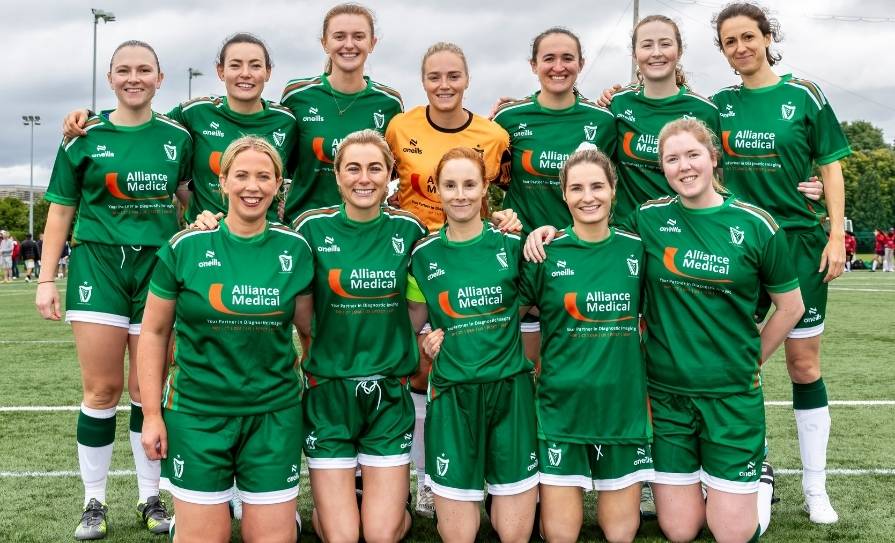
Photograph by: Rodney Smythe
The World Medical Football Championships (WMFC) took place in University College Dublin (UCD) on 5-12 July.
“UCD provided a perfect venue for the event. The decision to hold all of the matches on pitches located in one compact area of the university grounds generated a real carnival atmosphere at game time,” said Dr John Seery, who attended the event.
“Blessed by a heatwave, spectators moved between pitches and enjoyed the cacophony of languages and football cultures. Many of the delegates had travelled to Dublin with their families. Children, with enviable ball skills, played in the spaces around the pitches.”
For the first time, the nation fielded a women’s team in the championship, “led with pride and distinction by captain Dr Sinead Loughran”, Irish men’s team goalkeeper Dr Padraic McCarthy told the Medical Independent (MI).
While the team narrowly missed out on a quarter-final spot, “the Irish women left an indelible mark on the tournament”.
“From resolute defending to bursts of attacking flair, they gave everything in the green jersey, earning plaudits from fans and fellow competitors alike. Their presence marked a welcome and long-overdue chapter in Ireland’s medical football history; a beginning, not an end.”
The masters over-45s competition “offered its own drama”, according to Dr McCarthy.
Hopes were high, but the “fine margins of tournament football proved cruel”. The Irish team was involved in a frenetic and exciting 5-5 draw with Hungary, and a later victory over Argentina, only to just miss out on progress with a final group game defeat to Catalonia.
In the men’s tournament, the appearance of Republic of Ireland legend, Mr Paul McGrath, at the opening game set the tone for the week. Having previously won
the championship in Austria in 2023, the Irish men’s team came into the tournament with serious ambitions.
“The Ireland team, managed by Drogheda United ‘hall of famer’, Andy Myler, and captained by Dr Andy Delany, were a true reflection of our football culture,” said Dr Seery. “Uncompromising physicality in defence resulted in Ireland conceding only one goal in the entire tournament.”
Dr Seery added that defensive solidity combined with some finishes of genuine quality from forwards and midfielders took Ireland all the way to the final, eliminating Argentina and Germany in the knockout stage.
In the final, played in glorious sunshine in front of a large crowd, a well-organised Great Britain team containing several talented footballers were held to a minimum of chances.
“However, after a 0-0 draw in normal time, the British claimed the crown in a penalty shootout during which the advantage swung agonisingly between the two teams.”
Ireland thus finished the men’s tournament as runners-up, but with the top goal scorer in Dr David Gildea and the goalkeeper of the tournament in Dr Padraic McCarthy.
Dr McCarthy said that “the Irish contingent left the championship with heads held high”. He described it as an “unforgettable week in UCD”, with “huge credit” due to Dublin GP Dr Gavin Keane who spearheaded the effort to host the event.
The tournament and the week “were a great credit to all those involved”, added Dr Seery.
The next tournament is in Costa Rica. For further information, see the Instagram account
@irelandmedicalfootball
Further coverage of the World Medical Football Championships will appear in a future issue of MI.







Leave a Reply
You must be logged in to post a comment.