







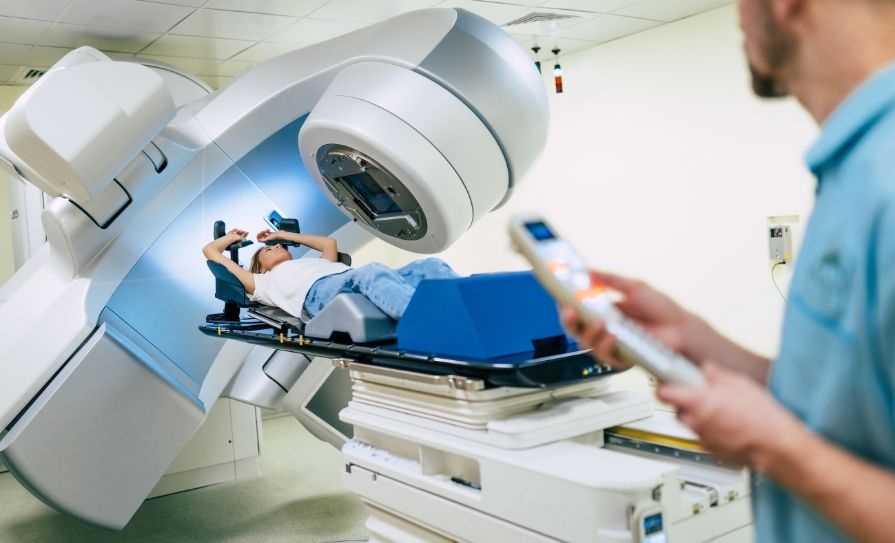
The higher specialist training (HST) intake for radiation oncology needs to increase in the coming years to meet growing patient demand, a new report has found.
The latest specialty-specific review from HSE National Doctors Training and Planning (NDTP) recommends raising the annual intake from six trainees between July 2024 and July 2026, to seven in July 2027, and then to eight per year through to 2030.
This expansion would increase the total number of trainees in the programme from 24 to 37 by 2030.
According to the report, titled Radiation Oncology Medical Workforce in Ireland 2024-2038, there are currently 21 non-training radiation oncology posts in the system contributing to the delivery of care. The report states that there is “an opportunity” to convert these non-training posts to training posts.
In the foreword, NDTP Medical Director Prof Anthony O’Regan explained the proposed expansion in trainee numbers is needed because healthcare demand is rising “exponentially” as a result of population growth, population ageing, and a range of other issues.
He said the proposed increase is “contingent on a number of factors, including a long-term commitment to substantially expand the consultant workforce and sufficient supply of suitable applicants for the programme”.
Prof O’Regan noted that best practice nationally and internationally recommends between eight and 12 radiation oncologists per million of the population. Ireland currently falls within this range, with 9.7 radiation oncologists per million of the population.
“However, the European average is closer to 12.8 consultants per million of the population and due to an ageing population and population growth it would be more advantageous for Ireland to be closer to this figure,” wrote Prof O’Regan.
“Achieving the international staffing recommendation ensures that consultant radiation oncologists have an estimated caseload of between 200-300 patients per consultant each year.
“This would be in line with the European average of 225 cases per consultant.”
According to the conclusion, the main aim of the report was to inform the HST intake for radiation oncology and this requires projecting the supply and demand of consultants “over a long period”.
“A 13-year time frame was chosen to coincide with other workforce planning projections.”
Separately, as reported last month in the Medical Independent, a recent NDTP report recommends increasing the training intake into radiology from 39 in 2025 to 75 in 2028.
The Radiology Workforce in Ireland 2024-2040 Preliminary Stakeholder Informed Review found that this increase “will require a substantial expansion” of the overall radiology training programme, with the total number of trainees projected to increase from 164 in 2024 to 375 in 2032. This expansion assumes no further increases in training in 2029.
A further review of the intake, commencing in 2027, is recommended in the report to feed into the estimates process and the 2029 trainee intake.
According to the NDTP review, as radiology has almost no non-training scheme posts to convert, the majority of this increase would need to come from new funding.









Leave a Reply
You must be logged in to post a comment.