







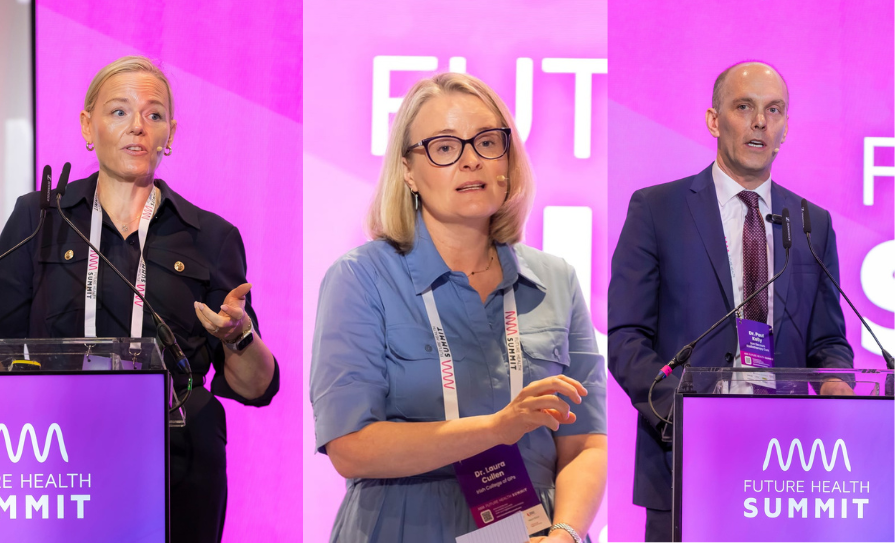
ICT was a major focus of this year’s Future Health Summit. David Lynch reports
The impact of technology – particularly ‘Femtech’ and the future national electronic health record (EHR) – was a significant theme on the opening morning of the recent Future Health Summit.
The Summit took place on 27–28 May in the Dublin Royal Convention Centre.
The session on Wednesday morning (27 May) focused on the evolution of women’s health, with discussions centring on data and developing personalised care.
Femtech
Femtech is the term for software apps and technological wearables designed to address women’s health, including pregnancy, menstruation, and menopause.
In recent years, Ireland has become a significant economic centre for this sector.
During a session on the evolution of women’s health, Dr Laura Cullen, Director of Women’s Health, Irish College of GPs, told attendees that she supports technological development to support her female patients.
However, she raised concerns about data protection and the level of trust patients can place in some of the apps currently available.
“Trust is everything in general practice,” Dr Cullen told attendees. “The care we provide has always been personalised… over the [patient’s] life-course. It’s also generated over multiple generations.”
Dr Cullen said she was “proud” that patients continue to seek her advice, despite being “constantly bombarded, 24–7 online” by information which sometimes might undermine the guidance she provides.
The reason that GPs and other doctors have confidence in their own advice is that it is grounded in evidence from “high-quality places”, such as established scientific and medical journals, which in turn underpin international medical guidelines and national clinical updates.
Dr Cullen outlined the important link between robust information and data integrity, quoting an editorial from a recent issue of the journal Contraception.
In the editorial, the journal’s editorial board expressed concern that the rapid expansion of Femtech in the sexual and reproductive health sphere amounts to a “high-stakes” real-time experiment, taking place without adequate safeguards for data protection and privacy.
Dr Cullen said such concern “worries somebody like me”.
She highlighted evidence that some apps sell women’s “intimate data”, with information collected from users in “this part of the world and processed in other jurisdictions” that operate under different legal frameworks.
She also noted that the data consent and permission information provided by many apps is often highly complex and difficult for users to understand.
Dr Cullen said GPs are trained to be strong advocates for their patients and stressed that there should be greater “safeguards around the use of intimate health data”.
If financial data can be encrypted, she asked, why is the same level of protection not afforded to women’s intimate health information?
She urged regulators in the area “to please catch up”. The GP also suggested that greater public investment in Femtech development could reduce the sector’s reliance on income generated through data sales.
Equity must also be central in Femtech development, Dr Cullen argued.
“Who are we developing it for? Are we developing it for privileged white women like me? Equity is absolutely essential, if this is to be of use for all women.”
Also speaking during the session, Dr Tanya Mulcahy (PhD), Director of the Health Innovation Hub Ireland, outlined the significant growth in the Femtech sector in Ireland since 2020.
While Dr Mulcahy said there have been positive developments, she emphasised the need for the creation of a national development laboratory to help support the sector.
Dr Lynda Keaveney, Group Health Officer, VHI, outlined the “huge advances” made in women’s health over recent decades in Ireland compared to the early years of the Irish state.
“I think it’s really important that we reframe women’s health so that it’s not just about reproduction,” Dr Keaveney told attendees.
“When you look back at where we are now, there is a huge amount of work already done, a huge amount of change that has already happened…. I think [in the future] it’s about having this really inclusive model and us all working together for that.”
Dr Keaveney said that it was particularly important that women’s voices and experience are heard in scientific studies.
She pointed out that, in the past, research has been “very male-focused”.
However, “there has been a real deliberate and quite successful change in that.”
Dr Keaveney noted that the Health Research Board’s Women’s Health Action Plan 2024–2025 has a specific focus to ensure that research is inclusive of women’s health.
Dr Keaveney concluded that progress in medicine is achieved when women “refuse to be invisible”.
A later session on the Wednesday morning, chaired by HSE Chief Clinical Officer Dr Colm Henry, tackled the topic of inequalities in the health service. One of the topics discussed during the session was the HSE’s EHR project.
EHR
In response to Dr Henry’s questions about the project, Dr Paul Kelly, Consultant Radiation Oncologist and Medical Director at Bon Secours Radiotherapy Cork, said the initiative represented a significant opportunity for the Irish health service.
Dr Kelly pointed out that EHRs have been deployed in radiotherapy for over a decade. “We’ve had a paperless system for some 15 years, so we have a lot of experience,” he said.
While Dr Kelly said EHRs had transformed healthcare systems and delivered significant benefits, he stressed that the national system must be implemented in a way that does not increase clinicians’ workload.
He acknowledged that one of the criticisms of EHRs is that inputting data can sometimes be “time-consuming”.
However, Dr Kelly said the use of artificial intelligence (AI) “has the potential to buy back some time”.
“Because certainly in cancer care, you want to be able to speak to a patient while you’re looking at them and not tied to a computer,” he told the meeting.
“Time is a precious resource, and you can spend quite a bit of your time having to input reams and reams of data, some of which you cannot extract too easily.”
The national EHR needs to ensure that the “human interaction” doctors have with their patients is not undermined.
The radiation oncologist also raised the issue of data protection.
“We have to think about patient access, and are [patients] going to be the controller of their information?…. I think the philosophy of the doctor or healthcare institution holding that data as if it belonged to that hospital… that mindset has to change. Because ultimately that’s the patient’s information.”
System
The Summit was opened by the new Secretary General of the Department of Health, Mr Derek Tierney.
On the issue of AI, Mr Tierney said: “The question is not will AI change healthcare, it already is. The question is, will we shape that change, or will it shape us?”
He outlined how AI is already impacting work with “clinicians and patients already using it – and innovation is accelerating at pace”.
Mr Tierney said if the Irish health service gets AI “right” there were many benefits, such as enhanced clinical pathways and improved outcomes for patients.
“But if we get it wrong, we will introduce new risks, fragment care further, and erode trust,” he warned.
“Leadership in this space is not optional, I believe it is essential.”
In general, Mr Tierney described the Irish health service as existing in something of “a paradox”.
Ireland has some of the best health outcomes in Europe; however, he admitted “the lived experience” of hospital patients does not always match that success.
He concluded by posing a question for policymakers and healthcare leaders: Are we simply fixing a system under pressure, or redesigning one in which pressure has become the norm?
It matters because “in truth, pressure is no longer a phase we are moving through; it is the environment we are operating in”.
Mr Tierney said it was important that the health service drives reform, while maintaining stability.
He noted the potential of the public-only consultant contract to extend working hours at hospitals, particularly on the weekend.







Leave a Reply
You must be logged in to post a comment.