







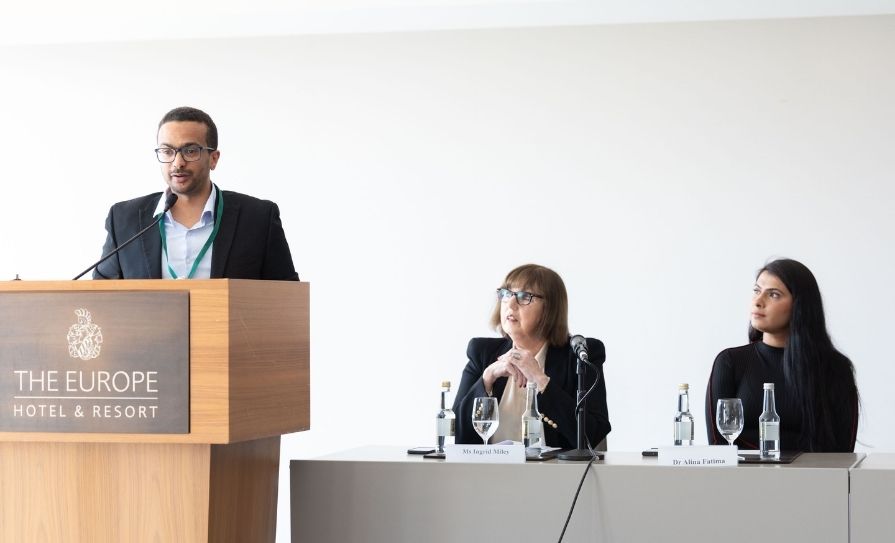
Recent preliminary research has found that 45 per cent of international medical graduates reported inadequate induction or orientation upon starting work in an Irish hospital.
The research was presented by Dr Alina Fatima, Senior House Officer in Psychiatry, the Mater Misericordiae University Hospital, Dublin, during the ‘International doctors in Ireland – Lived experiences and perspectives’ session at the IMO AGM.
The study also found that 32 per cent of respondents felt they were “sometimes treated differently for being different” and reported an average ‘moral distress’ score of 41 out of 100.
Speaking to the Medical Independent (MI) after her presentation, Dr Fatima said: “Most of the people reported facing some kind of moral distress…. So they are almost feeling that they are not really being seen as equals… or there is some discrimination.”
She pointed out, however, that “many people have reached out to say that things… settled down for them once they have been in the system for a few years”.
The study, which is ongoing, is a national online survey exploring the experiences of international NCHDs in Ireland, conducted by Dr Fatima in collaboration with Consultant in Old Age Psychiatry and IMO President Prof Matthew Sadlier.
Over 300 responses have been received to date.
“There have been a lot of wellbeing studies conducted in Ireland for healthcare professionals, but I didn’t find any that was particularly targeted at international medical graduates,” Dr Fatima told MI.
“That is where it came from.”
In her talk, Dr Fatima stressed her positive experiences working in Irish healthcare settings and the strong support she has received from colleagues.
She graduated in medicine in Pakistan and moved to Ireland four years ago.
“I was fortunate enough to find meaningful encounters here in the Irish healthcare system that I actually decided to stay,” Dr Fatima said.
However, she emphasised the importance of having honest conversations about the realities faced by international doctors.
“The system rewards people who blend in more easily,” Dr Fatima told the meeting.
“But inclusion shouldn’t always ask for differences to disappear.”
In conclusion, she said: “We are not here to fill the workforce gaps; we are here to provide our perspectives, our voices, our skills… [to] support the system to get stronger and better. The only way that is going to happen is if we ask for more than integration, [and] we ask for inclusion.”
The session also heard from Sudanese GP Dr Mohamed Elbadri, who is based with MyCork GP in Cork city.
After graduating from Ukraine, Dr Elbadri worked as a GP in Sudan for over 10 years before moving to Ireland.
In his talk, Dr Elbadri said it was important that doctors arriving in Ireland are aware of the support available from representative organisations, such as the IMO, and educational bodies, such as the Irish College of GPs (ICGP).
“If you take a survey of doctors who arrived from non-EU countries in the past three years – how many of them heard of the IMO? You would find it is a very low number. Of this low number, how many would know what the IMO could do for them?”
Dr Elbadri said he personally heard of the IMO when a colleague had an issue at work and the Organisation provided support.
He said he has recently successfully completed the ICGP International Medical Graduate Rural GP Programme and is now progressing towards specialist registration.
Dr Elbadri told the meeting that structured induction should be available for international doctors before they arrive in Ireland.
Like Dr Fatima, he spoke positively about his time working in Irish healthcare, describing Ireland as “one of the most welcoming countries in the world”.
However, he acknowledged “some people are facing real struggles with racism”.
The final speaker in the session was Dr Nallasegarampillai Muthalvan, Specialist Registrar in Emergency Medicine, Our Lady of Lourdes Hospital, Drogheda, Co Louth.
Dr Muthalvan, who comes from Sri Lanka, spoke about the challenges he has faced when working in the Irish health service and gaining access to training schemes.
During the panel discussion, moderator Ms Ingrid Miley referred to MI’s recent news story, which revealed that reports of racist abuse of healthcare staff increased by 73 per cent from 2023 to 2025.
Dr Fatima said that the racist abuse experienced by her and her colleagues was primarily verbal, although there have also been instances of physical abuse, “especially in the last year.”
Meanwhile, the national NCHD meeting at the AGM had earlier called on the HSE to review and improve the induction programmes it runs for international doctors.







Leave a Reply
You must be logged in to post a comment.