NOTE: By submitting this form and registering with us, you are providing us with permission to store your personal data and the record of your registration. In addition, registration with the Medical Independent includes granting consent for the delivery of that additional professional content and targeted ads, and the cookies required to deliver same. View our Privacy Policy and Cookie Notice for further details.
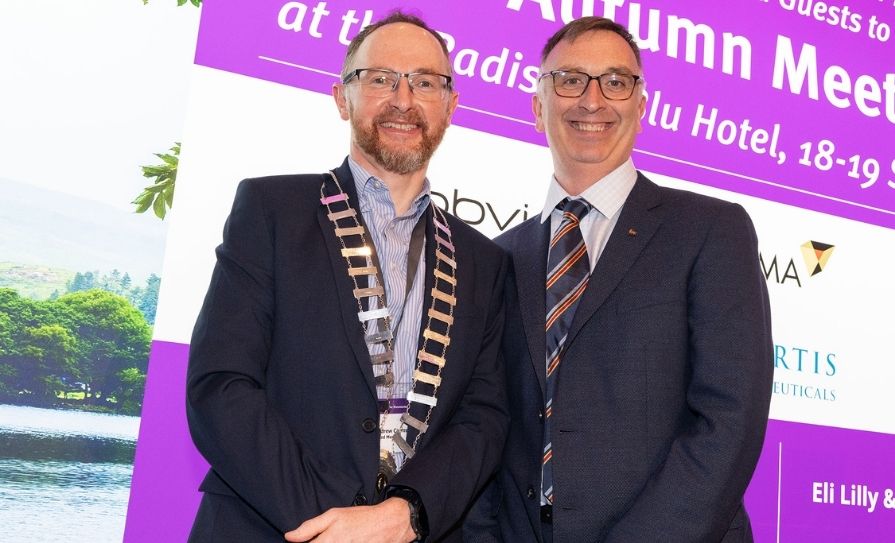
Pictured L-to-R: Dr Andrew Cairns, President, Irish Society for Rheumatology; and Dr John Ryan, immediate past-President
Dr Andrew Cairns, President of the Irish Society for Rheumatology, speaks to Catherine Reilly about the upcoming Spring Meeting
International and national experts will address the Irish Society for Rheumatology (ISR) Spring Meeting in Kilkenny on 16–17 April next.
President of the Society, Dr Andrew Cairns, remarked upon the consistent quality of the ISR’s scientific programmes. “I look forward to the ISR meetings every time they come around,” he told the Medical Independent. “The ISR packs quite a big punch into quite a short programme. As well as that, it is nice to catch up with our friends and colleagues from across the island.”
Dr Cairns is a Consultant Rheumatologist at Belfast Health and Social Care Trust (Musgrave Park and Belfast City Hospitals). The Spring Meeting will be his first as President, which he described as “an honour”.
An SpR meeting, which precedes the main programme, will include sessions facilitated by two of the meeting’s keynote speakers: Prof Myma Albayda and Prof Julie Paik from Johns Hopkins School of Medicine, US.
Profs Albayda and Paik are influential figures in rheumatology internationally. Dr Cairns said this will be a wonderful opportunity for trainees in Ireland to engage with them directly.
“To be face-to-face with world leaders in a small group, that is quite impressive, you don’t always get that [opportunity] as a trainee, so that is fantastic.”
Trainees will also deliver six oral clinical case presentations during the main meeting. Dr Cairns believed the number of abstracts submitted this year was the largest to date. “It has been very difficult to choose the six best of them from all the presentations, because they are really great cases.”
Supporting education and training is a central focus for the ISR. “We were very fortunate this year to be able to award two bursaries to two of our registrars of €50,000 each, which is funding them to spend a year as a Fellow at centres of excellence in the UK,” said Dr Cairns. “That is a really good use of our funds. I think that will increase the involvement of trainees with the Society. Hopefully that is something we can repeat again going forward.”
Main programme
The scientific programme will commence with a presentation titled ‘Axial spondyloarthritis (axSpA) – Challenges in imaging and diagnosis’ by Dr Sinead Maguire, Consultant Rheumatologist, Our Lady’s Hospital, Navan.
Dr Cairns noted that Dr Maguire has a special interest in this area, which is topical for rheumatologists.
“It is an area where biologic drugs have really transformed our management of these patients over the past couple of decades. But there are certainly ongoing challenges in imaging and diagnosis and treatment, so I think that’s a great place to start the meeting.”
Following this, Prof Albayda will present on ‘New tools in the evaluation and management of myositis’.
“This is an area of research for [Prof Albayda]. A number of us are using musculoskeletal ultrasound to examine joints of our patients with rheumatic disease, but muscle ultrasound hasn’t to date been a major area of practice for many of us, so I think that [presentation] will be really interesting for us to learn from.”
‘Latest experience in biologic therapies in axSpA – A French perspective’ is the title of a satellite meeting sponsored by UCB. The presenter is Dr Maxime A Breban, Head at Public Assistance Hospitals of Paris – Ambroise-Paré Hospital (Rheumatology Services), France.
“That will be very interesting,” said Dr Cairns, who expected there would be similarities in clinical practice between Ireland and France. “But it is always very interesting to see how colleagues in different jurisdictions are managing patients.”
The second day of the ISR Spring Meeting will open with a session (sponsored by AbbVie) titled ‘EVEREST and rheumatoid arthritis (RA): Why still aim for remission? Because it’s there…’. The panel includes Prof Sinead Harney, Cork University Hospital; Dr Donnacha O’Gradaigh, University Hospital Waterford; and Prof Carmel Silke, Our Lady’s Hospital, Manorhamilton.
The EVEREST (EleVatE care in RhEumatoid arthritiS with Treat-to-target) initiative is focused on improving the widespread implementation and attainment of pre-agreed target outcomes.
Treat-to-target is a strategy involving consistent management protocols that sets remission or low disease activity as a goal.
“As practising rheumatologists that is basically what we want to do for our patients with RA… is to target the disease and get their disease activity controlled to target,” outlined Dr Cairns.
Patients’ understanding of their condition and medication adherence are important factors in improving outcomes, he confirmed.
Another topical presentation will focus on ‘GLP-1 receptor agonists and their role in managing rheumatological conditions; from a dietetic perspective’. The presenter is Ms Aveline O’Neill, Clinical Dietitian, University Hospital Waterford.
Dr Cairns noted that the GLP-1 drugs – widely prescribed for type 2 diabetes and obesity – are “big news in medicine worldwide”. He said it was well-established that weight management plays an important role in the management of mechanical joint disease. Emerging research has suggested that GLP-1 receptor agonists may have a future role in the management of inflammatory rheumatic diseases in some patients. “I think it is an area of development and an area of learning,” said Dr Cairns.
Subject to more clinical data becoming available, these agents may be included in rheumatology practice in the future, he indicated.
‘Scleroderma updates – Addressing systemic involvement’ will be presented by Prof Paik, who has a special interest in this area. Dr Cairns said it is a “difficult area of practice” and anticipated this would be “an excellent session”.
The final presentation of the meeting will focus on the epidemiology of polymyalgia rheumatica and giant cell arteritis. It will be presented by Prof Max Yates, Associate Professor, Norfolk and Norwich University Hospital and University of East Anglia, UK.
Dr Cairns said this is an area of research for Prof Yates and his presentation will be of significant interest to delegates.
Advances
Meanwhile, Dr Cairns confirmed that rheumatology is a popular specialty choice for trainees from the North.
“Rheumatology is a very popular specialty, and I think that’s for a variety of reasons,” he said.
“I think certainly in the past couple of decades the advances in biologic therapy put rheumatology at the forefront of medicine, immunology, and science, and we can see that reflected in what we can do for our patients. I think as well, there is a lot of hands-on clinical skills, which I think is important, and the development of musculoskeletal ultrasound as well, allowing us to do very effective and direct procedures – joint injections, for example. I think that’s a nice mix that appeals to a lot of trainees.”
Rheumatology is a very popular specialty, and I think that’s for a variety of reasons












Leave a Reply
You must be logged in to post a comment.