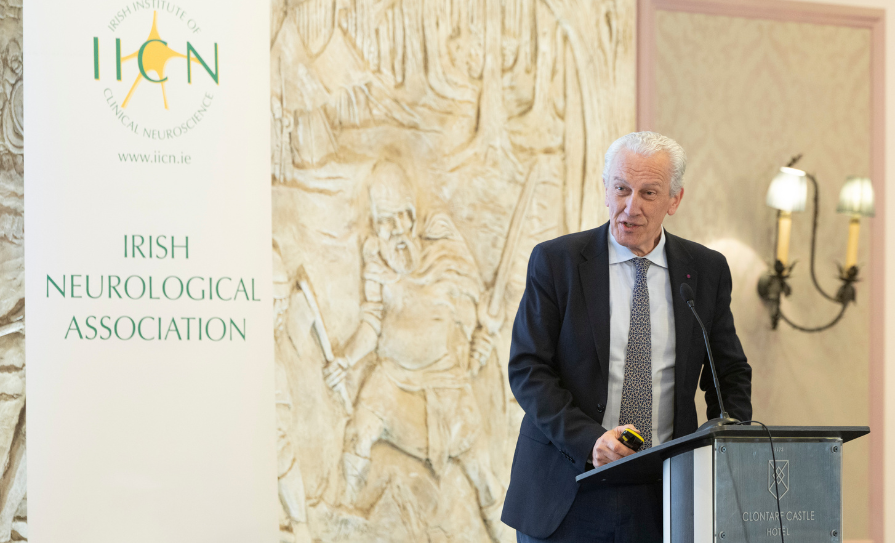
Prof Paul Boon
The Irish Neurological Association 2026 Annual Meeting featured distinguished international guest speakers.
Dr Heather Wilson, National Hospital for Neurology and Neurosurgery, Queen Square, London, UK, delivered a talk titled ‘Treatment sequencing in ageing patients with MS: Clinical evidence and practical decision-making’.
The annual Noel Callaghan Guest Lecture this year was given by Prof Paul Boon, Chairman and Senior Professor of Neurology, Ghent University Hospital, and Director of 4Brain at Ghent University, Belgium. The title of Prof Boon’s lecture was ‘The burden of neurological disorders and the importance of brain health related to epilepsy’.
He discussed the concept of ‘brain health’, which the World Health Organisation describes as “a state in which every individual can realise their own abilities and optimise their cognitive, emotional, psychological, and behavioural functioning to cope with life situations”.
He gave a brief synopsis of the burden and cost of neurological diseases, which affect in some way 43 per cent of the world’s population, or 3.4 billion individuals in 2021. Neurological disease is the leading cause of disability and the second-leading cause of mortality. Problems that exacerbate the situation include insufficient healthcare workforce and he noted Ireland’s lack of neurology specialists per population compared to many other countries.
Prof Boon also discussed the concept of ‘brain capital’, or brain health as a primary resource for nations. “The post-industrial era emphasises the brain as the main resource in countries lacking natural resources,” said Prof Boon. “Education and lifelong learning are vital for exploiting and maintaining brain capital and ensuring continuous development and adaptation of skills. Healthy brain ageing maintains and prolongs productivity in the economy and contributes to relief for health systems by reducing age-related cognitive decline.”
In his talk, Prof Boon touched on migraine, epilepsy, Parkinson’s disease, and other potentially devastating neurological conditions, as well as current treatment strategies and emerging therapies.
“The neurological burden is exceptionally high, and we can all agree on that, and the burden of epilepsy is also very high,” said Prof Boon. “Brain health is an important concept – it is a resource and a priority.
“Drug-resistant epilepsy is still at around 30 per cent, despite many and newer ASMs [anti-seizure medications], and surgery for epilepsy is complex, but curative, and is successful in up to 70 per cent of cases.”
Newer and less- or non-invasive alternatives for neurostimulation devices are being developed that will offer more personalised treatment. “However, no truly preventive therapies are available yet, because we still lack some essential knowledge on the mechanism of how an epileptic seizure actually starts, and perhaps more importantly, on why an epileptic seizure stops,” Prof Boon told the conference.
He concluded by issuing a call to action for colleagues: “What I dream of is that everybody in the room will become champions for brain health, understand what brain health is, and advocate for it,” he said, encouraging attendees to adopt a holistic approach in relation to the area.
This would involve ensuring a basic understanding of brain health, to optimise brain health throughout all stages of life; to support and disseminate public health strategies that can have a meaningful impact on brain health; and to promote brain health as a resource for nations and a priority for investment, said Prof Boon.












Leave a Reply
You must be logged in to post a comment.